History
 The Boucher (pronounced boo-shāy) Manufacturing Company, founded by H.E. Boucher, was
an American toy company based in New York that specialized in toy boats and toy trains. Italian-born
Horace E. Boucher (1874-1935) was a naval architect in the late 1800's who headed the U.S. Navy’s
model shop. In the early 1900's Boucher created ship models that came to be prized by museums all over the country —
more than 40 are displayed in the Smithsonian Institute. He established the Boucher Model Shops in 1905
in Manhattan at 95 Maiden Lane, in the financial district.
The company manufactured boats, horizontal center flue steam boilers for stand alone power and to power the boats,
and a blow torch to fire the steam engines. His innovative idea of mass-producing cast fittings and selling
kits to the general public started a new industry and helped turn what had been the art of a few highly
skilled craftsmen into a hobby enjoyed by thousands. These miniature steam engines were marketed as more
than just toys. Business grew rapidly. At some point in the early part of the 20th century Boucher incorporated
and moved his business to 415 Madison Avenue, still in New York City. He conducted both a wholesale and retail
business from that site. In addition to naval and other types of professional model making, Boucher manufactured
wooden scale model boat kits of sailing yachts and power boats that were popular with boys of the time, and
their fathers.
The Boucher (pronounced boo-shāy) Manufacturing Company, founded by H.E. Boucher, was
an American toy company based in New York that specialized in toy boats and toy trains. Italian-born
Horace E. Boucher (1874-1935) was a naval architect in the late 1800's who headed the U.S. Navy’s
model shop. In the early 1900's Boucher created ship models that came to be prized by museums all over the country —
more than 40 are displayed in the Smithsonian Institute. He established the Boucher Model Shops in 1905
in Manhattan at 95 Maiden Lane, in the financial district.
The company manufactured boats, horizontal center flue steam boilers for stand alone power and to power the boats,
and a blow torch to fire the steam engines. His innovative idea of mass-producing cast fittings and selling
kits to the general public started a new industry and helped turn what had been the art of a few highly
skilled craftsmen into a hobby enjoyed by thousands. These miniature steam engines were marketed as more
than just toys. Business grew rapidly. At some point in the early part of the 20th century Boucher incorporated
and moved his business to 415 Madison Avenue, still in New York City. He conducted both a wholesale and retail
business from that site. In addition to naval and other types of professional model making, Boucher manufactured
wooden scale model boat kits of sailing yachts and power boats that were popular with boys of the time, and
their fathers.
 The first model train product sold by Boucher was a #1 gauge live steam 4-6-2 Pacific
locomotive made for them by the British based Bassett-Lowke. It was listed
in the Boucher 1922 catalogue as the 'Steam Express Locomotive and Tender'. Locomotive length was 16",
overall length with tender was 28". It was identified as 3/8" scale and gauge 1 3/4". 1 gauge, gauge 1 or
gauge one is a model railroading and toy train standard that was popular in the early 20th century,
particularly with the European manufacturers. It is the track that actually measures 1.75 inches (44.45 mm),
between the centers of the 2 outside rails, making it larger than 'O' gauge but slightly smaller than wide gauge.
Wide, or Standard gauge became the dominant size in the U.S. for tinplate toy trains during the 1920's
as a result of World War I, which dramatically decreased foreign imports of 1 gauge models. Another reason
that 1 gauge lost popularity in the U.S. was due to Lionel's introduction of Standard
gauge.
The first model train product sold by Boucher was a #1 gauge live steam 4-6-2 Pacific
locomotive made for them by the British based Bassett-Lowke. It was listed
in the Boucher 1922 catalogue as the 'Steam Express Locomotive and Tender'. Locomotive length was 16",
overall length with tender was 28". It was identified as 3/8" scale and gauge 1 3/4". 1 gauge, gauge 1 or
gauge one is a model railroading and toy train standard that was popular in the early 20th century,
particularly with the European manufacturers. It is the track that actually measures 1.75 inches (44.45 mm),
between the centers of the 2 outside rails, making it larger than 'O' gauge but slightly smaller than wide gauge.
Wide, or Standard gauge became the dominant size in the U.S. for tinplate toy trains during the 1920's
as a result of World War I, which dramatically decreased foreign imports of 1 gauge models. Another reason
that 1 gauge lost popularity in the U.S. was due to Lionel's introduction of Standard
gauge.
 Boucher Manufacturing is best remembered today as the last of the makers of Standard gauge/Wide gauge
trains until the much smaller McCoy Manufacturing
revived the Standard gauge in the mid-1960's. The Boucher Manufacturing Company only made model
ships previous to their 1923 purchase of Voltamp's line of trains and tooling.
In the early 1900's Voltamp had been a direct competitor to Carlisle & Finch, the inventor of the
electric toy train. When Boucher bought the Voltamp line in 1923, they retained three of the five
basic steam-type locomotives and dropped all
Voltamp electric outline locomotives and trolley types. Boucher initially manufactured and sold the
Voltamp designed electric trains without modification, but soon they also modified from 2" 2 rail
to 2⅛" 3 rail to be compatible with Lionel's Standard gauge line.
One unique Boucher feature was that they mounted the Standard gauge track sections on wood bases.
In 1928, the factory and showroom was located at 152 Lafayette Street, New York City.
Boucher Manufacturing is best remembered today as the last of the makers of Standard gauge/Wide gauge
trains until the much smaller McCoy Manufacturing
revived the Standard gauge in the mid-1960's. The Boucher Manufacturing Company only made model
ships previous to their 1923 purchase of Voltamp's line of trains and tooling.
In the early 1900's Voltamp had been a direct competitor to Carlisle & Finch, the inventor of the
electric toy train. When Boucher bought the Voltamp line in 1923, they retained three of the five
basic steam-type locomotives and dropped all
Voltamp electric outline locomotives and trolley types. Boucher initially manufactured and sold the
Voltamp designed electric trains without modification, but soon they also modified from 2" 2 rail
to 2⅛" 3 rail to be compatible with Lionel's Standard gauge line.
One unique Boucher feature was that they mounted the Standard gauge track sections on wood bases.
In 1928, the factory and showroom was located at 152 Lafayette Street, New York City.
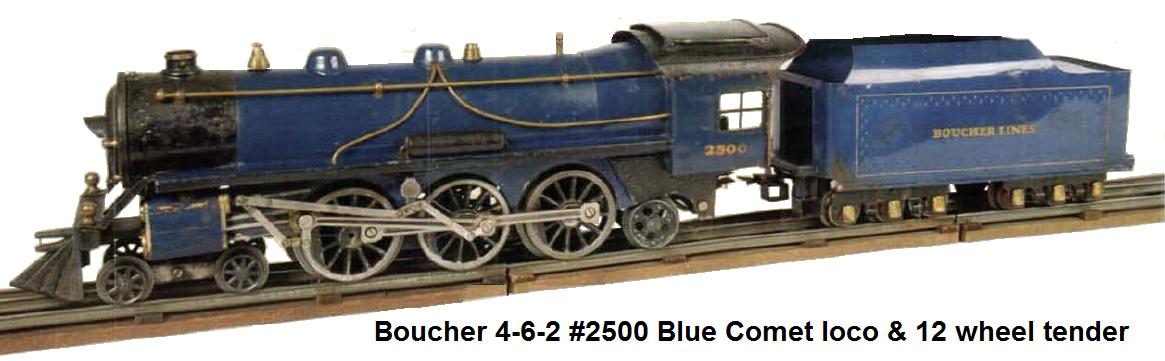
 Boucher production initially consisted of the 3 steam outline locomotives - #2100 4-4-0 Atlantic, #2222 4-6-0,
#2500 4-6-2 Pacific, along with 8 different freight cars and 3 passenger cars that were Voltamp carry-overs.
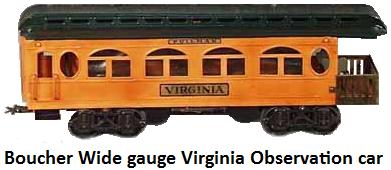
The intial set of passenger cars were a combine, a Pullman, and an observation car.
These cars came painted in solid colors, but were available in either orange, green or red, with black roofs.
The freight line remained the same as it was during Voltamp production, including utilization of the same
car numerals.
The freight cars were a #2109 stake bed flat car, #2114 cattle car, #2108 box car, #2112 coal hopper car,
#2111 gondola, a #2107 dump car, #2113 tank car and #2110 caboose. These freight cars were 13½ inches
long and 3½ inches wide. They sold for prices ranging between $2.50 to $4.00. The locomotives and the
freight cars were built using wood for the steam chests and car frames.
Trucks were made of cast iron and were highly detailed. Passenger car bodies were made of metal. These trains
appeared far more prototypical and less toylike than the competition's Standard gauge offerings from that era.
Boucher production initially consisted of the 3 steam outline locomotives - #2100 4-4-0 Atlantic, #2222 4-6-0,
#2500 4-6-2 Pacific, along with 8 different freight cars and 3 passenger cars that were Voltamp carry-overs.
The intial set of passenger cars were a combine, a Pullman, and an observation car.
These cars came painted in solid colors, but were available in either orange, green or red, with black roofs.
The freight line remained the same as it was during Voltamp production, including utilization of the same
car numerals.
The freight cars were a #2109 stake bed flat car, #2114 cattle car, #2108 box car, #2112 coal hopper car,
#2111 gondola, a #2107 dump car, #2113 tank car and #2110 caboose. These freight cars were 13½ inches
long and 3½ inches wide. They sold for prices ranging between $2.50 to $4.00. The locomotives and the
freight cars were built using wood for the steam chests and car frames.
Trucks were made of cast iron and were highly detailed. Passenger car bodies were made of metal. These trains
appeared far more prototypical and less toylike than the competition's Standard gauge offerings from that era.
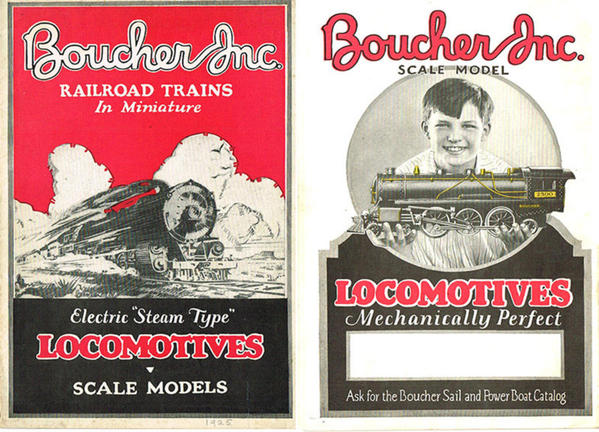
 Boucher marketed their trains as highly accurate 'scale' models, and occupied the high end of
the market. Their catalogs touted the products as 'mechanically perfect' 'Railroad Trains in
Miniature' and 'Toys that are more than just toys'. The Boucher #2222 locomotive was equipped with
the double field motor and a remote control. Length of the locomotive and tender was 28 inches and
it weighed in at 10 lbs. It was recommended to operate this locomotive on track with a radius of no less
than 50 inches, but any manufacturer's standard gauge track was usable. The list price of the
#2222 locomotive and tender was $39.50. The #2100 4-4-0 also employed a two field electric motor. It was
24½ inches in length (loco and tender) and weighed in at 8 lbs. It listed at $29.50 F.O.B. New York.
Boucher was the only manufacturer ever to catalog a six-wheel drive standard gauge locomotive. The famous 4-6-2
Boucher Deluxe can be called one of the top desirable classic trains of all time, and are highly
sought after by collectors. This engine was the only Wide gauge steam outline locomotive to be equipped
with twin double field motors. At 31 inches in length, the Boucher #2500 Deluxe loco & tender was also the
longest consist of motive power to ride Standard gauge rails during that era. A less expensive single motor
version was also available.
Boucher marketed their trains as highly accurate 'scale' models, and occupied the high end of
the market. Their catalogs touted the products as 'mechanically perfect' 'Railroad Trains in
Miniature' and 'Toys that are more than just toys'. The Boucher #2222 locomotive was equipped with
the double field motor and a remote control. Length of the locomotive and tender was 28 inches and
it weighed in at 10 lbs. It was recommended to operate this locomotive on track with a radius of no less
than 50 inches, but any manufacturer's standard gauge track was usable. The list price of the
#2222 locomotive and tender was $39.50. The #2100 4-4-0 also employed a two field electric motor. It was
24½ inches in length (loco and tender) and weighed in at 8 lbs. It listed at $29.50 F.O.B. New York.
Boucher was the only manufacturer ever to catalog a six-wheel drive standard gauge locomotive. The famous 4-6-2
Boucher Deluxe can be called one of the top desirable classic trains of all time, and are highly
sought after by collectors. This engine was the only Wide gauge steam outline locomotive to be equipped
with twin double field motors. At 31 inches in length, the Boucher #2500 Deluxe loco & tender was also the
longest consist of motive power to ride Standard gauge rails during that era. A less expensive single motor
version was also available.
 Boucher designed and manufactured the motor used in their locomotives. It was
equipped with double field coils, multiple bearings, a self oiling armature shaft, and self aligning brushes.
Marketing literature claimed that these electric motors would, "give long and satisfactory service.
Boucher motors are powerful and efficient, they have a quick pick up with no dead center on starting".
The gears were made of heavy bronze, machine cut with long bearings. another marketing claim was
that, "These gears transmit power with the slightest possible amount of loss". Regarding the field
used in their electric motors, Boucher claimed, "The field laminations require a fine grade of iron to
maintain efficiency and lightness. We use the best that can be secured in this country". The double field
coils were wound with a heavy insulated wire. This led to the claim that, "use of two fields instead of one
insures a quick getaway and an even supply of power". The brushes were made of Morganite Carbon, "the best
obtainable – are self aligning, easily replaced and as they are square, insure a broad contact without acting
as a brake on the motor. The commutator is made of the finest grade of material, well insulated, oil proof
and easily accessible for cleaning". The Armature bearings employed a steel shaft with long bronze bearings and
"an efficient oiling system to insure durability. The armature is beautifully balanced for smooth running,
windings of heavy insulated wire and not subject to shorting”. The bearing plates were made of heavy bronze,
nickle plated. They contained the brush holders and "insured alignment of the armature in the fields".
Boucher designed and manufactured the motor used in their locomotives. It was
equipped with double field coils, multiple bearings, a self oiling armature shaft, and self aligning brushes.
Marketing literature claimed that these electric motors would, "give long and satisfactory service.
Boucher motors are powerful and efficient, they have a quick pick up with no dead center on starting".
The gears were made of heavy bronze, machine cut with long bearings. another marketing claim was
that, "These gears transmit power with the slightest possible amount of loss". Regarding the field
used in their electric motors, Boucher claimed, "The field laminations require a fine grade of iron to
maintain efficiency and lightness. We use the best that can be secured in this country". The double field
coils were wound with a heavy insulated wire. This led to the claim that, "use of two fields instead of one
insures a quick getaway and an even supply of power". The brushes were made of Morganite Carbon, "the best
obtainable – are self aligning, easily replaced and as they are square, insure a broad contact without acting
as a brake on the motor. The commutator is made of the finest grade of material, well insulated, oil proof
and easily accessible for cleaning". The Armature bearings employed a steel shaft with long bronze bearings and
"an efficient oiling system to insure durability. The armature is beautifully balanced for smooth running,
windings of heavy insulated wire and not subject to shorting”. The bearing plates were made of heavy bronze,
nickle plated. They contained the brush holders and "insured alignment of the armature in the fields".
 Boucher sales literature stated that by assembling their train engines,
a youngster would gain the knowledge of how an engine actually worked. H. E. Boucher also claimed
to have used the highest quality materials available in the manufacturing process to assure that each
engine could be taken apart and put back together again as often as desired.
Boucher sales literature stated that by assembling their train engines,
a youngster would gain the knowledge of how an engine actually worked. H. E. Boucher also claimed
to have used the highest quality materials available in the manufacturing process to assure that each
engine could be taken apart and put back together again as often as desired.
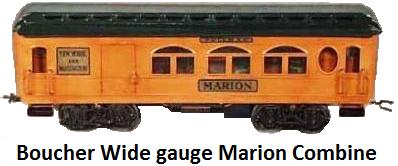 In 1929 Boucher produced a set of 4 new longer and updated metal passenger cars built on stamped steel six wheel trucks.
These were a New York combine, a Chicago Pullman, a Washington Pullman and a San Francisco observation car painted in a high
gloss Jersey Central blue and cream livery. The passenger cars were 20 inches long, 5½ inches high and 3½
inches wide. They were equipped with automatic couplers, compressed air tanks, interior lighting, brass finished journal
boxes and door handles. The baggage compartment in the combine car had a working sliding door. While two of the cars - the
Chicago and Manhattan - were actually Pullman cars, all 4 of these new models, including the New York Combine and the San
Francisco Observation, had the words 'Pullman' printed above the windows on each side of the car. They sold for $9.75 each.
The cars were offered in various sets, some sets came with three cars, some came with four cars. Some sets were headed by a
#2500 in black paint. But one famous 4 car set was completed with a #2500 loco and tender also painted in blue, and is
called the Boucher Blue Comet set. This set is often referred to as the 'King of Toy Trains'. But collectors insist that this
set is anything but a toy, due to its high level of realistic styling, proportions, metal work and scale model like detail.
The set was catalogued as the Washington Express and it retailed for $98.
In 1929 Boucher produced a set of 4 new longer and updated metal passenger cars built on stamped steel six wheel trucks.
These were a New York combine, a Chicago Pullman, a Washington Pullman and a San Francisco observation car painted in a high
gloss Jersey Central blue and cream livery. The passenger cars were 20 inches long, 5½ inches high and 3½
inches wide. They were equipped with automatic couplers, compressed air tanks, interior lighting, brass finished journal
boxes and door handles. The baggage compartment in the combine car had a working sliding door. While two of the cars - the
Chicago and Manhattan - were actually Pullman cars, all 4 of these new models, including the New York Combine and the San
Francisco Observation, had the words 'Pullman' printed above the windows on each side of the car. They sold for $9.75 each.
The cars were offered in various sets, some sets came with three cars, some came with four cars. Some sets were headed by a
#2500 in black paint. But one famous 4 car set was completed with a #2500 loco and tender also painted in blue, and is
called the Boucher Blue Comet set. This set is often referred to as the 'King of Toy Trains'. But collectors insist that this
set is anything but a toy, due to its high level of realistic styling, proportions, metal work and scale model like detail.
The set was catalogued as the Washington Express and it retailed for $98.

 In 1930, Boucher apparently split his company in two, with Boucher Playthings, Inc. becoming
the part of the business having to do with toys, including electric toy trains. In the 1930's the toy train
market was dominated by the so-called 'Big Four' of Lionel, Ives,
Dorfan, and American Flyer. Like all of them, Boucher
had struggled through the Great Depression. Boucher returned to concentrating on his primary model making
and scale model boat business, and, in 1932, just nine short years after acquiring the Voltamp line of
electric trains, he wrote to Manes Fuld, the owner of Voltamp, to ask if Fuld wanted to buy back the
electric train line. Fuld was not interested however. Boucher Standard gauge train manufacture was discontinued in 1934.
Horace Boucher died on April 27, 1935 of a heart attack at his home in Manhattan. While the company outlived all but Lionel,
by 1940 the 2⅛ inch Standard gauge had become an orphan standard that was priced beyond the means of
most consumers. Without a smaller, more affordable product to sell, and with World War II limiting what
it could produce, Boucher Playthings Manufacturing eventually went out of business completely in 1943.
In 1930, Boucher apparently split his company in two, with Boucher Playthings, Inc. becoming
the part of the business having to do with toys, including electric toy trains. In the 1930's the toy train
market was dominated by the so-called 'Big Four' of Lionel, Ives,
Dorfan, and American Flyer. Like all of them, Boucher
had struggled through the Great Depression. Boucher returned to concentrating on his primary model making
and scale model boat business, and, in 1932, just nine short years after acquiring the Voltamp line of
electric trains, he wrote to Manes Fuld, the owner of Voltamp, to ask if Fuld wanted to buy back the
electric train line. Fuld was not interested however. Boucher Standard gauge train manufacture was discontinued in 1934.
Horace Boucher died on April 27, 1935 of a heart attack at his home in Manhattan. While the company outlived all but Lionel,
by 1940 the 2⅛ inch Standard gauge had become an orphan standard that was priced beyond the means of
most consumers. Without a smaller, more affordable product to sell, and with World War II limiting what
it could produce, Boucher Playthings Manufacturing eventually went out of business completely in 1943.
In the 1970's John E. Harmon made and sold reproduction Boucher Standard gauge
3-rail trains. While these reproduction models were very close replicas of the original 2-inch gauge Voltamp trains made in
both B&O and PRR liveries, they are most often found labeled as Boucher. The models reproduced were the #2222 4-6-0 locomotive
and 8-wheel tender in cobalt blue, the #2500 4-6-2 in black with matching tender, the #2105 Tennessee Pullman,
#2107 Elizabeth Pullman, #2141 Marion Combo car, the #2140 Virginia Observation car, the #2109 flat car, the #2111 Gondola,
the #2114 Cattle car, the #2108 Box car, the #2113 Tank car, the #2115 Coal car, the #2112 Hopper, and the #2110 Caboose.
Today Boucher trains are highly collectible and are sought after by those that appreciate
the fine workmanship and attention to detail. They are very rarely found however, and when they are, they go for
very high prices. Examples of prices paid for these collectibles include $7100 brought at a Stout Auction conducted
on April 6, 2023 for a professionally restored Boucher #2222 4-6-0 steam loco with PRR tender, and $4300 for an original
#2500 4-6-2 steam loco and tender at a Stout Auction of The collection of Bill Paul TCA #65-1186 conducted on 11-2-2023.
A $2700 gavel price was achieved for a repainted blue with brass trim #2500 4-6-2 steam loco with an 8-wheel Boucher Lines
tender with cast iron wheels and trucks at a Stout Auction on November 19, 2022. At that same auction, a 3-car set
consisting of Boucher prewar standard gauge Royal Blue passenger cars - New York combo, Chicago Pullman and San Francisco
observation car sold for $8100. On October 27, 2018 an original Boucher Blue Comet passenger set that included a #2222
4-6-0 Loco, Boucher Lines tender, New York combo car, Washington Pullman and San Francisco observation car attained a final
gavel price at auction of $11,000. A $15,000 bid was the winner that took home a Royal Blue Passenger Set with a #2500 4-6-2
steam loco, Boucher Lines tender, New York Combo car, Chicago Pullman, Washington Pullman, and San Francisco Observation car
at the November 20, 2021 Stout Auction in Middlesex, PA.