Pronouced 'hoagy', the company was originally founded in 1909 in Manhattan, NY, by Hampden Hoge to produce
office supplies. Although the company retained his name, Hampden Hoge subsequently left the company in 1919, thus the toy trains which
bear his name, were not his idea. Henry Katz had started in the toy business as an employee for Ferdinand Strauss in 1917
and by 1928 had started his own toy business called Henry Katz & Company. In 1931, Katz dissolved his own company and came
to manage Hoge`s new toy division. The firm contracted construction of their toy designs to Mattatuck
Manufacturing Company in Waterbury, Conn. Train products included stamped steel passenger and animated circus cars as well as
electric and clockwork locomotives made to run on three rail 'O' gauge tubular track.
Pronouced 'hoagy', the company was originally founded in 1909 in Manhattan, NY, by Hampden Hoge to produce
office supplies. Although the company retained his name, Hampden Hoge subsequently left the company in 1919, thus the toy trains which
bear his name, were not his idea. Henry Katz had started in the toy business as an employee for Ferdinand Strauss in 1917
and by 1928 had started his own toy business called Henry Katz & Company. In 1931, Katz dissolved his own company and came
to manage Hoge`s new toy division. The firm contracted construction of their toy designs to Mattatuck
Manufacturing Company in Waterbury, Conn. Train products included stamped steel passenger and animated circus cars as well as
electric and clockwork locomotives made to run on three rail 'O' gauge tubular track.
 The first train products introduced in the 1931 Hoge catalogue included the Tom Thumb Railroad #881 three car electric passenger set
in 'O' gauge. It was stamped steel tinplate construction. The electric outline engine featured an operating headlight.
The set included a Pullman and an observation car. All Hoge tinplate passenger cars and freight cars were 4 wheeled.
Many toy train enthusiasts have stated that there is a very close resemblence in the look and design
of these Hoge trains and the Five-Fifteen Limited 'O' gauge tinplate electrics made by Henry Katz's own company. Also introduced in 1931 was the
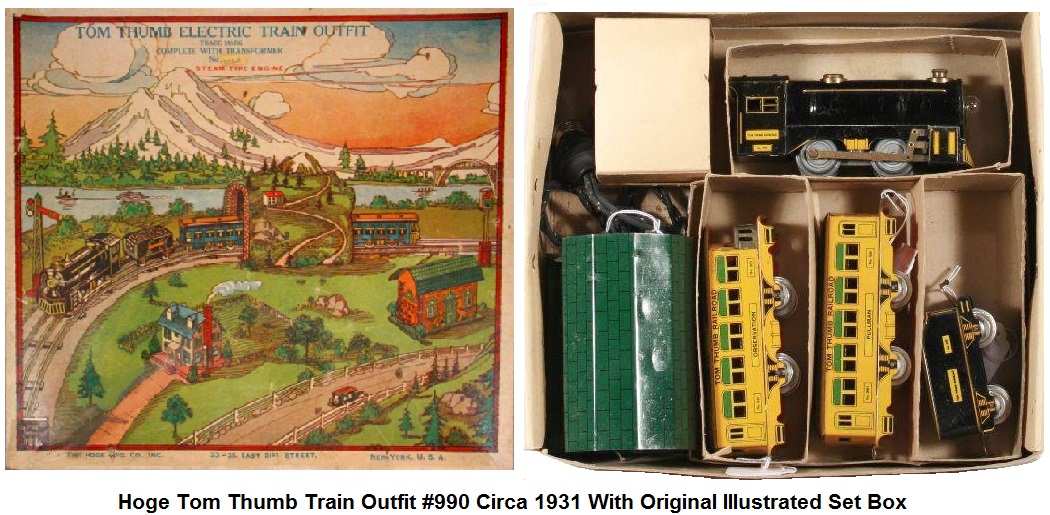
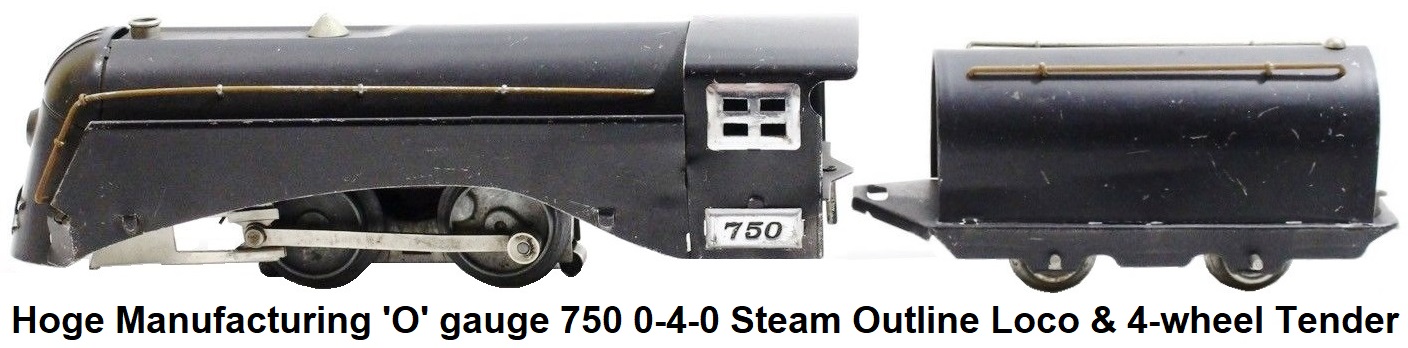
Tom Thumb RR #990 passenger set, powered by a steam type electric powered locomotive in an 0-4-0 configuration. The set featured the
engine, tender and three passenger cars - two Pullmans and the observation car. Each set came with track and transformer.
Extra track and transformers were also available for separate sale. These train sets came in beautifully illustrated packaging.
Hoge cardboard set boxtop graphics are considered to be some of the most beautiful
pieces of toy train artwork from any American manufacturers. Comparable box artwork can only be found from prewar European toy
train makers like Issmayer or Charles Rossignol.
The first train products introduced in the 1931 Hoge catalogue included the Tom Thumb Railroad #881 three car electric passenger set
in 'O' gauge. It was stamped steel tinplate construction. The electric outline engine featured an operating headlight.
The set included a Pullman and an observation car. All Hoge tinplate passenger cars and freight cars were 4 wheeled.
Many toy train enthusiasts have stated that there is a very close resemblence in the look and design
of these Hoge trains and the Five-Fifteen Limited 'O' gauge tinplate electrics made by Henry Katz's own company. Also introduced in 1931 was the
Tom Thumb RR #990 passenger set, powered by a steam type electric powered locomotive in an 0-4-0 configuration. The set featured the
engine, tender and three passenger cars - two Pullmans and the observation car. Each set came with track and transformer.
Extra track and transformers were also available for separate sale. These train sets came in beautifully illustrated packaging.
Hoge cardboard set boxtop graphics are considered to be some of the most beautiful
pieces of toy train artwork from any American manufacturers. Comparable box artwork can only be found from prewar European toy
train makers like Issmayer or Charles Rossignol.
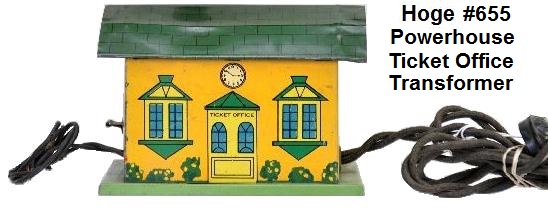
 The early electric sets included a transformer that was concealed
inside an orange and green tin-plate lithographed ticket office station named the #655 Tom Thumb Power House.
In 1934 Hoge introduced the Tom Thumb steam freight set.
It featured a steam locomotive, tender, box car,
tank car, gondola and caboose. These cars used a hook and slot coupling mechanism. A Union Pacific M10000 articultated
Streamliner, set #900 was also introduced in 1934. It was equipped with vestibules for coupling the cars and was a popular train
that remained catalogued throughout the company's production years. It featured a polished chrome finish and sold for $3.50.
The early electric sets included a transformer that was concealed
inside an orange and green tin-plate lithographed ticket office station named the #655 Tom Thumb Power House.
In 1934 Hoge introduced the Tom Thumb steam freight set.
It featured a steam locomotive, tender, box car,
tank car, gondola and caboose. These cars used a hook and slot coupling mechanism. A Union Pacific M10000 articultated
Streamliner, set #900 was also introduced in 1934. It was equipped with vestibules for coupling the cars and was a popular train
that remained catalogued throughout the company's production years. It featured a polished chrome finish and sold for $3.50.
 In 1935, Hoge introduced its New York,
New Haven & Hartford Comet streamliner, based on the real prototype that
was unveiled that same year and ran on the eastern seaboard of the US. Sometimes referred to as a 'Shovel Nose', the 1935 Hoge Comet Streamliner was
equipped with a buzzer and a bell that required special 5 rail track to be able to activate them. That same year they released
the #750 Circus set, featuring a #700 Commodore Vanderbilt type locomotive, tender, three animated Circus cars and a caboose. The
animated cars contained circus animals that appeared to move back and forth inside their cages when the train was in motion.
The cars were open slatted and the lithographed pictures of the animals were mounted on slides that were attached to axle cams.
When the trains rolled along the track, the animals moved back and forth inside. There was a Lion car, a Tiger car and a
Baboon car. The circus set sold for $3.50 with track and transformer, and is considered to be one of the most desirable of
Hoge production. Hoge's top of the line set #1000 featured a larger version of the Commodore Vanderbilt engine and polished chrome streamliner
passenger cars. The engine had an 0-6-0 wheel arrangement and measured over a foot long. This model featured
the first use of a reversing unit in Hoge train production. It sold for a whopping $6.
In 1935, Hoge introduced its New York,
New Haven & Hartford Comet streamliner, based on the real prototype that
was unveiled that same year and ran on the eastern seaboard of the US. Sometimes referred to as a 'Shovel Nose', the 1935 Hoge Comet Streamliner was
equipped with a buzzer and a bell that required special 5 rail track to be able to activate them. That same year they released
the #750 Circus set, featuring a #700 Commodore Vanderbilt type locomotive, tender, three animated Circus cars and a caboose. The
animated cars contained circus animals that appeared to move back and forth inside their cages when the train was in motion.
The cars were open slatted and the lithographed pictures of the animals were mounted on slides that were attached to axle cams.
When the trains rolled along the track, the animals moved back and forth inside. There was a Lion car, a Tiger car and a
Baboon car. The circus set sold for $3.50 with track and transformer, and is considered to be one of the most desirable of
Hoge production. Hoge's top of the line set #1000 featured a larger version of the Commodore Vanderbilt engine and polished chrome streamliner
passenger cars. The engine had an 0-6-0 wheel arrangement and measured over a foot long. This model featured
the first use of a reversing unit in Hoge train production. It sold for a whopping $6.
 Hoge also offered set #500 which was a great
running mechanical streamliner (clockwork powered) version of
their electric diesel style streamliner. It sold for $1.50. Hoge's 1935 ad campaign was "See Hoge Before You Buy."
In March 1936, C. L Rivenburgh, who eight years earlier had been a sales manager at
Ives Manufacturing, was brought on at Hoge Manufacturing, with similar duties.
Hoge also offered set #500 which was a great
running mechanical streamliner (clockwork powered) version of
their electric diesel style streamliner. It sold for $1.50. Hoge's 1935 ad campaign was "See Hoge Before You Buy."
In March 1936, C. L Rivenburgh, who eight years earlier had been a sales manager at
Ives Manufacturing, was brought on at Hoge Manufacturing, with similar duties.
 Train line manufacturing ceased completely in 1939 although sales of inventory was continued through 1942.
Hoge was then bought and eventually dissolved by Mattatuck in 1958. Mattatuck converted the tooling and dies for the toy trains
to other product lines. Henry Katz and Company subsequently purchased Buddy L trains. The Hoge Company
laid dormant for almost forty years until it was purchased on March 19, 1981 by Newbraugh Brothers Toys, Inc. of Berkeley
Springs, WV. Newbraugh Brothers purchased the Hoge name, trademark, and rights to make and manufacture Hoge Toys. Newbraugh had acquired the
tooling for making 'O' scale passenger and freight cars from the purchase of Ed Alexander's American Model Railroad Company
Train line manufacturing ceased completely in 1939 although sales of inventory was continued through 1942.
Hoge was then bought and eventually dissolved by Mattatuck in 1958. Mattatuck converted the tooling and dies for the toy trains
to other product lines. Henry Katz and Company subsequently purchased Buddy L trains. The Hoge Company
laid dormant for almost forty years until it was purchased on March 19, 1981 by Newbraugh Brothers Toys, Inc. of Berkeley
Springs, WV. Newbraugh Brothers purchased the Hoge name, trademark, and rights to make and manufacture Hoge Toys. Newbraugh had acquired the
tooling for making 'O' scale passenger and freight cars from the purchase of Ed Alexander's American Model Railroad Company
 and was in need of an 'O' gauge locomotive. They bought Hoge and its patents for locomotives and transformers with the intentions of using
their engines and electrical system to package and sell complete train outfits of the combined two companies.
According to John Newbraugh the only thing ever produced by Newbraugh Brothers with the Hoge name on it was the
Hoge commemorative car they made using blank Lionel box car shells for the TCA Toy Train Museum. The Hoge name
eventually became the property of Robert Hoge (no direct relation to the founder), of Wasco, IL, an avid Hoge collector and operator,
who acquired all rights in 1991.
and was in need of an 'O' gauge locomotive. They bought Hoge and its patents for locomotives and transformers with the intentions of using
their engines and electrical system to package and sell complete train outfits of the combined two companies.
According to John Newbraugh the only thing ever produced by Newbraugh Brothers with the Hoge name on it was the
Hoge commemorative car they made using blank Lionel box car shells for the TCA Toy Train Museum. The Hoge name
eventually became the property of Robert Hoge (no direct relation to the founder), of Wasco, IL, an avid Hoge collector and operator,
who acquired all rights in 1991.
Hoge trains were only made for a brief 8 years and as a result are scarce and are highly sought after by toy
train hobbyists and collectors.