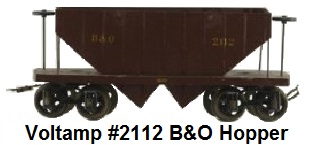
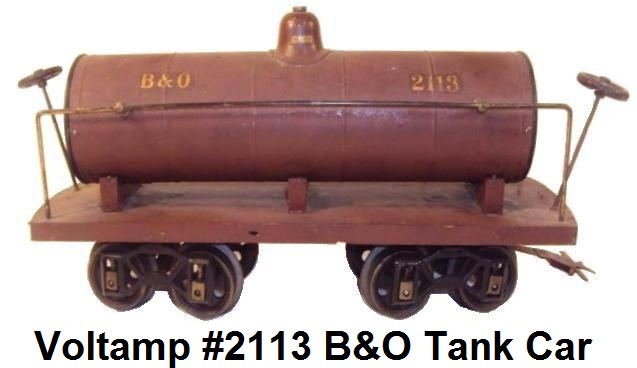
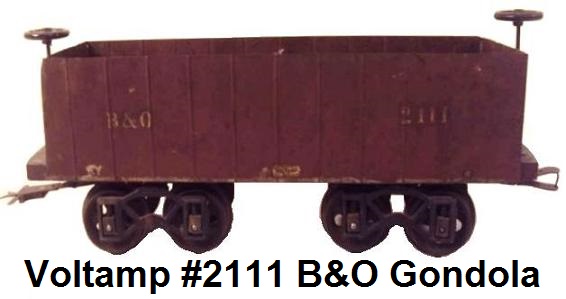
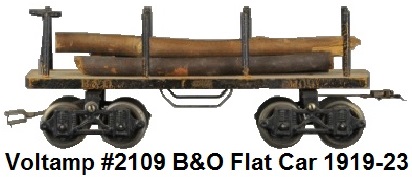
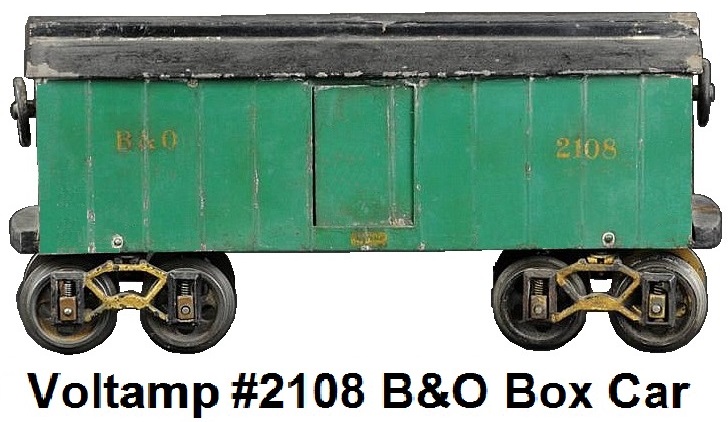
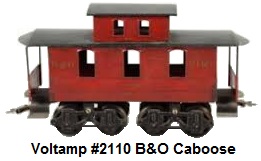
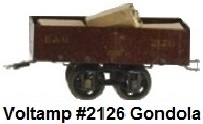
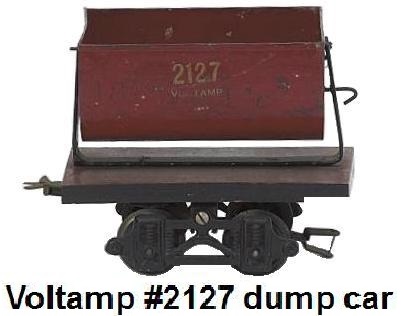
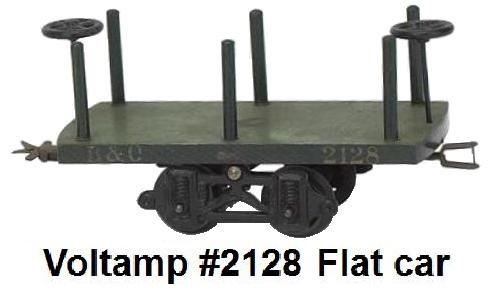
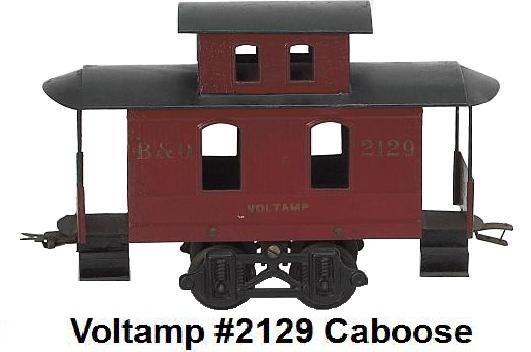
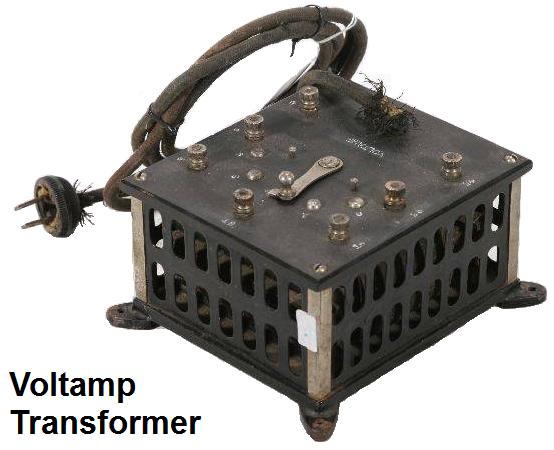
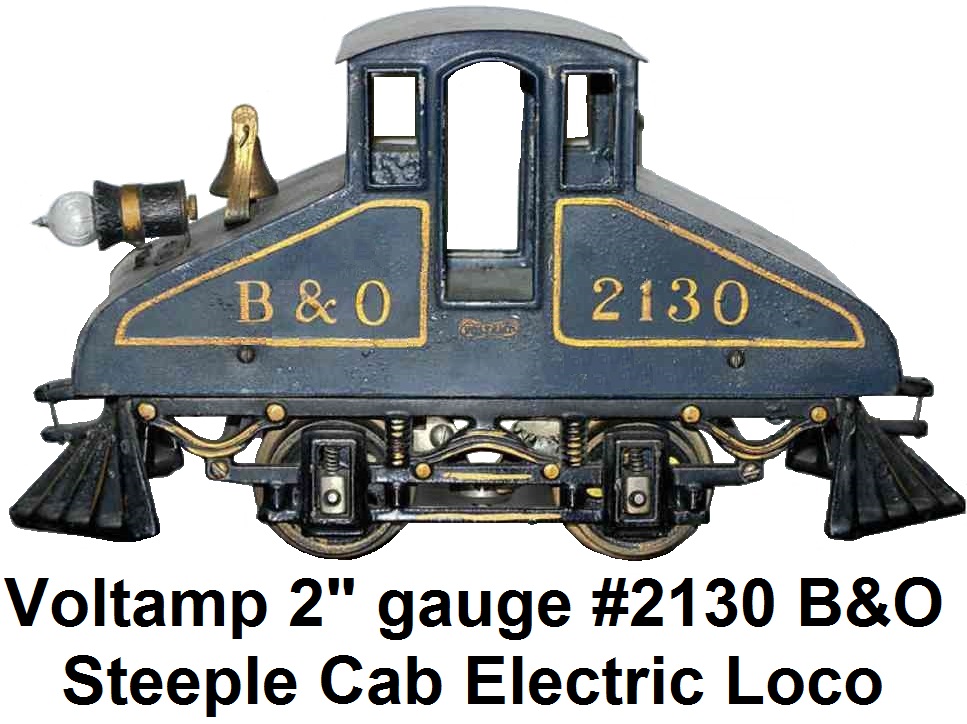
 Voltamp was an early American manufacturer of toy trains based in Baltimore, Maryland. Founded by
Manes E. Fuld (1863-1956), the son of a Baltimore stove dealer, in the 1890's. Voltamp holds an important
place in the evolution of the toy train hobby for its 1907 release of the first electric toy train that
operated on ordinary household alternating current. This was a significant advancement for toy train
operation because earlier electric trains had used battery power. For the first time, the toy train
world had wall current powered electric trains, instead of spring powered/clockwork, battery powered,
and fire-powered steam.
Voltamp was an early American manufacturer of toy trains based in Baltimore, Maryland. Founded by
Manes E. Fuld (1863-1956), the son of a Baltimore stove dealer, in the 1890's. Voltamp holds an important
place in the evolution of the toy train hobby for its 1907 release of the first electric toy train that
operated on ordinary household alternating current. This was a significant advancement for toy train
operation because earlier electric trains had used battery power. For the first time, the toy train
world had wall current powered electric trains, instead of spring powered/clockwork, battery powered,
and fire-powered steam.
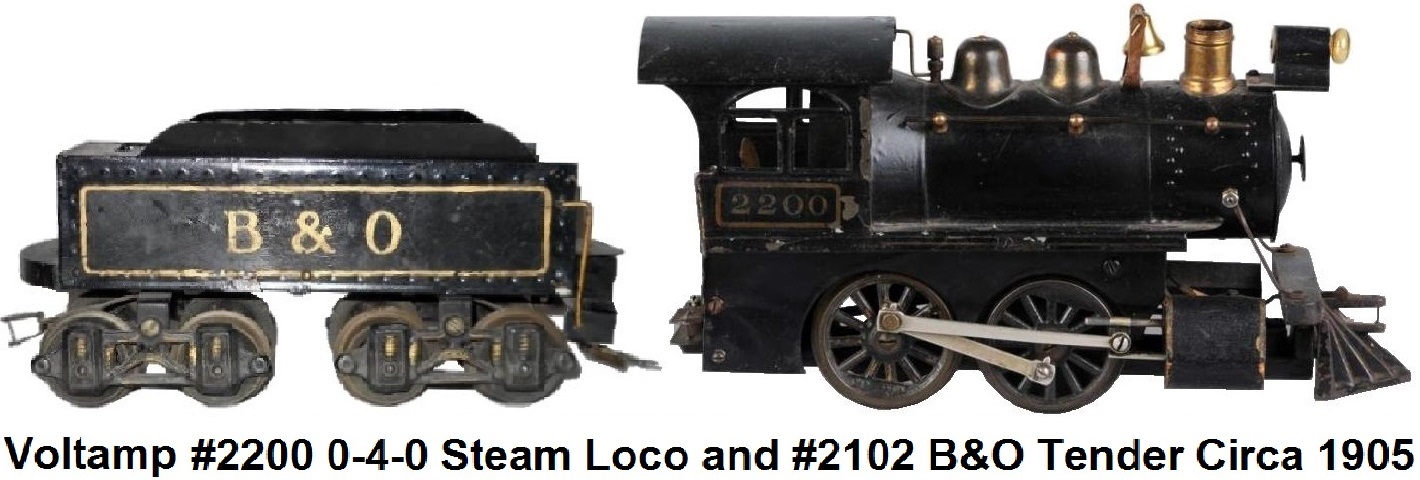 The Voltamp Electric Manufacturing Co., organized to manufacture electric motors, toys, and novelties in 1904,
was an outgrowth of the Chloride of Silver Dry Cell Battery Co., of Baltimore City, MD. The Chloride of Silver Dry
Cell Co. was originally formed in New York in 1879, and incorporated in New York State in 1887. Eventually the firm
moved to the 500 block of West Franklin Street in Baltimore sometime during the late 1880's or early 1890's.
The expansion into making toy trains all started when Fuld, who owned the company, brought out a model Locomotive that he
had made for his son Edwin in 1897. Fuld's friends who had seen the set thought the model was so good looking and so novel
that they encouraged him to go into production.
The Voltamp Electric Manufacturing Co., organized to manufacture electric motors, toys, and novelties in 1904,
was an outgrowth of the Chloride of Silver Dry Cell Battery Co., of Baltimore City, MD. The Chloride of Silver Dry
Cell Co. was originally formed in New York in 1879, and incorporated in New York State in 1887. Eventually the firm
moved to the 500 block of West Franklin Street in Baltimore sometime during the late 1880's or early 1890's.
The expansion into making toy trains all started when Fuld, who owned the company, brought out a model Locomotive that he
had made for his son Edwin in 1897. Fuld's friends who had seen the set thought the model was so good looking and so novel
that they encouraged him to go into production.
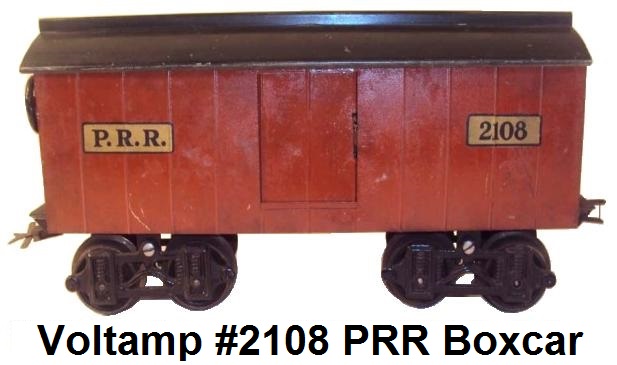
Voltamp released its first toy train product in 1903 and the result was a complete sellout. Its first
locomotive sold for $10. Because they were expensive and people were wary of electrical power, Voltamp
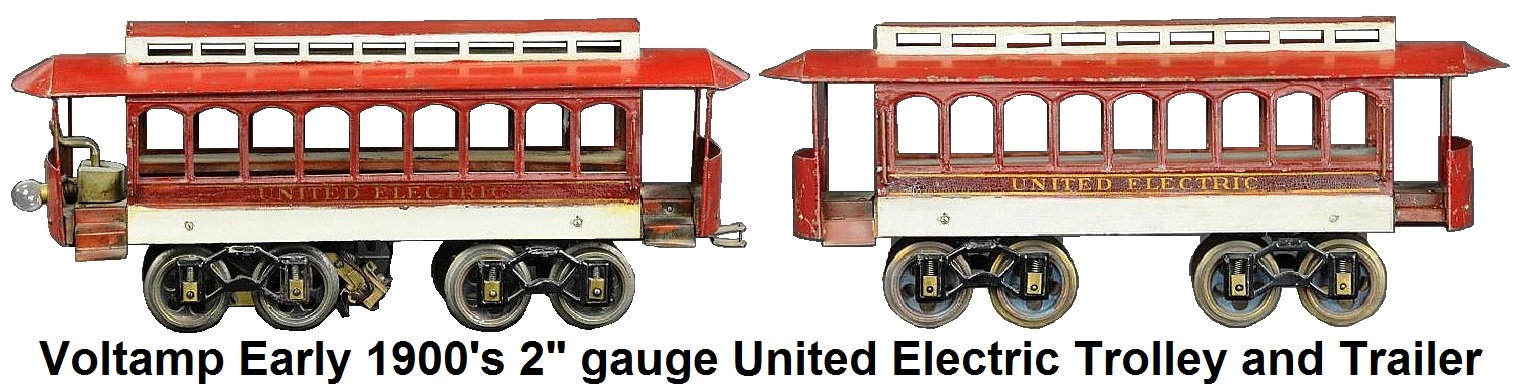 trains never sold nationally as well as they did in Baltimore. Voltamp did not even release a catalog showing their
own trains until 1908. These trains were known for their surprising detail. The 1908 catalog introduced
freight and smaller #2103-2107 flat-end passenger cars and the early versions of the #2100 and #2200
locomotives. Also shown were the 4 and 8 wheel trolleys. These power units were fitted with DC single
field wound motors.
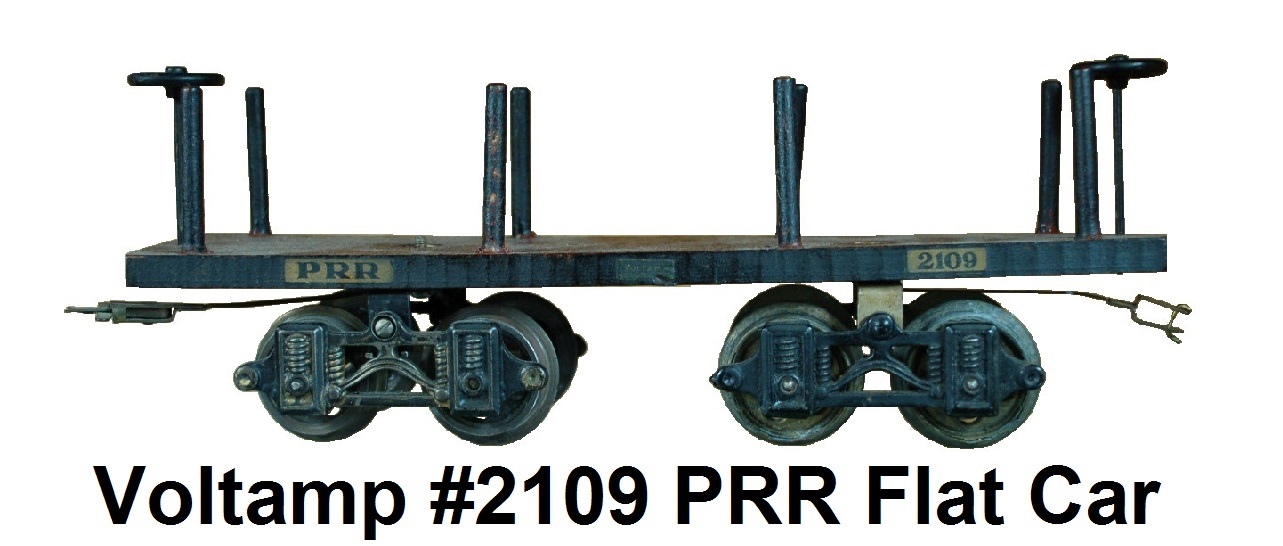
Voltamp's trains utilized the same 2 inch gauge metal track as Carlisle & Finch,
the inventor of the electric toy train. The Voltamp line included mostly B & O steamers, electrics and
passenger cars that ran on the 2 rail track.
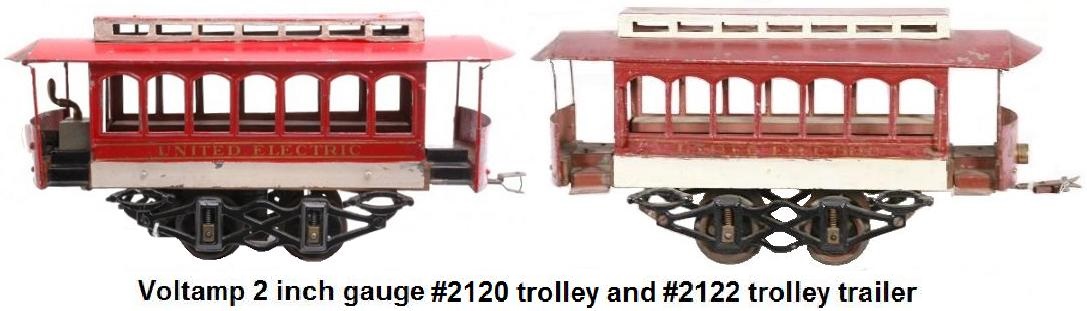
Voltamp trains and trolleys preserved the local color of the B. & O. Railroad
and the Old United Railway Cars of Baltimore. Unlike the brass and nickel Trolleys and cars of
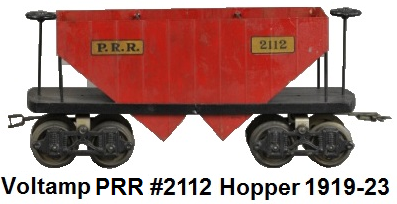
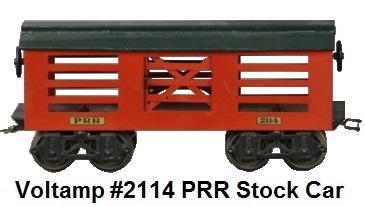
Carlisle & Finch, all Voltamp equipment was painted. Trucks were cast iron,
the wheels were brass. Other distinguishing features
about Voltamp Trains were the real springs and brass bearings on the trucks of the earlier
models. About 1914 the Sprung Trucks were changed to solid truck frames with cast-in simulated springs.
The very early models had dummy headlights, however by 1907 all Locomotives and almost every
Trolley had working headlights.
trains never sold nationally as well as they did in Baltimore. Voltamp did not even release a catalog showing their
own trains until 1908. These trains were known for their surprising detail. The 1908 catalog introduced
freight and smaller #2103-2107 flat-end passenger cars and the early versions of the #2100 and #2200
locomotives. Also shown were the 4 and 8 wheel trolleys. These power units were fitted with DC single
field wound motors.
Voltamp's trains utilized the same 2 inch gauge metal track as Carlisle & Finch,
the inventor of the electric toy train. The Voltamp line included mostly B & O steamers, electrics and
passenger cars that ran on the 2 rail track.
Voltamp trains and trolleys preserved the local color of the B. & O. Railroad
and the Old United Railway Cars of Baltimore. Unlike the brass and nickel Trolleys and cars of
Carlisle & Finch, all Voltamp equipment was painted. Trucks were cast iron,
the wheels were brass. Other distinguishing features
about Voltamp Trains were the real springs and brass bearings on the trucks of the earlier
models. About 1914 the Sprung Trucks were changed to solid truck frames with cast-in simulated springs.
The very early models had dummy headlights, however by 1907 all Locomotives and almost every
Trolley had working headlights.

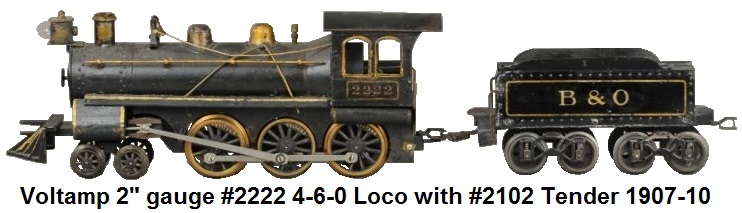
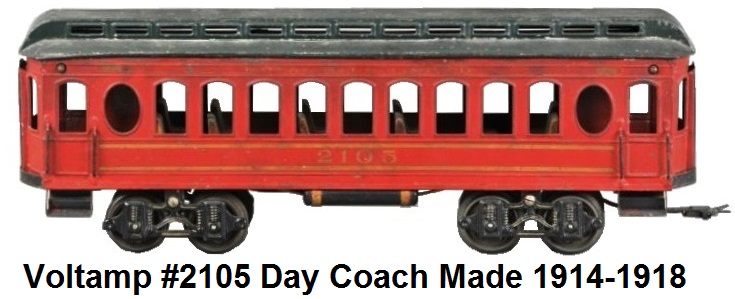
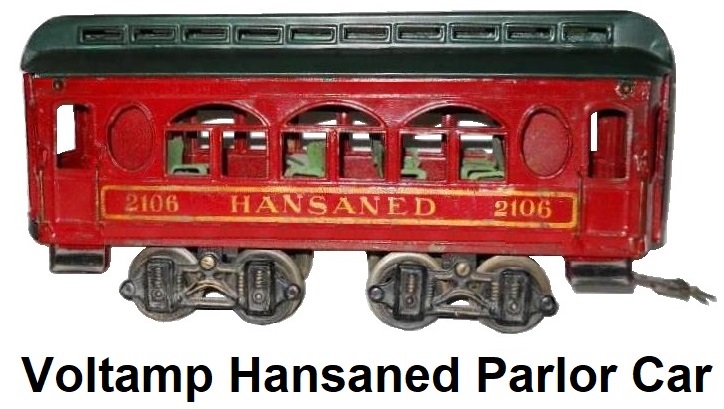
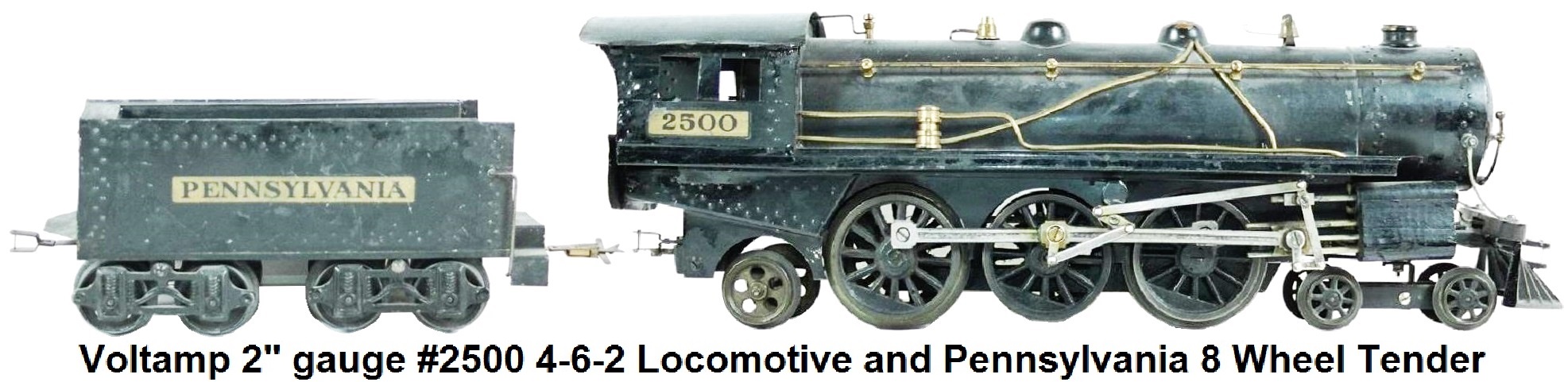 In 1910 Voltamp expanded the line to include the #2222 4-6-0 loco and also introduced
the #2105-2107 larger passenger cars.
The general characteristic of Voltamp trains, when compared with other 2" trains made by Carlisle & Finch and
Howard trains, is that it is heavier and more expensive equipment.
Also this was the only company that identified its product with the word
"Voltamp" in gold leaf on the cars and cast into the drive wheels and frames on their
steam type locos. Unlike Carlisle & Finch, who made their Locomotive frames out of wood (with the exception
of the early #45 which was built around a brass frame) Voltamp locomotive frames were of heavy cast iron construction.
Passenger and freight cars did use wooden bases.
Another distinctive feature of Voltamp trains was the "automatic coupler." The cars would couple automatically
when pushed together. Uncoupling had to be done manually. C. & F. had an unusual system
for coupling which consisted of a curved metal band at each end of the car. A small "U" hook dropped over
the bands was the actual coupler, the curved bands acting more or less as bumpers. Voltamp made a
large assortment of locomotives ranging from the small 0-4-0 #2130 Tunnel Engine to their largest
4-6-2 #2500 Locomotive which was 31 inches long with its tender, and weighed 11 pounds. They also made a
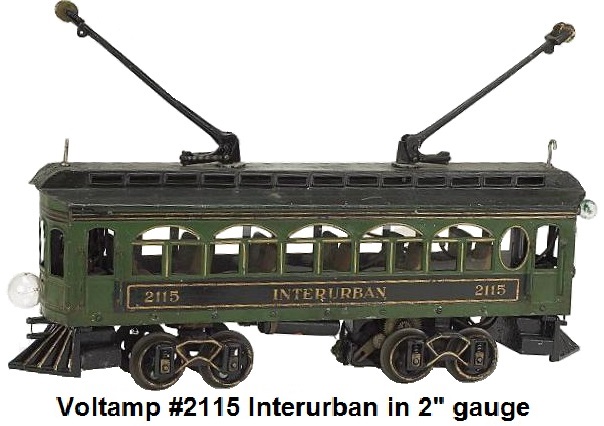
#2115 Interurban that was 18" long and had a wood base and sheet metal body.
In 1910 Voltamp expanded the line to include the #2222 4-6-0 loco and also introduced
the #2105-2107 larger passenger cars.
The general characteristic of Voltamp trains, when compared with other 2" trains made by Carlisle & Finch and
Howard trains, is that it is heavier and more expensive equipment.
Also this was the only company that identified its product with the word
"Voltamp" in gold leaf on the cars and cast into the drive wheels and frames on their
steam type locos. Unlike Carlisle & Finch, who made their Locomotive frames out of wood (with the exception
of the early #45 which was built around a brass frame) Voltamp locomotive frames were of heavy cast iron construction.
Passenger and freight cars did use wooden bases.
Another distinctive feature of Voltamp trains was the "automatic coupler." The cars would couple automatically
when pushed together. Uncoupling had to be done manually. C. & F. had an unusual system
for coupling which consisted of a curved metal band at each end of the car. A small "U" hook dropped over
the bands was the actual coupler, the curved bands acting more or less as bumpers. Voltamp made a
large assortment of locomotives ranging from the small 0-4-0 #2130 Tunnel Engine to their largest
4-6-2 #2500 Locomotive which was 31 inches long with its tender, and weighed 11 pounds. They also made a
#2115 Interurban that was 18" long and had a wood base and sheet metal body.
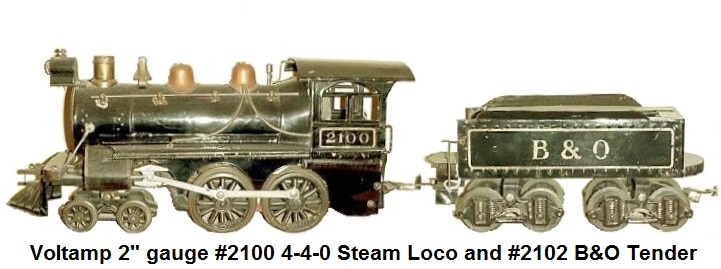 Early catalogs touted that "There is no trouble department with Voltamp Railways", and boasted as to why
two rail systems were superior to three rail model train systems. Having a two rail system enabled use of
a relay for reversing the direction of the train. The trains weren't really toys that children could run.
They had to be set up by the parents. Electricity was still considered to be dangerous in the early 20th
centrury. By 1913 the Voltamp catalogue was 130 pages long, and included trolleys, trains accessories and
hardware. Voltamp made 2 rail track mounted to wood bases. The radius of the complete oval was 78½
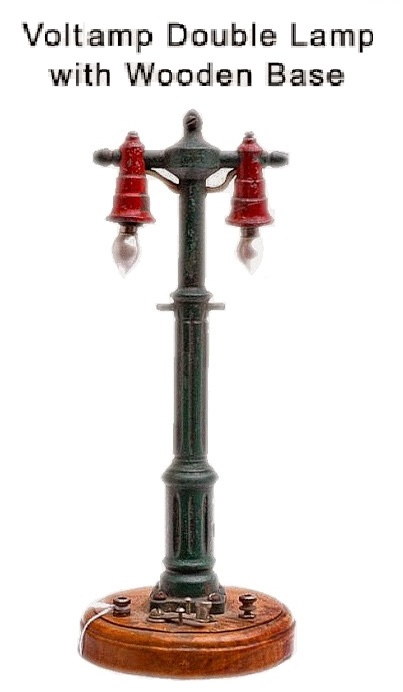
inches. Switch tracks were also made. They even offered French Victorian style lighted electric lamp post
accessories in the catalogue.
Early catalogs touted that "There is no trouble department with Voltamp Railways", and boasted as to why
two rail systems were superior to three rail model train systems. Having a two rail system enabled use of
a relay for reversing the direction of the train. The trains weren't really toys that children could run.
They had to be set up by the parents. Electricity was still considered to be dangerous in the early 20th
centrury. By 1913 the Voltamp catalogue was 130 pages long, and included trolleys, trains accessories and
hardware. Voltamp made 2 rail track mounted to wood bases. The radius of the complete oval was 78½
inches. Switch tracks were also made. They even offered French Victorian style lighted electric lamp post
accessories in the catalogue.
In 1915 Voltamp provided trains for the Panama-Pacific Exposition held in San Francisco,
Ca. The theme for the layout was the Southern Pacific RR and the trains provided were uniquely decorated for
this purpose. The model train layout 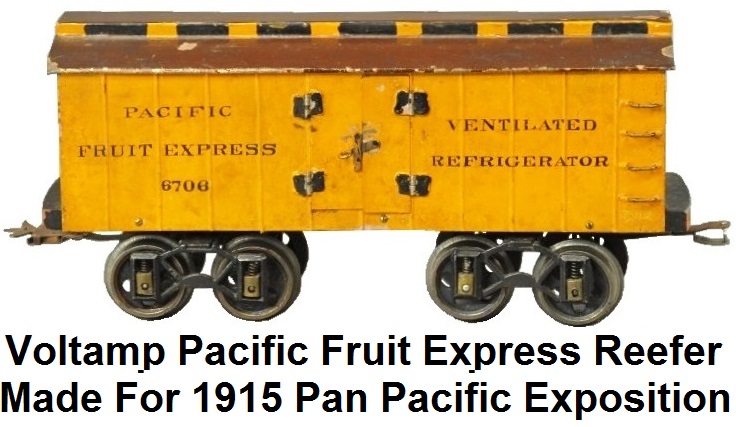 ran both a freight and passenger set. The freight set consisted of refrigerator cars and a caboose. The
refrigerator cars were modified box cars that were unique to the Pan Pacific sets but were never catalogued
or made available for sale. There were minor variations in the refrigerator cars paint schemes depicting
the roof ventilators. The caboose was also different from the standard Voltamp model in that it was fitted
with rear lights, a track current pickup, and a resistor to stepdown the track voltage. The presence of the
resistor supports a theory that these trains ran on high voltage. The passenger set consisted of Pullmans,
of which two were labeled Stockton and San Francisco. These are the only known cars from this exhibition that
have survived and exist in a private collection today. Both of these Pullmans were identical except for their
names and numbers. These passenger cars are fitted with a lighting circuit that differs from the one utilized
on the caboose. Current is fed into the cars via wires that are run through the tender frame and are connected
to the loco. A female/male plug arrangement facilitates separation of the cars. The circuit in the loco that
provides current to this lighting has the same type resistor as found in the caboose. All equipment in these
sets, including the 4-6-2 Pacific type styeam loco and tender, bore Southtern Pacific markings and had
features such as wood bottom frames, sprung trucks, and flat ends on the passenger cars that date them to the
early Voltamp period. The locos appear similar to the early version #2500 Pacific circa 1913, but is
distinguishable from later models by the small drive wheels.
ran both a freight and passenger set. The freight set consisted of refrigerator cars and a caboose. The
refrigerator cars were modified box cars that were unique to the Pan Pacific sets but were never catalogued
or made available for sale. There were minor variations in the refrigerator cars paint schemes depicting
the roof ventilators. The caboose was also different from the standard Voltamp model in that it was fitted
with rear lights, a track current pickup, and a resistor to stepdown the track voltage. The presence of the
resistor supports a theory that these trains ran on high voltage. The passenger set consisted of Pullmans,
of which two were labeled Stockton and San Francisco. These are the only known cars from this exhibition that
have survived and exist in a private collection today. Both of these Pullmans were identical except for their
names and numbers. These passenger cars are fitted with a lighting circuit that differs from the one utilized
on the caboose. Current is fed into the cars via wires that are run through the tender frame and are connected
to the loco. A female/male plug arrangement facilitates separation of the cars. The circuit in the loco that
provides current to this lighting has the same type resistor as found in the caboose. All equipment in these
sets, including the 4-6-2 Pacific type styeam loco and tender, bore Southtern Pacific markings and had
features such as wood bottom frames, sprung trucks, and flat ends on the passenger cars that date them to the
early Voltamp period. The locos appear similar to the early version #2500 Pacific circa 1913, but is
distinguishable from later models by the small drive wheels.
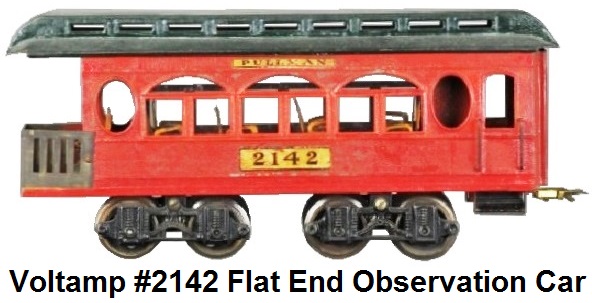
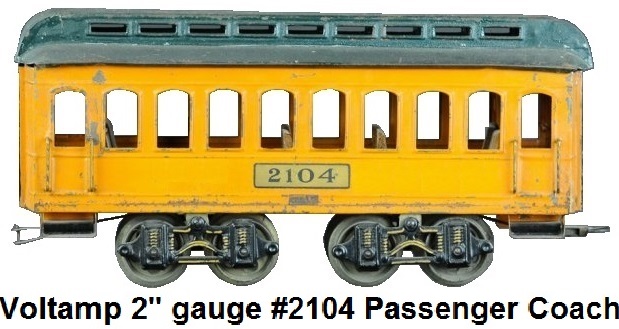
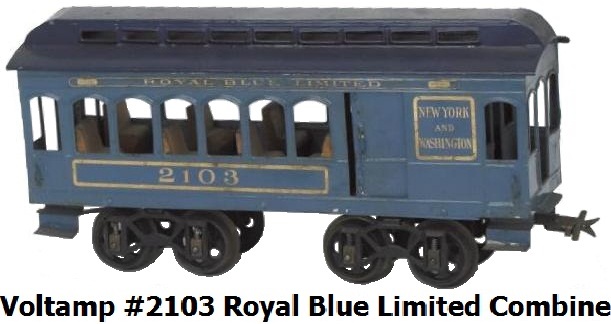
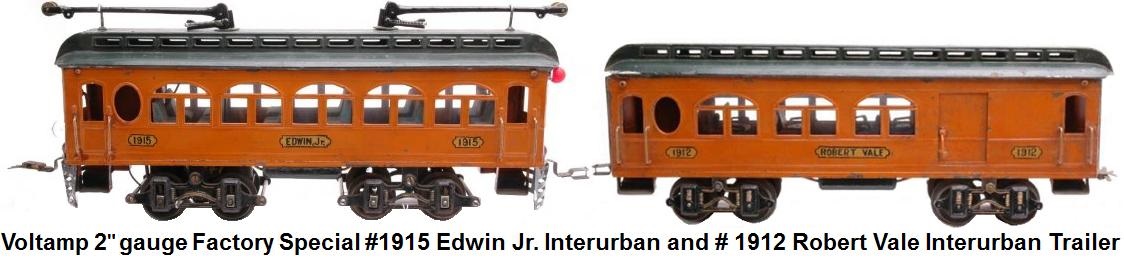
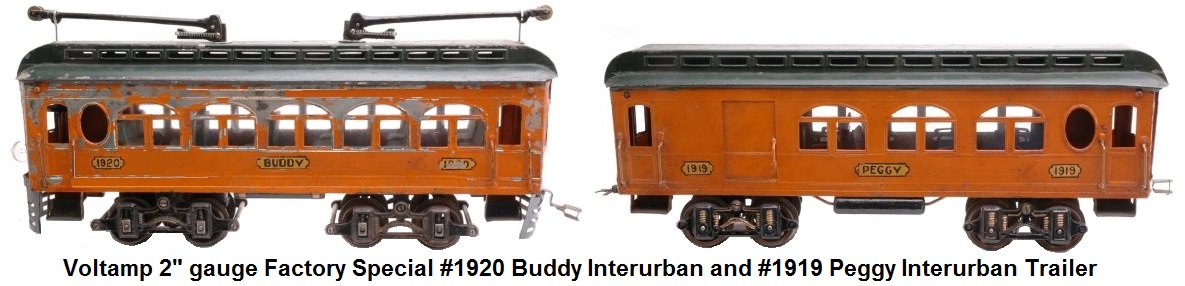
 Another unique item produced by Voltamp starting in 1915 was a set of 2" gauge Interurban cars
made specially for Vale Fitzpatrick. Fitzpatrick had met socially with Manes Fuld around 1915 and
somewhow through their friendship convinced Fuld to design and manufacture the rare Voltamp W.B.
& A. Interurban cars. Fitzpatrick had requested that the Voltamp factory paint the Interurbans with
orange bodies, dark green roofs and letter them with his children's names. The first 2 cars came off
of the manufacturing line in August 1915 and were the 'Edwin Jr.' power car and
the 'Robert Vale' trailer car. The power car was actually a Voltamp coach fitted with 2 trolley poles,
and the trailer was a Voltamp combination baggage car. The cars were also numbered with the dates of
birth of the 1st and 2nd born sons of Fitzpatrick - #1915 for the power unit and #1912 for the
trailer. Later in September 1920, 2 more cars were created for the set. A #1920 'Buddy' power car
named for the 3rd son, and the #1919 'Peggy' trailer named for Fitzpatrick's daughter. Each of
these cars were also numbered to represent the namesake's birth years. The cars included interior
lighting and seating. These one of a kind trains remained in the Fitzpatrick family through 1994
when they were acquired by TCA member Larry House.
Another unique item produced by Voltamp starting in 1915 was a set of 2" gauge Interurban cars
made specially for Vale Fitzpatrick. Fitzpatrick had met socially with Manes Fuld around 1915 and
somewhow through their friendship convinced Fuld to design and manufacture the rare Voltamp W.B.
& A. Interurban cars. Fitzpatrick had requested that the Voltamp factory paint the Interurbans with
orange bodies, dark green roofs and letter them with his children's names. The first 2 cars came off
of the manufacturing line in August 1915 and were the 'Edwin Jr.' power car and
the 'Robert Vale' trailer car. The power car was actually a Voltamp coach fitted with 2 trolley poles,
and the trailer was a Voltamp combination baggage car. The cars were also numbered with the dates of
birth of the 1st and 2nd born sons of Fitzpatrick - #1915 for the power unit and #1912 for the
trailer. Later in September 1920, 2 more cars were created for the set. A #1920 'Buddy' power car
named for the 3rd son, and the #1919 'Peggy' trailer named for Fitzpatrick's daughter. Each of
these cars were also numbered to represent the namesake's birth years. The cars included interior
lighting and seating. These one of a kind trains remained in the Fitzpatrick family through 1994
when they were acquired by TCA member Larry House.
Voltamp Factory Specials
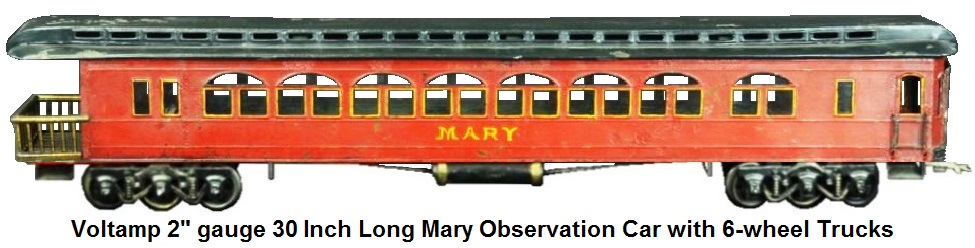
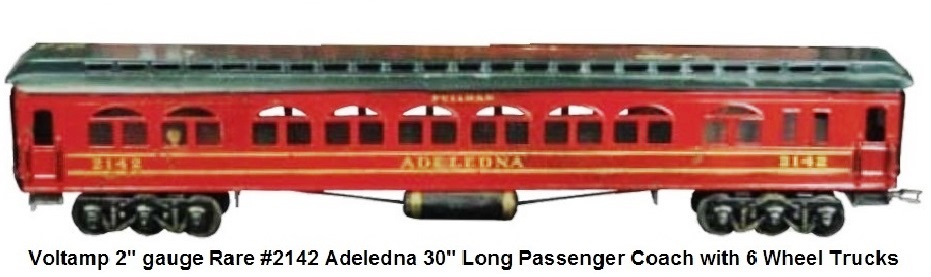
 An additional famous Voltamp factory special item was the 30 inch long 2" gauge passenger cars
circa 1914-18. These were thought to of been constructed to also exhibit at the 1915 Panama-Pacific Exposition held in
San Francisco. There are two known examples of this car, the pullman type and the observation car with platform.
Manes Fuld had several children, and he wanted to name his trains after them. Adeledna is a combination of
his children Adel and Edna's names. Evidently this name was used on several versions of Voltamp passenger
cars and on the later version of the #2115 Interurban. The matching 30 inch observation car was given
the name Mary.
An additional famous Voltamp factory special item was the 30 inch long 2" gauge passenger cars
circa 1914-18. These were thought to of been constructed to also exhibit at the 1915 Panama-Pacific Exposition held in
San Francisco. There are two known examples of this car, the pullman type and the observation car with platform.
Manes Fuld had several children, and he wanted to name his trains after them. Adeledna is a combination of
his children Adel and Edna's names. Evidently this name was used on several versions of Voltamp passenger
cars and on the later version of the #2115 Interurban. The matching 30 inch observation car was given
the name Mary.
 A full set of Voltamp trains with a B&O freight engine and cars sold for $155 in 1923, which was
equivalent to the cost of a used car during that era. Although Voltamp outlasted Carlisle & Finch,
its primary competitor, both companies were eclipsed in the marketplace by the Ives
Manufacturing Company and Lionel Corporation, and Voltamp exited
the market in 1923, selling its trademark, files, inventory, tooling and line to Horace
Boucher, who manufactured
model boats at the time. Boucher modified the Voltamp line from 2" 2 rail to 2 1/8" 3 rail in order to
be compatible with Lionel's Standard Gauge line. Fuld retained his North Paca Street electrical business and
continued to operate under the Chloride of Silver Dry Cell Company of Baltimore name, which sold batteries,
tools, doorbells, light bulbs and electrically powered medical devices. But its trains are what gave Voltamp
its lasting name.
A full set of Voltamp trains with a B&O freight engine and cars sold for $155 in 1923, which was
equivalent to the cost of a used car during that era. Although Voltamp outlasted Carlisle & Finch,
its primary competitor, both companies were eclipsed in the marketplace by the Ives
Manufacturing Company and Lionel Corporation, and Voltamp exited
the market in 1923, selling its trademark, files, inventory, tooling and line to Horace
Boucher, who manufactured
model boats at the time. Boucher modified the Voltamp line from 2" 2 rail to 2 1/8" 3 rail in order to
be compatible with Lionel's Standard Gauge line. Fuld retained his North Paca Street electrical business and
continued to operate under the Chloride of Silver Dry Cell Company of Baltimore name, which sold batteries,
tools, doorbells, light bulbs and electrically powered medical devices. But its trains are what gave Voltamp
its lasting name.
 In 2006 Pride Lines Ltd., of Lindenhurst, NY 11757, filed a U.S. federal
trademark registration for Voltamp. The federal status of that trademark filing had been indicated
as abandoned-failure to respond or late response at that time. Shortly thereafter, Pride Lines Ltd.
manufactured and sold a reproduction of the Voltamp #2115 Interurban for 3-rail Standard gauge
track. Pride Lines later went on to make and sell additional reproductions of the Voltamp 4
wheel freight cars and the #2130 Steeple Cab electirc for Standard gauge, 3-rail track operation.
In 2006 Pride Lines Ltd., of Lindenhurst, NY 11757, filed a U.S. federal
trademark registration for Voltamp. The federal status of that trademark filing had been indicated
as abandoned-failure to respond or late response at that time. Shortly thereafter, Pride Lines Ltd.
manufactured and sold a reproduction of the Voltamp #2115 Interurban for 3-rail Standard gauge
track. Pride Lines later went on to make and sell additional reproductions of the Voltamp 4
wheel freight cars and the #2130 Steeple Cab electirc for Standard gauge, 3-rail track operation.
Voltamp trains are highly sought after by collectors and antique toy dealers today because they
 were always produced in fairly small numbers. In October
of 1997, three Voltamp engines and nine cars, manufactured around 1915, sold quickly at an
auction in Baltimore, MD for $44,550. In November 2006, a Voltamp train set sold for $7,280
at an auction in Vineland, NJ. In 2008, a pair of Voltamp Interurban Trolleys made in 1914
was offered for $75,000. The late Ward Kimball's Voltamp #2115 Interurban brought $35,000 at auction.
On November 12, 2012 a 1907 Voltamp #2100 B&O 4-4-0 locomotive and 8-wheel tender sold for $10,367.87
on eBay. A Voltamp Interurban from the Dick Claus collection sold for $25,370 in a November 2012 Bertoia auction.
In a May 2013 auction, a Voltamp live steam 2" gauge 4-6-2 locomotive with 8-wheel tender sold within
estimate for $10,600. At that same auction, a Voltamp #2100 painted light blue, sold for $18,880, and a set
of 3 rare Voltamp box cars made for the 1915 Pan Pacific Expo realized $15,340. In 2014 a Voltamp #2222
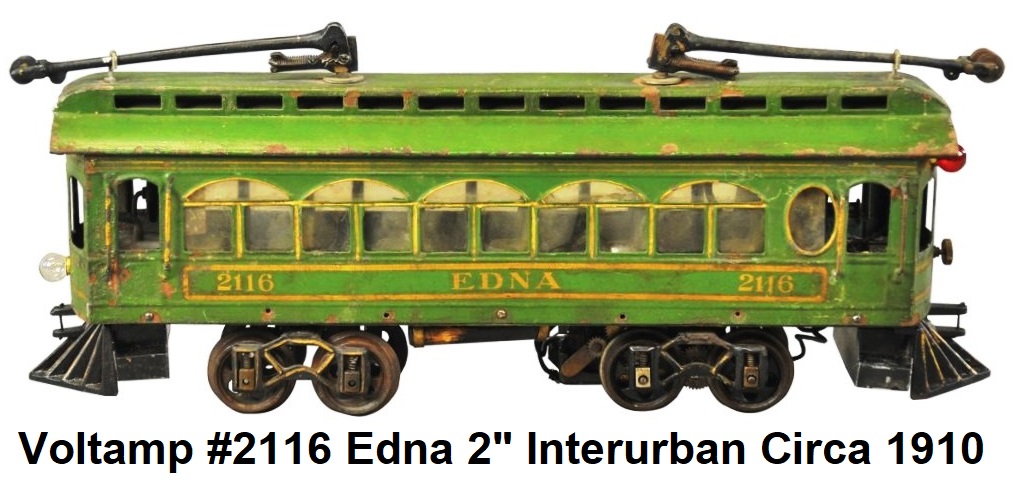
loco and tender circa 1910 realized $30,680 at auction. A circa 1910 Voltamp #2116 'Edna' interurban toy
tram, 16½ inches long and an early version, with an olive green painted body and a wood floor, sold
for $21,240 at a Toys, Trains & Banks Auction held May 8-9, 2015 by Bertoia Auctions in Vineland, N.J.
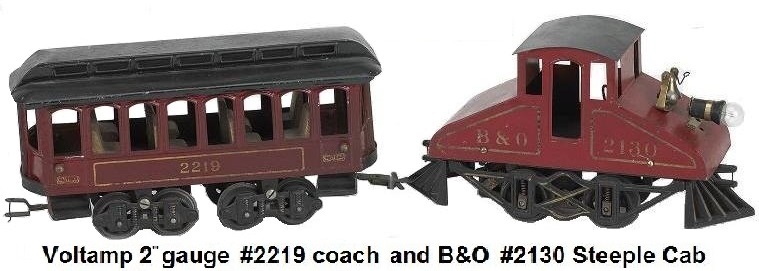
An original Voltamp passenger train set consisting of a #2220 0-4-0 locomotive with early headlight and very
rare Pennsylvania 4-wheel tender, along with The New York and Washington #2219 coach and #2218 combine car
sold at auction for $26,550 in 2016. Only four or five of these eight wheeled passenger car sets are known
to exist. At the 2016 Bertoia auction of Jerry & Nina Greene's collection of toy trains and accessories,
a Voltamp #2219 trolley in light blue flew past its $2,500/$3,000 estimate to realize $11,400.
were always produced in fairly small numbers. In October
of 1997, three Voltamp engines and nine cars, manufactured around 1915, sold quickly at an
auction in Baltimore, MD for $44,550. In November 2006, a Voltamp train set sold for $7,280
at an auction in Vineland, NJ. In 2008, a pair of Voltamp Interurban Trolleys made in 1914
was offered for $75,000. The late Ward Kimball's Voltamp #2115 Interurban brought $35,000 at auction.
On November 12, 2012 a 1907 Voltamp #2100 B&O 4-4-0 locomotive and 8-wheel tender sold for $10,367.87
on eBay. A Voltamp Interurban from the Dick Claus collection sold for $25,370 in a November 2012 Bertoia auction.
In a May 2013 auction, a Voltamp live steam 2" gauge 4-6-2 locomotive with 8-wheel tender sold within
estimate for $10,600. At that same auction, a Voltamp #2100 painted light blue, sold for $18,880, and a set
of 3 rare Voltamp box cars made for the 1915 Pan Pacific Expo realized $15,340. In 2014 a Voltamp #2222
loco and tender circa 1910 realized $30,680 at auction. A circa 1910 Voltamp #2116 'Edna' interurban toy
tram, 16½ inches long and an early version, with an olive green painted body and a wood floor, sold
for $21,240 at a Toys, Trains & Banks Auction held May 8-9, 2015 by Bertoia Auctions in Vineland, N.J.
An original Voltamp passenger train set consisting of a #2220 0-4-0 locomotive with early headlight and very
rare Pennsylvania 4-wheel tender, along with The New York and Washington #2219 coach and #2218 combine car
sold at auction for $26,550 in 2016. Only four or five of these eight wheeled passenger car sets are known
to exist. At the 2016 Bertoia auction of Jerry & Nina Greene's collection of toy trains and accessories,
a Voltamp #2219 trolley in light blue flew past its $2,500/$3,000 estimate to realize $11,400.

 Manes E. Fuld was born in Baltimore on July 7, 1862 to parents Ephriam and Caroline Fuld. As a young boy growing up in
Baltimore he attended public schools and the University of Maryland where he attained a degree in pharmacology in 1883.
Fuld was a man of varied interests. He started out as a Shakespearean actor who performed in David Belasco productions of
Broadway plays in New York over a 5-year period from 1883-88.
Fuld then returned to Baltimore where he opened a drug store and pharmacy in Bolton Hill, MD at Park Avenue and McMechen
Street that he operated until after the turn of the century. He lived in the Marlborough Apartments, also the home of
Manes E. Fuld was born in Baltimore on July 7, 1862 to parents Ephriam and Caroline Fuld. As a young boy growing up in
Baltimore he attended public schools and the University of Maryland where he attained a degree in pharmacology in 1883.
Fuld was a man of varied interests. He started out as a Shakespearean actor who performed in David Belasco productions of
Broadway plays in New York over a 5-year period from 1883-88.
Fuld then returned to Baltimore where he opened a drug store and pharmacy in Bolton Hill, MD at Park Avenue and McMechen
Street that he operated until after the turn of the century. He lived in the Marlborough Apartments, also the home of
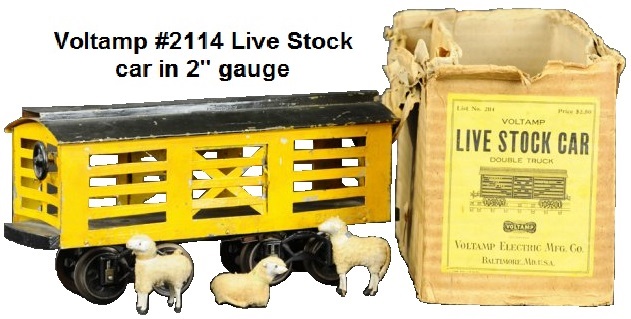 the famous art-collecting Cone sisters. He was also a notable member of Baltimore's
Jewish community. On February 6, 1906 Fuld applied for a US patent on electric
motor improvements that he invented. These improvements included a removable brush
configuration that made it easier to replace worn motor brushes in small electric motors and
a stud/arm configuration with a notch and eye in the arm that provided a more efficient way to
engage the motor brush from the end plate. This patent, #US837213A was awarded on November 27, 1906.
Patent #US840451A was granted to Fuld on 1-1-1907 for improvements in construction of commutators that he invented.
On June 23, 1919 Manes E. Fuld filed for another patent on a dry cell battery that
he designed. US patent #1439956 was awarded on December 26, 1922 for this invention. Fuld also
held 3 patents awarded by the US Patent Office in 1899 for an induction coil (#620027), a dry cell battery (627917)
and an electric cell packing case (#627408). Over his lifetime, Fuld was awarded 8 patents.
the famous art-collecting Cone sisters. He was also a notable member of Baltimore's
Jewish community. On February 6, 1906 Fuld applied for a US patent on electric
motor improvements that he invented. These improvements included a removable brush
configuration that made it easier to replace worn motor brushes in small electric motors and
a stud/arm configuration with a notch and eye in the arm that provided a more efficient way to
engage the motor brush from the end plate. This patent, #US837213A was awarded on November 27, 1906.
Patent #US840451A was granted to Fuld on 1-1-1907 for improvements in construction of commutators that he invented.
On June 23, 1919 Manes E. Fuld filed for another patent on a dry cell battery that
he designed. US patent #1439956 was awarded on December 26, 1922 for this invention. Fuld also
held 3 patents awarded by the US Patent Office in 1899 for an induction coil (#620027), a dry cell battery (627917)
and an electric cell packing case (#627408). Over his lifetime, Fuld was awarded 8 patents.
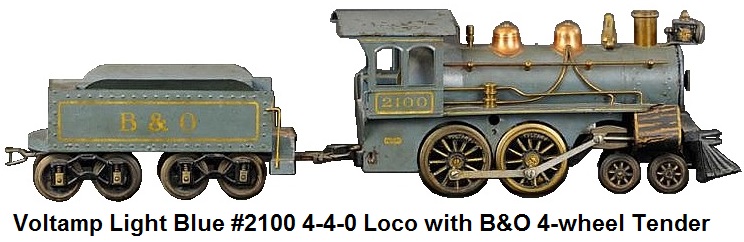
Manes E. Fuld retired from active participation in the dry cell battery business in 1949. He
passed away in Baltimore at his home located in the Ingram Hall Apartments
on the morning of Wednesday June 13, 1956. He was 93 years old.