 Quality Craft Models was an American Hobby Manufacturer founded in 1965 by Bob Weaver and his wife Shirley. It started as an
operation producing wooden and white metal Craftsman Kits consisting of buildings and rolling stock, in gauges from 'N' to
'O'. Over time Quality Craft grew into a major manufacturer and supplier of ready-to-run plastic and brass 'O' gauge 2-rail
and 3-rail scale model trains representing American railroad prototypes from the middle 20th-century to the first part of the
21st century.
Quality Craft Models was an American Hobby Manufacturer founded in 1965 by Bob Weaver and his wife Shirley. It started as an
operation producing wooden and white metal Craftsman Kits consisting of buildings and rolling stock, in gauges from 'N' to
'O'. Over time Quality Craft grew into a major manufacturer and supplier of ready-to-run plastic and brass 'O' gauge 2-rail
and 3-rail scale model trains representing American railroad prototypes from the middle 20th-century to the first part of the
21st century.
The first location for the business was an old, single story print shop located on Wheatley Avenue in
Northumberland, PA. The early craftsman freight car kits produced by Quality Craft were described by modelers as good
looking, easy to obtain, and easy to put together. If properly assembled, detailed and finished with a good paint job,
these models were considered to be on a par with, or better than the brass imports available at the time. Quality Craft
was one of the few manufacturers to put out a line of freight car kits that represented the contemporary style of then
current cars operating on the prototypical railroads of the day. These included C&O 61' well hole flat cars and Milwaukee
Road 40' ribbed box cars. Joe Hayter became President of the company in 1969. Joe was for a time
married to Bob Weaver's daughter. In 1974, a newer, more modern facility was constructed near the old print shop.
 Prior to 1980, Quality Craft made trains in HO gauge, but dropped out of the HO scale business.
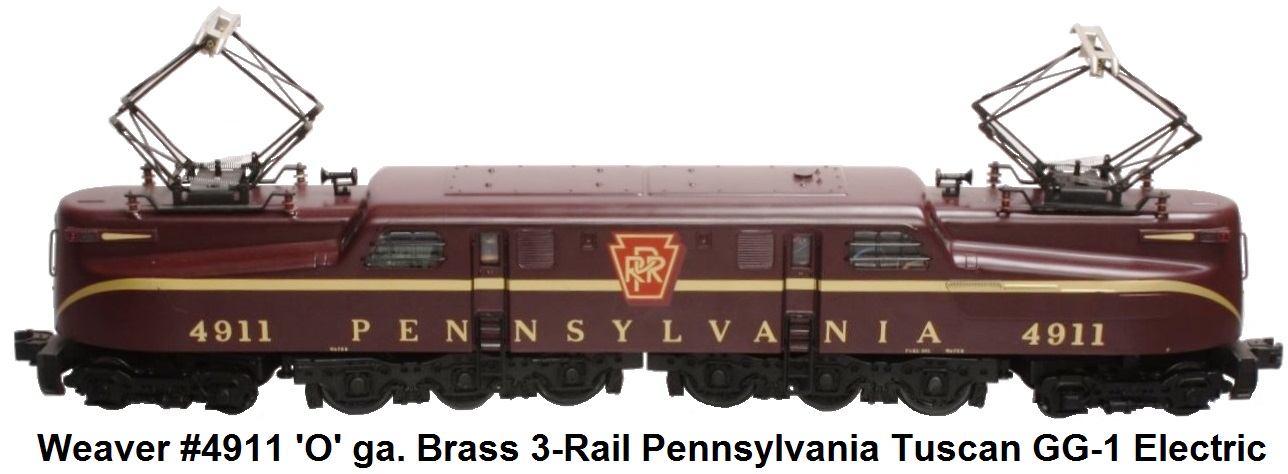
From that time on many fine scale 'O' gauge models were produced. Locomotives such as the GG-1, Baldwin
Sharks, Pennsy Torpedo, SP Daylight, articulated Class R-2s, and the NYC Dreyfuss Hudson were all issued to scale.
Prior to 1980, Quality Craft made trains in HO gauge, but dropped out of the HO scale business.
From that time on many fine scale 'O' gauge models were produced. Locomotives such as the GG-1, Baldwin
Sharks, Pennsy Torpedo, SP Daylight, articulated Class R-2s, and the NYC Dreyfuss Hudson were all issued to scale.
 The first plastic injection molded 'O' gauge model produced was the 2-Bay Hopper in 1980. Around this time the name Weaver
was adopted. During this period both Atlas and AHM had been unsuccessful at marketing plastic
ready to run 'O' scale models and the outlook for getting state-of-the art models in 'O' scale was bleak. However, Weaver's
entry into the genre turned out to be a very welcome addition. Bob Weaver believed that his choice of an open coal hopper
as his first offering was very fortuitous because modelers tended to run solid long prototypical trains of these hoppers,
and that was good for sales. The hopper was only available in kit form, less trucks and couplers. It had a one-piece body
with all of the grabs cast on, a separate under frame, a brake wheel, brake reservoir/triple valve cluster and two braces for
the hopper slope sheets - 6 parts in all. The kits were originally set-up for 2-rail trucks
(Athearn being the logical choice at the time) and Kadee couplers. But in the early to mid 1980's
the hunger for 3-rail trains by modelers and operators was answered by offering a choice of 2-rail or 3-rail. Weaver was one
of the first manufacturers to introduce scale models to the 3-rail market. They developed a 3-rail truck with a truck-mounted
coupler. Bob Weaver knew that the 3-rail market was about three times the size of the 2-rail market. Weaver's lack of fine
detail was a natural fit for the 3-rail market of that day with it's more casual operations. Eventually Weaver offered their
own trucks and couplers in 2 and 3-rail, in plastic and diecast. Ready-to-run cars are an imperative for the 3-rail crowd and
Weaver eventually offered those too. Soon thereafter, the kit versions were withdrawn from the market.
The first plastic injection molded 'O' gauge model produced was the 2-Bay Hopper in 1980. Around this time the name Weaver
was adopted. During this period both Atlas and AHM had been unsuccessful at marketing plastic
ready to run 'O' scale models and the outlook for getting state-of-the art models in 'O' scale was bleak. However, Weaver's
entry into the genre turned out to be a very welcome addition. Bob Weaver believed that his choice of an open coal hopper
as his first offering was very fortuitous because modelers tended to run solid long prototypical trains of these hoppers,
and that was good for sales. The hopper was only available in kit form, less trucks and couplers. It had a one-piece body
with all of the grabs cast on, a separate under frame, a brake wheel, brake reservoir/triple valve cluster and two braces for
the hopper slope sheets - 6 parts in all. The kits were originally set-up for 2-rail trucks
(Athearn being the logical choice at the time) and Kadee couplers. But in the early to mid 1980's
the hunger for 3-rail trains by modelers and operators was answered by offering a choice of 2-rail or 3-rail. Weaver was one
of the first manufacturers to introduce scale models to the 3-rail market. They developed a 3-rail truck with a truck-mounted
coupler. Bob Weaver knew that the 3-rail market was about three times the size of the 2-rail market. Weaver's lack of fine
detail was a natural fit for the 3-rail market of that day with it's more casual operations. Eventually Weaver offered their
own trucks and couplers in 2 and 3-rail, in plastic and diecast. Ready-to-run cars are an imperative for the 3-rail crowd and
Weaver eventually offered those too. Soon thereafter, the kit versions were withdrawn from the market.
 Bob Weaver felt that every time he came out with a new freight car he essentially was buying a house, due to the cost of
having dies made. With the expense involved to have the tooling completed for plastic injection molding, it was
decided to get the most out of one mold. Therefore, the 2-Bay Hopper tooling was made in
such a way that the side and ends could be interchangeable allowing Weaver to produce a 2-Bay Offset
or 2-Bay Ribbed car with regular, peaked or rounded ends. The tooling and injection molding was
completed by Train Miniature, located in Chicago. Thus, Weaver Models, a division of Quality Craft
Models, was born, and the Ultra Line was created.
Bob Weaver felt that every time he came out with a new freight car he essentially was buying a house, due to the cost of
having dies made. With the expense involved to have the tooling completed for plastic injection molding, it was
decided to get the most out of one mold. Therefore, the 2-Bay Hopper tooling was made in
such a way that the side and ends could be interchangeable allowing Weaver to produce a 2-Bay Offset
or 2-Bay Ribbed car with regular, peaked or rounded ends. The tooling and injection molding was
completed by Train Miniature, located in Chicago. Thus, Weaver Models, a division of Quality Craft
Models, was born, and the Ultra Line was created.
 Next to join the Weaver Ultra Line Family was the 40' and 50' Tank Cars. Again, with careful
planning and the removal / addition of sections to the mold, Weaver could inject either size tank
from the same mold. Train Miniature also produced this mold for Weaver. Keeping with the times, Weaver tanks
were offered in 2-rail and 3-rail from the start. This second choice of a car design, the modern tank car, nearly put
Weaver out of business because it dd not sell well at all. The 50' Rail Box and 4-Bay Centerflows were soon to follow.
Poly-X-Co., out of Philipsburg, NJ did the mold work on these two projects. Soon after, Wilhold Company,
located in Sunbury, PA contacted Weaver regarding tooling needs. They did a fine job on the next release,
which was the PS-2 Covered Hopper. Under Joe Hayter's direction, the company evolved and improved the product line.
Fragile plastic freight car trucks were replaced with die-cast metal ones, some superb passenger equipment was made,
and modern refrigerator cars with sound-generating 'refrigeration units' were offered. These cars were 'O' scale. The
3-rail models had Bettendorf side bearing trucks and couplers.
Next to join the Weaver Ultra Line Family was the 40' and 50' Tank Cars. Again, with careful
planning and the removal / addition of sections to the mold, Weaver could inject either size tank
from the same mold. Train Miniature also produced this mold for Weaver. Keeping with the times, Weaver tanks
were offered in 2-rail and 3-rail from the start. This second choice of a car design, the modern tank car, nearly put
Weaver out of business because it dd not sell well at all. The 50' Rail Box and 4-Bay Centerflows were soon to follow.
Poly-X-Co., out of Philipsburg, NJ did the mold work on these two projects. Soon after, Wilhold Company,
located in Sunbury, PA contacted Weaver regarding tooling needs. They did a fine job on the next release,
which was the PS-2 Covered Hopper. Under Joe Hayter's direction, the company evolved and improved the product line.
Fragile plastic freight car trucks were replaced with die-cast metal ones, some superb passenger equipment was made,
and modern refrigerator cars with sound-generating 'refrigeration units' were offered. These cars were 'O' scale. The
3-rail models had Bettendorf side bearing trucks and couplers.
 Weaver developed their own in-house pad-printing process to decorate the models. And Weaver developed product
the old fashioned way by speculating on which models would sell and in what quantity. Weaver never adopted the build-to-order
just-in-time business model that became the industry standard. When a former Wilhold employee decided to go into business for
himself an opportunity arose for Weaver. Being located only ½ mile North on the same road from the Weaver plant was
just too convenient to pass up. Besides, he was very skilled at his trade. The 3-Bay Coal Car was his first project for
Weaver. This formed a tooling relationship that would last until Weaver ceased manufacturing operations. Plastic molded
freight car offerings expanded to cover a large variety of rolling stock including troop transports, Milwaukee Road type
ribbed side box cars, wood side gondolas, Northeastern cabooses, and trailer-on-flatcars sporting a great number of authentic
and colorful liveries. Many of these car types (e.g. RoadRailers, 57' Reefers, High-Side Hoppers) were not done in 'O' scale
before or since. Road names for each of these changed from year to year and counting all of the variations would lead to
thousands, if not 10,000 or more distinct products.
Weaver developed their own in-house pad-printing process to decorate the models. And Weaver developed product
the old fashioned way by speculating on which models would sell and in what quantity. Weaver never adopted the build-to-order
just-in-time business model that became the industry standard. When a former Wilhold employee decided to go into business for
himself an opportunity arose for Weaver. Being located only ½ mile North on the same road from the Weaver plant was
just too convenient to pass up. Besides, he was very skilled at his trade. The 3-Bay Coal Car was his first project for
Weaver. This formed a tooling relationship that would last until Weaver ceased manufacturing operations. Plastic molded
freight car offerings expanded to cover a large variety of rolling stock including troop transports, Milwaukee Road type
ribbed side box cars, wood side gondolas, Northeastern cabooses, and trailer-on-flatcars sporting a great number of authentic
and colorful liveries. Many of these car types (e.g. RoadRailers, 57' Reefers, High-Side Hoppers) were not done in 'O' scale
before or since. Road names for each of these changed from year to year and counting all of the variations would lead to
thousands, if not 10,000 or more distinct products.
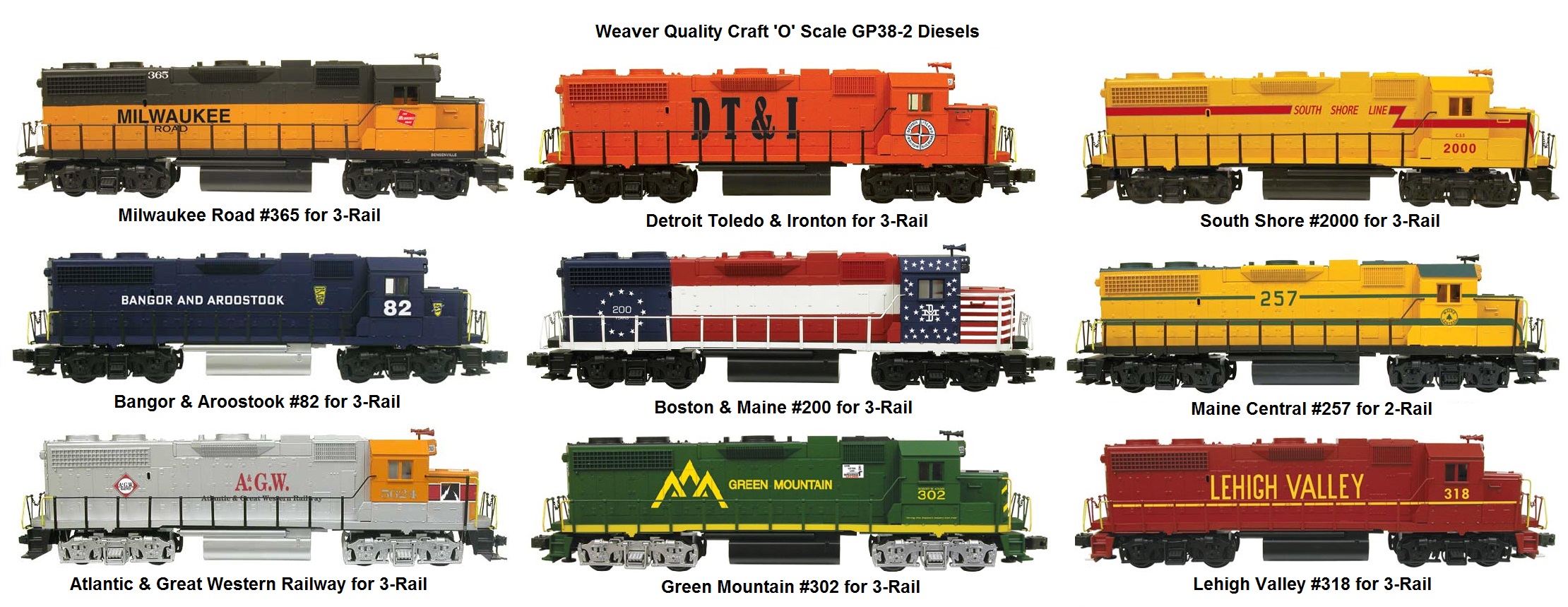
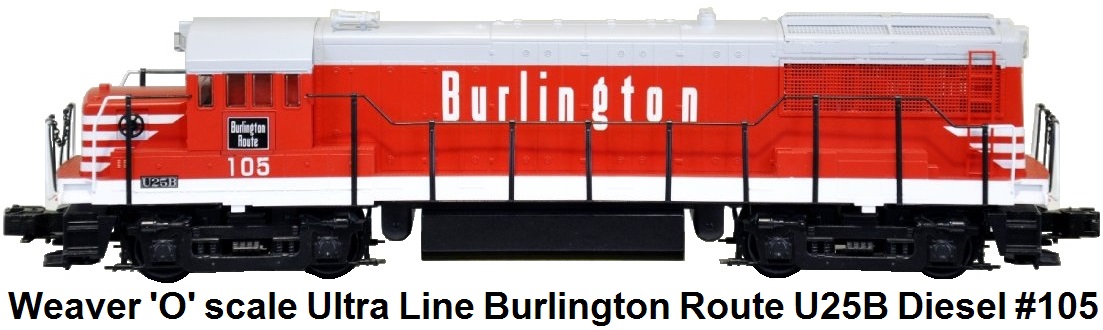
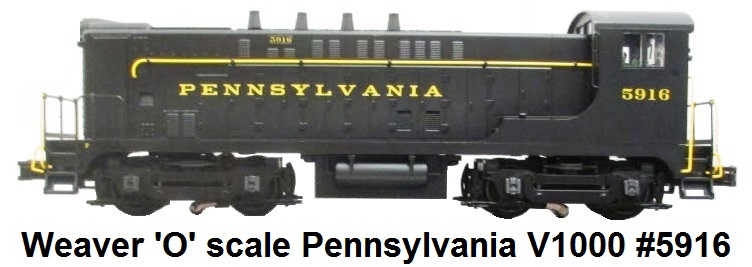
 The early to mid 1980's also welcomed the first plastic 'O' gauge diesel project - the Alco RS-3 Diesel
locomotive. Models of the Alco FA-2/FB-2, Baldwin V1000, EMD E8 and GP38-2, GE U25B, Alco RS-11/RSC-12, and the
huge Alco Century C628 joined the ranks of Weaver diesels over time. These engines were powered by a
Pittman motor and all-axle geared drive. In 1990 connections were established
with Samhongsa of South Korea to enter into the brass 'O' Scale Market.
Weaver's first project was the PRR M1a 4-8-2. Approximately 800 to 900 units of this model were produced,
with only about 50 being built for 2-rail operation. With the lack of other 'O' gauge manufacturers, Weaver immediately sold
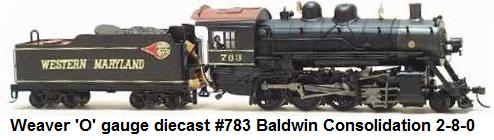
every one. A wide range of 'O' scale 3-rail brass locomotives that are still prized by operators and collectors was developed,
including a Consolidation and an 0-6-0. Over time they offered many, many brass steamers, biased towards larger passenger
steam, streamlined steam and, the PRR K4s, T1 and NYC Hudson notwithstanding, representing the less frequently modeled roads
like GN, MILW, NH, NKP, CN, CP, and LV. In addition to brass steamers, brass cabooses, electrics and even brass structures
were imported. Most of these imports were one-time offerings. From 1990 to 1993 numerous brass and plastic model projects
were successfully marketed by the Weaver team.
The early to mid 1980's also welcomed the first plastic 'O' gauge diesel project - the Alco RS-3 Diesel
locomotive. Models of the Alco FA-2/FB-2, Baldwin V1000, EMD E8 and GP38-2, GE U25B, Alco RS-11/RSC-12, and the
huge Alco Century C628 joined the ranks of Weaver diesels over time. These engines were powered by a
Pittman motor and all-axle geared drive. In 1990 connections were established
with Samhongsa of South Korea to enter into the brass 'O' Scale Market.
Weaver's first project was the PRR M1a 4-8-2. Approximately 800 to 900 units of this model were produced,
with only about 50 being built for 2-rail operation. With the lack of other 'O' gauge manufacturers, Weaver immediately sold
every one. A wide range of 'O' scale 3-rail brass locomotives that are still prized by operators and collectors was developed,
including a Consolidation and an 0-6-0. Over time they offered many, many brass steamers, biased towards larger passenger
steam, streamlined steam and, the PRR K4s, T1 and NYC Hudson notwithstanding, representing the less frequently modeled roads
like GN, MILW, NH, NKP, CN, CP, and LV. In addition to brass steamers, brass cabooses, electrics and even brass structures
were imported. Most of these imports were one-time offerings. From 1990 to 1993 numerous brass and plastic model projects
were successfully marketed by the Weaver team.
 The Samhongsa / Weaver Team also ventured into the plastic market. Numerous plastic diesels were produced:
SD40-2's, the Alco C628's, C630's, the Alco FA's, Alco RS11's/D12's, the GP38's, GE U25B's, Baldwin Sharks and
EMD E8's. At that time, Weaver was releasing 1,000 to 1,500 diesels per style. About 100 to 200 were offered in 2-rail,
the remainder in 3-rail. These locomotives utilized the oft-decried 'China Drive'. The dual motor drive was what was offered
by the Chinese builders and a requirement woven into the culture of the 3-rail community. At about this time, the domestically
produced diesels were transitioned to the China drive as well. QSI DCC Sound was introduced into
the models in late 1991 / early 1992. In the mid 1990's, Samhongsa made a strong connection with
Mike's Train House. From then on, they would no longer produce anything in 'O' scale
for anyone other than Mike's. At that point in time, Joe Hayter contracted with MTH to produce Weaver diecast Bettendorf
trucks and wheel sets.
The Samhongsa / Weaver Team also ventured into the plastic market. Numerous plastic diesels were produced:
SD40-2's, the Alco C628's, C630's, the Alco FA's, Alco RS11's/D12's, the GP38's, GE U25B's, Baldwin Sharks and
EMD E8's. At that time, Weaver was releasing 1,000 to 1,500 diesels per style. About 100 to 200 were offered in 2-rail,
the remainder in 3-rail. These locomotives utilized the oft-decried 'China Drive'. The dual motor drive was what was offered
by the Chinese builders and a requirement woven into the culture of the 3-rail community. At about this time, the domestically
produced diesels were transitioned to the China drive as well. QSI DCC Sound was introduced into
the models in late 1991 / early 1992. In the mid 1990's, Samhongsa made a strong connection with
Mike's Train House. From then on, they would no longer produce anything in 'O' scale
for anyone other than Mike's. At that point in time, Joe Hayter contracted with MTH to produce Weaver diecast Bettendorf
trucks and wheel sets.
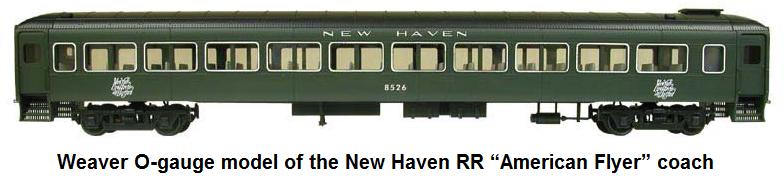
 Weaver passenger car offerings included smooth and fluted-side streamline cars in many different road names as
well as the unique offerings like the Pullman Bradley (sometimes referred to as the American Flyer style) coaches and a
Milwaukee Road Hiawatha streamliner with a beavertail observation car. The wartime
Troop Sleeper, Kitchen Cars and Coaches were offered in both passenger and the postwar express car configurations.
These passenger cars were very popular with modelers and scale operators as they featured a high level
of exterior detail, die-cast trucks, metal handrails, opening doors, glass windows, interior lighting and detailed
interiors.
Weaver passenger car offerings included smooth and fluted-side streamline cars in many different road names as
well as the unique offerings like the Pullman Bradley (sometimes referred to as the American Flyer style) coaches and a
Milwaukee Road Hiawatha streamliner with a beavertail observation car. The wartime
Troop Sleeper, Kitchen Cars and Coaches were offered in both passenger and the postwar express car configurations.
These passenger cars were very popular with modelers and scale operators as they featured a high level
of exterior detail, die-cast trucks, metal handrails, opening doors, glass windows, interior lighting and detailed
interiors.
 In late 1992 / early 1993 Weaver moved into a state-of-the-art facility located along Route 11
approximately 1 mile North of Northumberland. 1993 also saw the induction of Bob Weaver into the 'O' Scale Hall of Fame
at ceremonies held in Indianapolis, IN for his contributions to the development and history of 2-rail 'O' scale modeling.
That was also the year Joe Hayter officially took control of
Weaver Models by purchasing the business from Bob Weaver. 1995 was also a significant landmark for Weaver as it was the
first time an 'Ultra Line' catalog was officially published featuring models produced in-house.
Prior to that, the few catalogs released featured one or two brass, Gold Edition, imported models.
What started out as an eight page catalog produced one time per year grew into a 28+ page semi-annual
release.
In late 1992 / early 1993 Weaver moved into a state-of-the-art facility located along Route 11
approximately 1 mile North of Northumberland. 1993 also saw the induction of Bob Weaver into the 'O' Scale Hall of Fame
at ceremonies held in Indianapolis, IN for his contributions to the development and history of 2-rail 'O' scale modeling.
That was also the year Joe Hayter officially took control of
Weaver Models by purchasing the business from Bob Weaver. 1995 was also a significant landmark for Weaver as it was the
first time an 'Ultra Line' catalog was officially published featuring models produced in-house.
Prior to that, the few catalogs released featured one or two brass, Gold Edition, imported models.
What started out as an eight page catalog produced one time per year grew into a 28+ page semi-annual
release.
 It was not until 1997 that Weaver located a brass builder to fill the shoes of Samhongsa, resulting in the
February '98 release of a brass Union Pacific 49er 4-6-2. By this time, numerous other manufacturers
jumped on the 'O' gauge 'Band Wagon', resulting in a variety of choices for the discriminating modeler.
Weaver's lower production quantities of 300 3-rail (225 with sound and 75 without sound) and 50 2-rail
was evidence of this. From then on, Weaver catalogued and released two to three brass offerings each year with the
Boston & Maine P4 Pacific being the final offering in 2013.
It was not until 1997 that Weaver located a brass builder to fill the shoes of Samhongsa, resulting in the
February '98 release of a brass Union Pacific 49er 4-6-2. By this time, numerous other manufacturers
jumped on the 'O' gauge 'Band Wagon', resulting in a variety of choices for the discriminating modeler.
Weaver's lower production quantities of 300 3-rail (225 with sound and 75 without sound) and 50 2-rail
was evidence of this. From then on, Weaver catalogued and released two to three brass offerings each year with the
Boston & Maine P4 Pacific being the final offering in 2013.
 Quality Craft became a batch producer, manufacturing a line of true 1/4" 'O' Scale freight cars and locomotives.
Products were created in limited runs. Locomotives ranged in price from $250.00-$300.00. Weaver also sold Scalecoat
Model Railroad Paint, which was used on all the models produced in-house. Some of the HO kits made by
Quality Craft in the 1970's were picked up and re-issued under the Gloor Craft Models line. When
Crown Model Products closed down their 'O' scale car manufacturing business in 2000, Weaver
acquired the tooling for their 40' woodside reefer, 40' steel box car, and outside braced wood box car.
Some early versions of these cars produced by Weaver can be found with the letters CMP molded on the underside plastic,
as the acquired Crown Model Products car floors were being used up.
Weaver Models released a scale Milwaukee Road Hiawatha set in 2000, and they also entered into a license agreement with
Lionel to use their TrainMaster Command Control (TMCC) and RailSounds technology. TMCC technology
permitted operation of multiple trains on the same track without complex wiring. RailSounds, provided digital sound effects
to complement the digital control features of the system, and gave the locomotives realistic digitized sounds to accompany
movements. The first Weaver products to use TrainMaster Command Control and Railsounds were the brass versions of the Hudson
and the Atlantic. 2000 also saw the release of the C&NW Yellow Jacket 4-6-2 and D&RGW M-64 as part of the Gold Edition Brass
Roster.
Quality Craft became a batch producer, manufacturing a line of true 1/4" 'O' Scale freight cars and locomotives.
Products were created in limited runs. Locomotives ranged in price from $250.00-$300.00. Weaver also sold Scalecoat
Model Railroad Paint, which was used on all the models produced in-house. Some of the HO kits made by
Quality Craft in the 1970's were picked up and re-issued under the Gloor Craft Models line. When
Crown Model Products closed down their 'O' scale car manufacturing business in 2000, Weaver
acquired the tooling for their 40' woodside reefer, 40' steel box car, and outside braced wood box car.
Some early versions of these cars produced by Weaver can be found with the letters CMP molded on the underside plastic,
as the acquired Crown Model Products car floors were being used up.
Weaver Models released a scale Milwaukee Road Hiawatha set in 2000, and they also entered into a license agreement with
Lionel to use their TrainMaster Command Control (TMCC) and RailSounds technology. TMCC technology
permitted operation of multiple trains on the same track without complex wiring. RailSounds, provided digital sound effects
to complement the digital control features of the system, and gave the locomotives realistic digitized sounds to accompany
movements. The first Weaver products to use TrainMaster Command Control and Railsounds were the brass versions of the Hudson
and the Atlantic. 2000 also saw the release of the C&NW Yellow Jacket 4-6-2 and D&RGW M-64 as part of the Gold Edition Brass
Roster.
 Weaver did not make track or accessories. They also never produced starter type train sets. A decision was made
by Weaver management to avoid venturing into those aspects of the model train market as there were already several other
manufacturers offering those products. Instead, Weaver concentrated its efforts on developing and marketing products that no
other supplier provided, and to filling the void for what was missing that hobbyists would want to purchase.
Weaver did not make track or accessories. They also never produced starter type train sets. A decision was made
by Weaver management to avoid venturing into those aspects of the model train market as there were already several other
manufacturers offering those products. Instead, Weaver concentrated its efforts on developing and marketing products that no
other supplier provided, and to filling the void for what was missing that hobbyists would want to purchase.
 Weaver utilized a fabricator in Asia that was also utilized by K-Line at the time, and as a
result, the same tooling was used for producing some of the limited run brass locomotive offerings. One such example was the
USRA Light 4-6-2 Pacific's marketed by Weaver in the spring of 2005. Weaver light Pacific's were available in both 2 and
3-rail versions in 13 road names, not all of which were in fact USRA light Pacific operators. After first appearing in the
spring 2005 catalog they remained in Weaver's advertising until sold out. Road names offered were ATSF, B&M, CN, C&NW, GTW,
IC, L&N, LV, MEC, MILW, N&W, WM, Reading and US Army.
Weaver utilized a fabricator in Asia that was also utilized by K-Line at the time, and as a
result, the same tooling was used for producing some of the limited run brass locomotive offerings. One such example was the
USRA Light 4-6-2 Pacific's marketed by Weaver in the spring of 2005. Weaver light Pacific's were available in both 2 and
3-rail versions in 13 road names, not all of which were in fact USRA light Pacific operators. After first appearing in the
spring 2005 catalog they remained in Weaver's advertising until sold out. Road names offered were ATSF, B&M, CN, C&NW, GTW,
IC, L&N, LV, MEC, MILW, N&W, WM, Reading and US Army.
 In 2006 Weaver offered the Royal Train's blue CN 4-8-4 Confederation (Northern) in both 2-rail and 3-rail 'O' gauge/scale.
A matching set of Pullman-Bradley deluxe coaches was also made available.
Weaver released the 'O' scale brass model of the Canadian Pacific Empress 4-6-4 in 2007 along with a matching set of
Pullman Bradley deluxe coaches. They also produced a CP Express boxcar in 4 different car numbers for those that preferred a
freight consist over a passenger consist. That same year they introduced their 40' fish belly flat car and the Pennsylvania
B60b baggage and Railway Post Office cars. The company also announced a new joint venture with the European manufacturer
ETS to exclusively carry their European trains product line in the United States.
In 2006 Weaver offered the Royal Train's blue CN 4-8-4 Confederation (Northern) in both 2-rail and 3-rail 'O' gauge/scale.
A matching set of Pullman-Bradley deluxe coaches was also made available.
Weaver released the 'O' scale brass model of the Canadian Pacific Empress 4-6-4 in 2007 along with a matching set of
Pullman Bradley deluxe coaches. They also produced a CP Express boxcar in 4 different car numbers for those that preferred a
freight consist over a passenger consist. That same year they introduced their 40' fish belly flat car and the Pennsylvania
B60b baggage and Railway Post Office cars. The company also announced a new joint venture with the European manufacturer
ETS to exclusively carry their European trains product line in the United States.
 Weaver was renowned for a high level of personalized customer service. All telephone calls to their plant were answered by a
person, not a machine. The production and assembly of rolling stock in the United States enabled the ability to quickly
deliver on special runs for train clubs and collector societies. Weaver had a lower minimum quantity requirement
(100 cars) when producing exclusive offerings for the Model RR clubs. The Weaver PS-1 40' box car became a special favorite
with these types of customers. Weaver was also always willing to provide visitors to their Northumberland, PA plant with
guided tours.
Weaver was renowned for a high level of personalized customer service. All telephone calls to their plant were answered by a
person, not a machine. The production and assembly of rolling stock in the United States enabled the ability to quickly
deliver on special runs for train clubs and collector societies. Weaver had a lower minimum quantity requirement
(100 cars) when producing exclusive offerings for the Model RR clubs. The Weaver PS-1 40' box car became a special favorite
with these types of customers. Weaver was also always willing to provide visitors to their Northumberland, PA plant with
guided tours.
By 2013 Weaver, which had employed as many as 30 personnel in the past, was carrying around 12.
Approximately 70% of production (assembly, painting, decal application and shipping) was taking place in the USA at the
Northumberland facility. It was not a 100% American-made product listing, but, at about 70%, was the best in the nation.
Sales were carried out through model train stores, via the Weaver website and through dealers who moved from train show
to train show. The market became tough, the hobby grew grayer and collectors slowed down their buying. Young people found
computers and texting. "I don't know what the future holds," said Joe Hayter. Weaver wanted to try and maintain production
in the United States but, could not could pay higher U.S. tooling and production costs and remain competitive.
 In 2015, Joe Hayter of Weaver Models announced his retirement and the closing of the manufacturing business as of June, after
50 years in the model railroad hobby. Weaver was the last firm that produced or assembled a majority of their locomotives
and rolling stock in
the United States. During the company's years of operation a number of extremely interesting and unique models were brought
to the marketplace. Weaver filled a void where up to the time they actually made a model, it was often overlooked by other
'O' scale manufacturers. Some of the unique and innovative Weaver models included the Pullman Bradley (American Flyer type)
passenger cars, the WWII Troop Sleepers, the Kitchen, the Hospital, and the Express cars, the Milwaukee Road S3 Northern and
F6a Baltic steam locomotives, the Northeastern cabooses and the PRR BP-20 diesel locomotives. While some of these models
would potentially become available from other manufacturers, it typically was Weaver's initial production of them that
motiviated the emulators. The Scalecoat paint products line created by Quality Craft was purchased by
Minuteman Scale Models of Pepperell, MA and the paint products
will continue to be available to modelers. Unassembled Quality Craft kits from the 1960's can still occasionally be found on
eBay and at train shows. In 2016 Atlas picked up the Weaver tooling for products that were produced in China and started
manufacturing the Weaver 20' container loads in Evergreen, MOL, K-Line, and Hanjin markings. Atlas also acquired the tooling
for the 2-8-0, U25B, RS11 and VO-1000 locomotives, the Troop Sleeper and Kitchen Cars, the Pullman Bradley Coaches, the War
Emergency Gondola, the B&O Wagontop box car and the H30 covered hopper. In addition, the molds for the telephone poles were
obtained. Lionel acquired the Weaver tooling for products produced in the United States. Most of the older, scale sized
Weaver cars that date back to when Bob Weaver still owned the company were included in the USA produced items, along with
the bodies for the RS-3 (RSD-4/5), the Alco FA-2's, and the GP-38's. Some of the newer cars that were made in the USA were
the Milwaukee Road rib-sided box car, the fish belly flat cars and the woodside gondolas. By 2017 Lionel was showing some
newly released freight cars produced from the former Weaver tooling in their catalogs.
In 2015, Joe Hayter of Weaver Models announced his retirement and the closing of the manufacturing business as of June, after
50 years in the model railroad hobby. Weaver was the last firm that produced or assembled a majority of their locomotives
and rolling stock in
the United States. During the company's years of operation a number of extremely interesting and unique models were brought
to the marketplace. Weaver filled a void where up to the time they actually made a model, it was often overlooked by other
'O' scale manufacturers. Some of the unique and innovative Weaver models included the Pullman Bradley (American Flyer type)
passenger cars, the WWII Troop Sleepers, the Kitchen, the Hospital, and the Express cars, the Milwaukee Road S3 Northern and
F6a Baltic steam locomotives, the Northeastern cabooses and the PRR BP-20 diesel locomotives. While some of these models
would potentially become available from other manufacturers, it typically was Weaver's initial production of them that
motiviated the emulators. The Scalecoat paint products line created by Quality Craft was purchased by
Minuteman Scale Models of Pepperell, MA and the paint products
will continue to be available to modelers. Unassembled Quality Craft kits from the 1960's can still occasionally be found on
eBay and at train shows. In 2016 Atlas picked up the Weaver tooling for products that were produced in China and started
manufacturing the Weaver 20' container loads in Evergreen, MOL, K-Line, and Hanjin markings. Atlas also acquired the tooling
for the 2-8-0, U25B, RS11 and VO-1000 locomotives, the Troop Sleeper and Kitchen Cars, the Pullman Bradley Coaches, the War
Emergency Gondola, the B&O Wagontop box car and the H30 covered hopper. In addition, the molds for the telephone poles were
obtained. Lionel acquired the Weaver tooling for products produced in the United States. Most of the older, scale sized
Weaver cars that date back to when Bob Weaver still owned the company were included in the USA produced items, along with
the bodies for the RS-3 (RSD-4/5), the Alco FA-2's, and the GP-38's. Some of the newer cars that were made in the USA were
the Milwaukee Road rib-sided box car, the fish belly flat cars and the woodside gondolas. By 2017 Lionel was showing some
newly released freight cars produced from the former Weaver tooling in their catalogs.