 K-Line Electric Trains was a brand name of 'O' gauge, 'S' gauge, and 'G' gauge model railway locomotives, rolling
stock, and buildings. Formerly the brand name under which Chapel Hill, North Carolina-based MDK
Inc., sold its products.
K-Line Electric Trains was a brand name of 'O' gauge, 'S' gauge, and 'G' gauge model railway locomotives, rolling
stock, and buildings. Formerly the brand name under which Chapel Hill, North Carolina-based MDK
Inc., sold its products.
 MDK was founded in 1975 by Maury D. Klein. Maury Klein began his career in toy trains at
age four,
while watching a battery powered train circle a loop of track. He was puzzled and unsatisfied. At age
six, he received a Lionel train set. He was no longer puzzled.
MDK was founded in 1975 by Maury D. Klein. Maury Klein began his career in toy trains at
age four,
while watching a battery powered train circle a loop of track. He was puzzled and unsatisfied. At age
six, he received a Lionel train set. He was no longer puzzled.
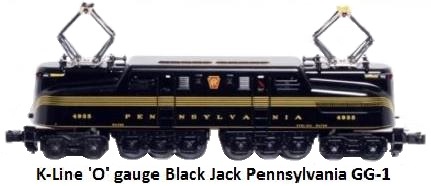 Maury's train collection began to grow, and by 1974 he was repairing and selling model trains through a small
mail order business while attending classes at the University of North Carolina in Chapel Hill. The more he sold the
more he realized that there was room for his own train company in the tinplate marketplace. Soon, on a plot
of land near Chapel Hill, NC, Maury constructed a building for his mail order business. Shortly thereafter,
in 1979, with the help of his father, Mark Klein, Maury and friends began building 'O-27' and 'O' gauge track
under the name MDK K-Line.
Maury's train collection began to grow, and by 1974 he was repairing and selling model trains through a small
mail order business while attending classes at the University of North Carolina in Chapel Hill. The more he sold the
more he realized that there was room for his own train company in the tinplate marketplace. Soon, on a plot
of land near Chapel Hill, NC, Maury constructed a building for his mail order business. Shortly thereafter,
in 1979, with the help of his father, Mark Klein, Maury and friends began building 'O-27' and 'O' gauge track
under the name MDK K-Line.
 Like competitor MTH Electric Trains, MDK was a large Lionel dealer, and its
mail-order ads appeared in magazines such as Model Railroader in the late 1970's. MDK first used the
K-Line name on a line of aftermarket Lionel-compatible tubular track as well as a copy of the
A.C. Gilbert American Flyer line of two-rail 'S' gauge track which Maury Klein
acquired at Gilbert's demise.
Like competitor MTH Electric Trains, MDK was a large Lionel dealer, and its
mail-order ads appeared in magazines such as Model Railroader in the late 1970's. MDK first used the
K-Line name on a line of aftermarket Lionel-compatible tubular track as well as a copy of the
A.C. Gilbert American Flyer line of two-rail 'S' gauge track which Maury Klein
acquired at Gilbert's demise.
 Louis Marx and Company's final demise in 1978 led to MDK increasing the K-Line
product line. In 1980, MDK purchased the tooling for Marx's Plasticville-like Marxville buildings and
accessories for train sets at bankruptcy. In 1981, K-Line began turning out 'O' gauge scale buildings
as K-LineVille. In their line of K-LineVille buildings, you can find original Marx buildings as the supermarket,
police station, school, fire house, airport hangar, L-shaped farm house, ranch house, colonial house, farm and barn,
church, water tower, grade crossing, unpainted people and farm animal figures, cars and telephone poles. K-Line recast
many Marx accessories, including the operating barrel loader, operating diesel fueling station, operating switch tower
and operating crossing gate. K-Line street lamps are Marx recasts, too. K-Line was also able to recover additional Marx
tooling by scavenging through old factories and warehouses. In an oft-repeated story, Maury Klein and his plant manager, Brent
Chambers, found the molds for the Marx 1947 model #333 Pacific and #1829 4-6-2 Hudson locomotives in a
dilapidated Fisher-Price warehouse near Buffalo, New York in 1984. The warehouse was unlighted, unheated,
and was missing part of its roof. Snow was actually coming through the hole in the roof, as they scavenged
the molds. K-Line's original version of the S2 switcher and RDC BUDD car were based on recast Marx body shells.
Louis Marx and Company's final demise in 1978 led to MDK increasing the K-Line
product line. In 1980, MDK purchased the tooling for Marx's Plasticville-like Marxville buildings and
accessories for train sets at bankruptcy. In 1981, K-Line began turning out 'O' gauge scale buildings
as K-LineVille. In their line of K-LineVille buildings, you can find original Marx buildings as the supermarket,
police station, school, fire house, airport hangar, L-shaped farm house, ranch house, colonial house, farm and barn,
church, water tower, grade crossing, unpainted people and farm animal figures, cars and telephone poles. K-Line recast
many Marx accessories, including the operating barrel loader, operating diesel fueling station, operating switch tower
and operating crossing gate. K-Line street lamps are Marx recasts, too. K-Line was also able to recover additional Marx
tooling by scavenging through old factories and warehouses. In an oft-repeated story, Maury Klein and his plant manager, Brent
Chambers, found the molds for the Marx 1947 model #333 Pacific and #1829 4-6-2 Hudson locomotives in a
dilapidated Fisher-Price warehouse near Buffalo, New York in 1984. The warehouse was unlighted, unheated,
and was missing part of its roof. Snow was actually coming through the hole in the roof, as they scavenged
the molds. K-Line's original version of the S2 switcher and RDC BUDD car were based on recast Marx body shells.
 The next acquisition was a collection of Kusan rolling stock dies. Kusan
Model Trains (KMT) Corporation built 'O' gauge plastic toy trains using dies made by
Auburn Model Trains (American Model Trains in an earlier life).
In 1961, KMT bailed from toy train manufacturing and the dies were snapped up by Andy Kriswalus
for his Kris Model Trains Company. Kris sank in the early 1980's, however, and Jerry Williams bought
many of the dies for his Williams Reproductions. Williams used some of the
molds for his own models before selling them to MDK K-Line in 1986.
By 1986, K-Line was producing O27 locomotives, cars, and figures from former Marx and
Kusan tooling, and, with minor changes, began marketing them under the K-Line
brand, competing with Lionel at the low end of the market. The dies mostly remained unchanged, with
only the branding changing--for example, "Marxville" plastic buildings became "K-LineVille". K-Line
changed the couplers on the Marx-derived trains to make the cars compatible with Lionel,
and, eventually, improved the graphics.
The next acquisition was a collection of Kusan rolling stock dies. Kusan
Model Trains (KMT) Corporation built 'O' gauge plastic toy trains using dies made by
Auburn Model Trains (American Model Trains in an earlier life).
In 1961, KMT bailed from toy train manufacturing and the dies were snapped up by Andy Kriswalus
for his Kris Model Trains Company. Kris sank in the early 1980's, however, and Jerry Williams bought
many of the dies for his Williams Reproductions. Williams used some of the
molds for his own models before selling them to MDK K-Line in 1986.
By 1986, K-Line was producing O27 locomotives, cars, and figures from former Marx and
Kusan tooling, and, with minor changes, began marketing them under the K-Line
brand, competing with Lionel at the low end of the market. The dies mostly remained unchanged, with
only the branding changing--for example, "Marxville" plastic buildings became "K-LineVille". K-Line
changed the couplers on the Marx-derived trains to make the cars compatible with Lionel,
and, eventually, improved the graphics.
 K-Line's 1986 catalog featured track, buildings and rolling stock at very affordable prices.
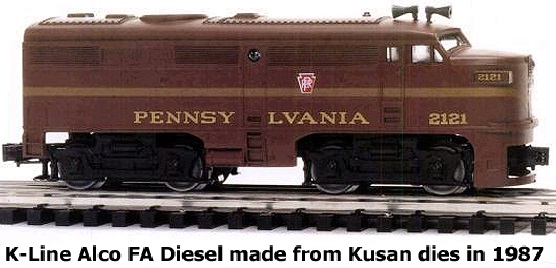
Meanwhile, two KMT diesel locomotive molds for an Alco FA-12 and an MP-15, were being reworked and updated
by K-Line's research and development team.
K-Line's 1986 catalog featured track, buildings and rolling stock at very affordable prices.
Meanwhile, two KMT diesel locomotive molds for an Alco FA-12 and an MP-15, were being reworked and updated
by K-Line's research and development team.
 During the 1980's, K-Line filled much the same role that Marx had in the model
railroading arena,
supplying similar trains at a lower price than Lionel, but with less prestige. Because K-Line's budget
offerings remained almost unchanged from the old Marx designs, Marx collectors
would sometimes source spare parts from K-Line.
During the 1980's, K-Line filled much the same role that Marx had in the model
railroading arena,
supplying similar trains at a lower price than Lionel, but with less prestige. Because K-Line's budget
offerings remained almost unchanged from the old Marx designs, Marx collectors
would sometimes source spare parts from K-Line.
Maury Klein's 1987 catalog opened to reveal
train sets, track, and accessories that threatened to
catapault the company into the industry's upper echelon, alongside Lionel, Williams, MTH, and
Weaver. But while Klein offered quality products at low prices, he was a
step away from the premium grade models of the competition. K-Line continued to inch forward. One 1987 item that aided greatly in that effort
was the brand new MK-15 'O' gauge diesel switcher that was powered by dual Mabuchi DC can motors mounted in the trucks. It was an
outstanding product. It was available in New York Central's green or black, Chessie, Santa Fe blue and yellow,
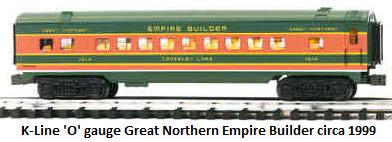
 Great Northern, CSX, Norfolk Southern, and Southern Pacific paint schemes. 1989 saw the release of heavyweight passenger cars,
SP Overnight Classic box cars in 4 pack sets, and a B&O Budd RDC 3-car set. The Budd cars were made from original Marx tooling.
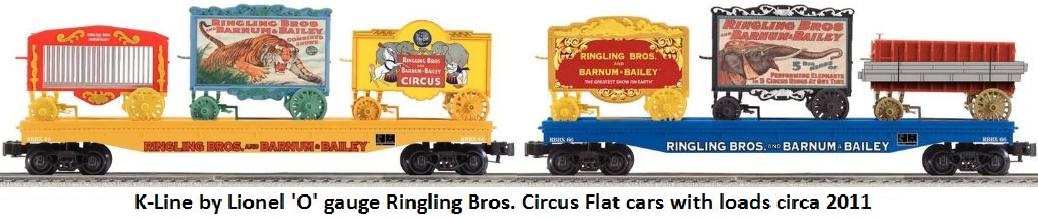
The 1993 K-Line catalog was 68 pages and touted the very colorful Circus Train with Ringling Bros. and Barnum & Bailey markings
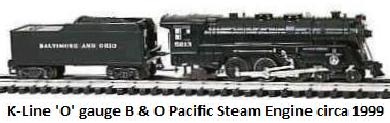
on the tender and all cars. The set was headed by a blue and red 4-6-2 steam loco with whistling tender. By 1995
K-Line had upgraded the original Kusan dies to produce an Alco ABA version of the MKT Texas Special
with considerable detail added. The company continued to produce a series of complete ready to run train sets headed by
the Alco engine, and decorated in several other road names, pulling new highly detailed plastic injection molded streamlined
passenger cars. Licensing deals were made with several major corporations such as Hershey's and Coca-Cola resulting in sets being issued in the
highly recognizable color schemes and branding from these companies.
Great Northern, CSX, Norfolk Southern, and Southern Pacific paint schemes. 1989 saw the release of heavyweight passenger cars,
SP Overnight Classic box cars in 4 pack sets, and a B&O Budd RDC 3-car set. The Budd cars were made from original Marx tooling.
The 1993 K-Line catalog was 68 pages and touted the very colorful Circus Train with Ringling Bros. and Barnum & Bailey markings
on the tender and all cars. The set was headed by a blue and red 4-6-2 steam loco with whistling tender. By 1995
K-Line had upgraded the original Kusan dies to produce an Alco ABA version of the MKT Texas Special
with considerable detail added. The company continued to produce a series of complete ready to run train sets headed by
the Alco engine, and decorated in several other road names, pulling new highly detailed plastic injection molded streamlined
passenger cars. Licensing deals were made with several major corporations such as Hershey's and Coca-Cola resulting in sets being issued in the
highly recognizable color schemes and branding from these companies.
 In the 1990's, K-Line was able to purchase more
disused tooling from other manufacturers, and to develop some of their own new tooling, allowing
the company to offer full-size 'O' gauge for the first time, which it supplemented with pricier 'O' gauge
locomotives and rolling stock of its own design, shifting its emphasis away from its budget offerings.
The first edition of the K-Line 1999 catalog announced the introduction of a series of new extruded aluminum passenger
cars available in 15", 18" and 21" lengths. The cars were made in a variety of liveries identifying
most major railroads such as Pennsylvania, Canadian Pacific, Lackawanna, and NYC. In 2001 K-Line produced their 'O' gauge
version of the Southern Pacific GS-4 Daylight steam locomotive. The model was well received by hobbyists, and featured
sophisticated electronics combined with a permanent magnet DC motor, rubber traction tires, and improvements
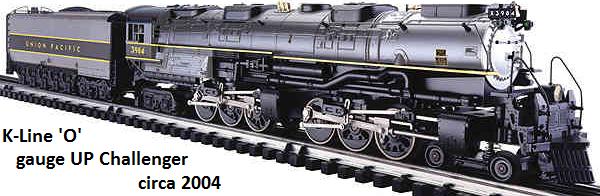
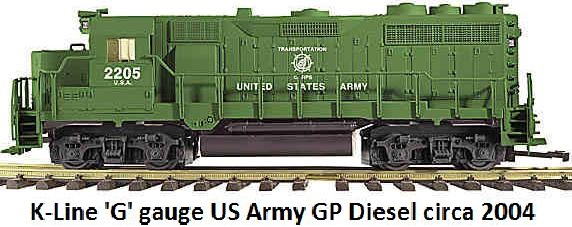
in die-casting techniques. In 2004 K-Line released their detailed 1:48 scale die-cast Mikado 2-8-2 steam locomotive.
In the 1990's, K-Line was able to purchase more
disused tooling from other manufacturers, and to develop some of their own new tooling, allowing
the company to offer full-size 'O' gauge for the first time, which it supplemented with pricier 'O' gauge
locomotives and rolling stock of its own design, shifting its emphasis away from its budget offerings.
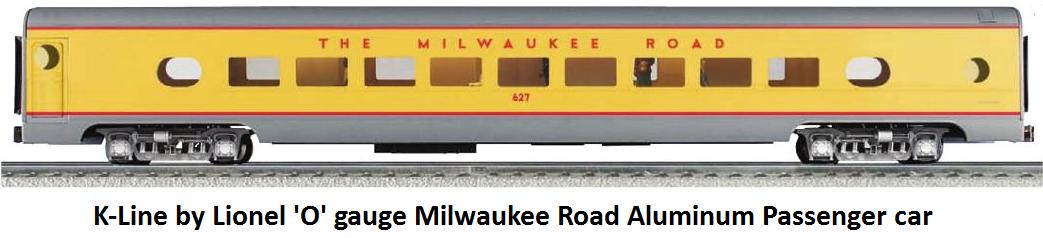
The first edition of the K-Line 1999 catalog announced the introduction of a series of new extruded aluminum passenger
cars available in 15", 18" and 21" lengths. The cars were made in a variety of liveries identifying
most major railroads such as Pennsylvania, Canadian Pacific, Lackawanna, and NYC. In 2001 K-Line produced their 'O' gauge
version of the Southern Pacific GS-4 Daylight steam locomotive. The model was well received by hobbyists, and featured
sophisticated electronics combined with a permanent magnet DC motor, rubber traction tires, and improvements
in die-casting techniques. In 2004 K-Line released their detailed 1:48 scale die-cast Mikado 2-8-2 steam locomotive.
 K-Line's 'S' gauge offerings were a later entry, providing budget-priced cars as well as the
already produced track compatible with American Flyer-brand trains. Unlike its line of 'O' gauge products,
K-Line's marketing on its 'S' gauge cars centered its price advantage over the competition. Most of the 'S'
gauge products were made from old Marx O27 molds, with 'S' gauge trucks replacing the 'O' trucks. The K-Line 'S' gauge
repurposed Marx box car was a near perfect fit for the prototype dimensional standards of mid-195O's and later railroading.
The K-line 'S' gauge repurposed Marx 3-dome tank car was less prototypical, but acceptable. These cars were far
more prototypical than the stamped metal cars A. C. Gilbert produced in 1953 and 1954 for its most inexpensive American Flyer sets. The
freight car's $20.00 price tag included sprung metal trucks and operating knuckle couplers.
K-Line's 'S' gauge offerings were a later entry, providing budget-priced cars as well as the
already produced track compatible with American Flyer-brand trains. Unlike its line of 'O' gauge products,
K-Line's marketing on its 'S' gauge cars centered its price advantage over the competition. Most of the 'S'
gauge products were made from old Marx O27 molds, with 'S' gauge trucks replacing the 'O' trucks. The K-Line 'S' gauge
repurposed Marx box car was a near perfect fit for the prototype dimensional standards of mid-195O's and later railroading.
The K-line 'S' gauge repurposed Marx 3-dome tank car was less prototypical, but acceptable. These cars were far
more prototypical than the stamped metal cars A. C. Gilbert produced in 1953 and 1954 for its most inexpensive American Flyer sets. The
freight car's $20.00 price tag included sprung metal trucks and operating knuckle couplers.


In order to compete in a marketplace dominated by the likes of Lionel and MTH, K-Line began to offer
its more expensive engines at a loss. They also hired a former Lionel engineer to help them innovate and develop products that incorporated
new technologies. K-Line and Lionel were known to criticize one another's offerings in print
advertisements, and the two companies challenged one another in court as well. Lionel discovered someone in K-Line's employ
had knowledge of Lionel trade secrets based on the CW-80 Transformer and others dealing with Cruise Control for Toy Trains.
The two companies settled a lawsuit on August 10, 2005
with K-Line agreeing to withdraw infringing products by January 31, 2006 and paying a royalty to
Lionel in the interim. K-Line also licensed some of its technology to Lionel, and reimbursed $700,000
 of legal costs. Shortly thereafter the settlement fell apart and on August 23, 2005, MDK filed for
Chapter 11 bankruptcy protection. On October 27, K-Line and Lionel reached a new settlement, including
a permanent injunction against manufacturing products containing the disputed technology, a $2 million
damage claim in its bankruptcy case, and royalty-free access to several K-Line patents.
of legal costs. Shortly thereafter the settlement fell apart and on August 23, 2005, MDK filed for
Chapter 11 bankruptcy protection. On October 27, K-Line and Lionel reached a new settlement, including
a permanent injunction against manufacturing products containing the disputed technology, a $2 million
damage claim in its bankruptcy case, and royalty-free access to several K-Line patents.
K-Line's 2005 bankruptcy petition stated that its annual sales were between
$7 and $8 million.
 Over the next few months, K-Line's operations slowed and there were numerous layoffs and rumors
of potential purchasers, which were highly publicized among hobbyists. On February 16, 2006, Lionel
announced it had purchased K-Line. Since Lionel was also in bankruptcy, the deal, which actually
involved the purchase of K-Line by Sanda Kan, its Chinese subcontractor, followed by Sanda Kan's
licensing of the trademarks and intellectual property to Lionel, took several weeks to become final.
The deal was finalized on April 18, 2006, and Lionel made the announcement the following day. K-Line was
now owned by Sanda Kan, the Chinese toy manufacturer that formerly
acted as K-Line's subcontractor. Sanda Kan licensed the use of the K-Line brand and intellectual
property to Lionel Trains LLC.
Over the next few months, K-Line's operations slowed and there were numerous layoffs and rumors
of potential purchasers, which were highly publicized among hobbyists. On February 16, 2006, Lionel
announced it had purchased K-Line. Since Lionel was also in bankruptcy, the deal, which actually
involved the purchase of K-Line by Sanda Kan, its Chinese subcontractor, followed by Sanda Kan's
licensing of the trademarks and intellectual property to Lionel, took several weeks to become final.
The deal was finalized on April 18, 2006, and Lionel made the announcement the following day. K-Line was
now owned by Sanda Kan, the Chinese toy manufacturer that formerly
acted as K-Line's subcontractor. Sanda Kan licensed the use of the K-Line brand and intellectual
property to Lionel Trains LLC.
 Prior to the 2005 legal action, the relationship between Lionel and K-Line had generally been
more amicable than Lionel's relationship with MTH. Lionel had licensed TMCC to K-Line, and K-Line
produced a number of repair manuals for postwar-era Lionel. K-Line had also produced commemorative
cars celebrating some of Lionel's significant anniversaries, which has sometimes caused confusion
among collectors.
Prior to the 2005 legal action, the relationship between Lionel and K-Line had generally been
more amicable than Lionel's relationship with MTH. Lionel had licensed TMCC to K-Line, and K-Line
produced a number of repair manuals for postwar-era Lionel. K-Line had also produced commemorative
cars celebrating some of Lionel's significant anniversaries, which has sometimes caused confusion
among collectors.
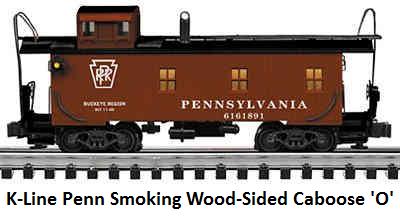 From 2006 to 2010 Lionel continued a limited run of K-Line trains called
K-Line by Lionel. This was done primarily to sell leftover acquired inventory. They also issued separate K-Line by Lionel catalogs until 2010.
Missing were the extravagant passenger trains which had competed directly with Lionel's
premium products. In a twist of fate, in the K-Line acquisition, Lionel gained possession of the rights to produce American Flyer
track, which until then was missing from its American Flyer train line. When the Lionel license expired, Sandra Kan
sold the K-Line dies to several other companies, with some going to each of Atlas,
Williams by Bachmann, and Ready Made Toys (RMT).
K-Line dies, tooling and molds that were acquired by Ready Made Toys (RMT) continued to be utilized for marketing new products with new road
names never utilized by K-Line, under the RMT banner. RMT had K-Line Super Snap track and some freight hoppers. They also had use of the 13.5"
plastic passenger car molds. Some of the longer car molds were altered in order to produce the RMT 'Peeps'. RMT also utilized modified K-Line
molds to create the BEEF F-3 diesels. Bachmann/Williams received some of the scale K-Line diesels (RS3 and GP-35) as well as Super Street
track, which was rebranded as E-Z Streets. For a brief time there was a company called O-Line Reproductions that was offering products
made from K-Line tooling. This included Super Snap track, switches, cross tracks as well as relatively inexpensive accessories and freight
cars. It is beleived that these products were actually contracted by RMT to be produced overseas, however, they did not take actual delivery
due to cash flow issues. Heartland Hobby Wholesale, a distributor of model train products, purchased the undelivered orders and offered them
under the O-Line Reproductions branding.
From 2006 to 2010 Lionel continued a limited run of K-Line trains called
K-Line by Lionel. This was done primarily to sell leftover acquired inventory. They also issued separate K-Line by Lionel catalogs until 2010.
Missing were the extravagant passenger trains which had competed directly with Lionel's
premium products. In a twist of fate, in the K-Line acquisition, Lionel gained possession of the rights to produce American Flyer
track, which until then was missing from its American Flyer train line. When the Lionel license expired, Sandra Kan
sold the K-Line dies to several other companies, with some going to each of Atlas,
Williams by Bachmann, and Ready Made Toys (RMT).
K-Line dies, tooling and molds that were acquired by Ready Made Toys (RMT) continued to be utilized for marketing new products with new road
names never utilized by K-Line, under the RMT banner. RMT had K-Line Super Snap track and some freight hoppers. They also had use of the 13.5"
plastic passenger car molds. Some of the longer car molds were altered in order to produce the RMT 'Peeps'. RMT also utilized modified K-Line
molds to create the BEEF F-3 diesels. Bachmann/Williams received some of the scale K-Line diesels (RS3 and GP-35) as well as Super Street
track, which was rebranded as E-Z Streets. For a brief time there was a company called O-Line Reproductions that was offering products
made from K-Line tooling. This included Super Snap track, switches, cross tracks as well as relatively inexpensive accessories and freight
cars. It is beleived that these products were actually contracted by RMT to be produced overseas, however, they did not take actual delivery
due to cash flow issues. Heartland Hobby Wholesale, a distributor of model train products, purchased the undelivered orders and offered them
under the O-Line Reproductions branding.
Many 'O' gauge train operators considered K-Line's 1:48 scale
heavyweight passenger cars and 21" extruded aluminum passenger cars to be highly collectable, and the K-Line licensed Ringling Bros. Circus
cars are prized by 3-rail model railroad collectors and operators world wide. Since K-Line trains are no longer produced, their collectability
has increased substantially. After the K-Line bankruptcy and the $3.8 million dollar debt K-Line left Sanda Kan holding, the rules changed where
all products had to be paid for in full before shipping to the US. Actually before the end of the original K-Line company, K-Line could no
longer get new products shipped to them without them being paid in full. Which is why some of the last cataloged K-Line products are the hardest
to find: The ones actually made were made in very small quantities. K-Line trains are still being bought and sold and are fairly easy to find,
many still in unopened original packaging, in Hobby Stores, at Toy Train Swap meets, and on the Internet.


Link to Legacy K-Line Trains Web Site where you can find an
on-line catalog of products made between 1999-2005.