 AMT was formally established in 1948 in Fort Wayne, Indiana by tool and die maker Jack Ferris. The company
is famous for producing a large line of the most realistic 'O' gauge streamlined passenger cars made during
the immediate postwar era. AMT also created and marketed a line of highly detailed near-scale models of
eye-catching box cars that were decorated with authentic road names and paint schemes. The company was perhaps one of
the most overlooked train makers of the late 1940's and early 1950's. Its legacy, however, ties into virtually
every major producer of 'O' gauge trains in business today. While almost everyone has heard of manufacturers
from this era such as American Flyer, Lionel, and
Marx, American Model Toys was a fourth maker of toy trains in the late 1940's and early
1950's that while much smaller and unknown, was very innovative, and built quality products.
AMT was formally established in 1948 in Fort Wayne, Indiana by tool and die maker Jack Ferris. The company
is famous for producing a large line of the most realistic 'O' gauge streamlined passenger cars made during
the immediate postwar era. AMT also created and marketed a line of highly detailed near-scale models of
eye-catching box cars that were decorated with authentic road names and paint schemes. The company was perhaps one of
the most overlooked train makers of the late 1940's and early 1950's. Its legacy, however, ties into virtually
every major producer of 'O' gauge trains in business today. While almost everyone has heard of manufacturers
from this era such as American Flyer, Lionel, and
Marx, American Model Toys was a fourth maker of toy trains in the late 1940's and early
1950's that while much smaller and unknown, was very innovative, and built quality products.
 Jack Ferris cut his teeth in model railroading early on. He started Scale
Model Railways in 1929, a company dedicated to ¼" to the foot scale. They sold kits and
custom-built models. In 1940, the company was purchased by the Megow Corporation, a company that
created kits for airplanes and ships. Then Jack changed careers and became the
head of a plastic-rubber research group of a large rubber company, but he took up tinplate as a hobby.
Jack Ferris cut his teeth in model railroading early on. He started Scale
Model Railways in 1929, a company dedicated to ¼" to the foot scale. They sold kits and
custom-built models. In 1940, the company was purchased by the Megow Corporation, a company that
created kits for airplanes and ships. Then Jack changed careers and became the
head of a plastic-rubber research group of a large rubber company, but he took up tinplate as a hobby.
 Tinplate railroading was a great way for Jack to bond with his son, Jack Jr., and they built
a huge home layout together. One day Jack Jr. asked his dad why there were no streamlined model
train passenger cars made like the real ones that ran on the prototypical railroads of the era.
During the post WWII era, railroads were desperate to retain passenger traffic so they updated their
fleets with gleaming streamlined coaches, diners, and observation cars. Jack Sr. decided he would
manufacture models of this equipment to fill the niche. Little did Jack
know that the resulting series of 'O' gauge streamliner cars would become very popular with hobbyists
in a short period of time, and bring Jack back into the toy train manufacturing business.
Tinplate railroading was a great way for Jack to bond with his son, Jack Jr., and they built
a huge home layout together. One day Jack Jr. asked his dad why there were no streamlined model
train passenger cars made like the real ones that ran on the prototypical railroads of the era.
During the post WWII era, railroads were desperate to retain passenger traffic so they updated their
fleets with gleaming streamlined coaches, diners, and observation cars. Jack Sr. decided he would
manufacture models of this equipment to fill the niche. Little did Jack
know that the resulting series of 'O' gauge streamliner cars would become very popular with hobbyists
in a short period of time, and bring Jack back into the toy train manufacturing business.
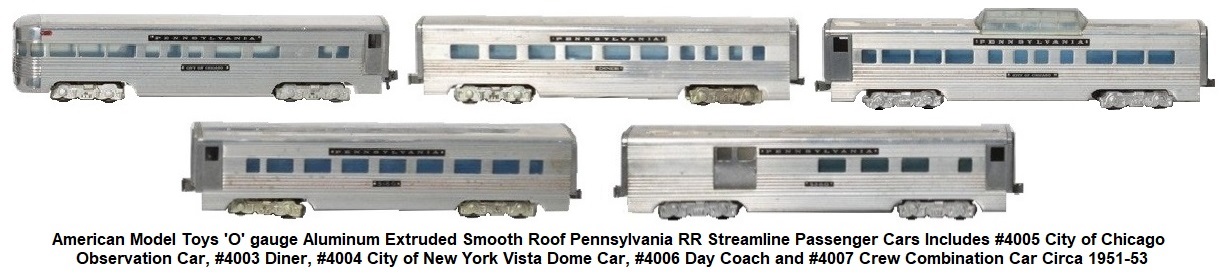
AMT offered nine different cataloged versions of the Santa Fe passenger cars with
smooth roofs.
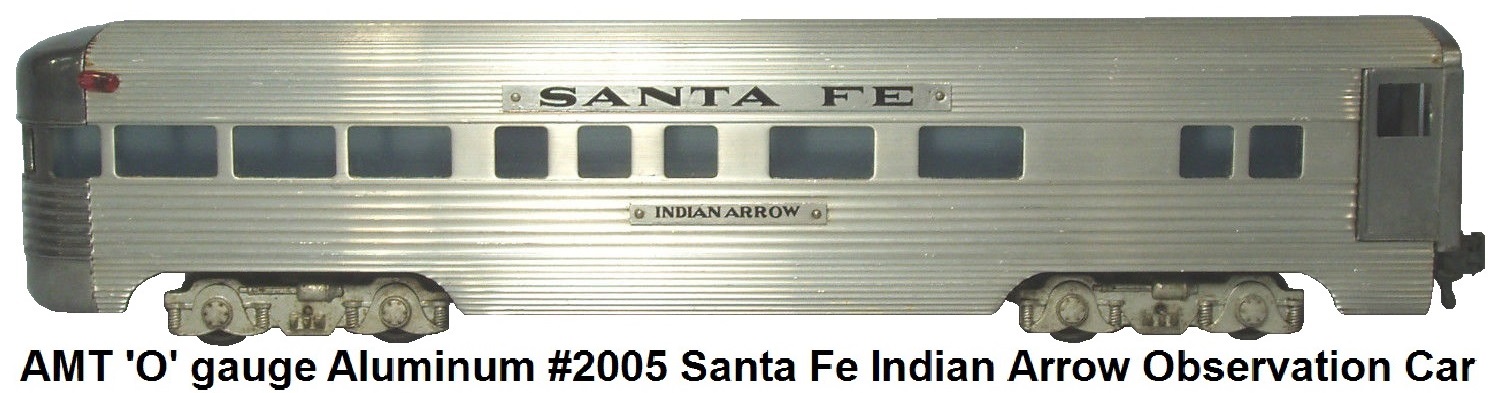
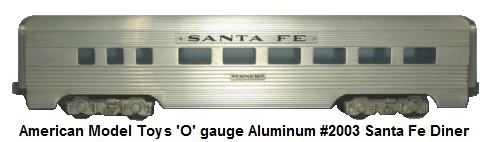
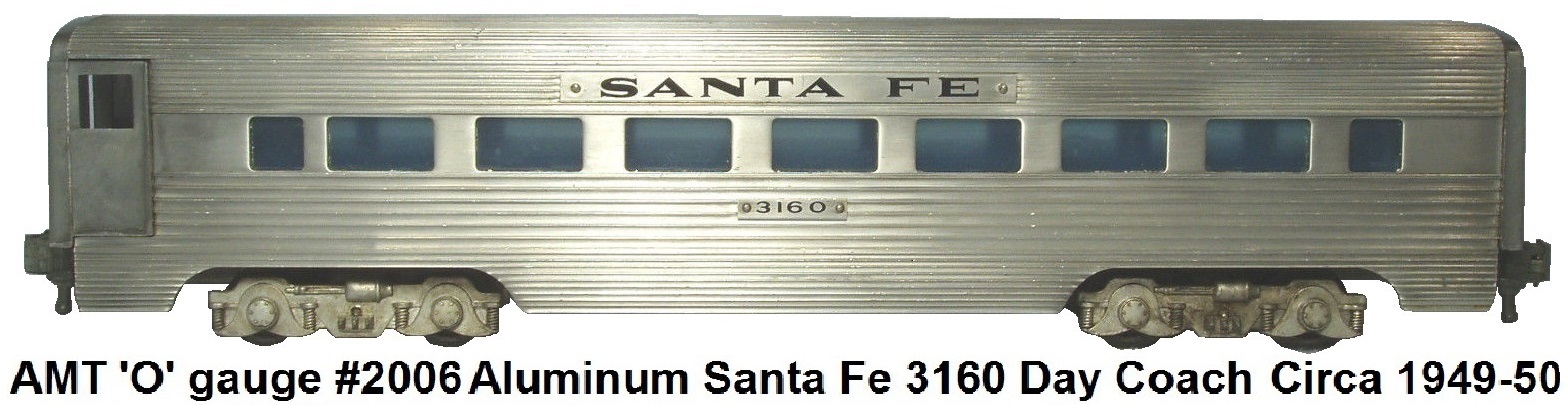
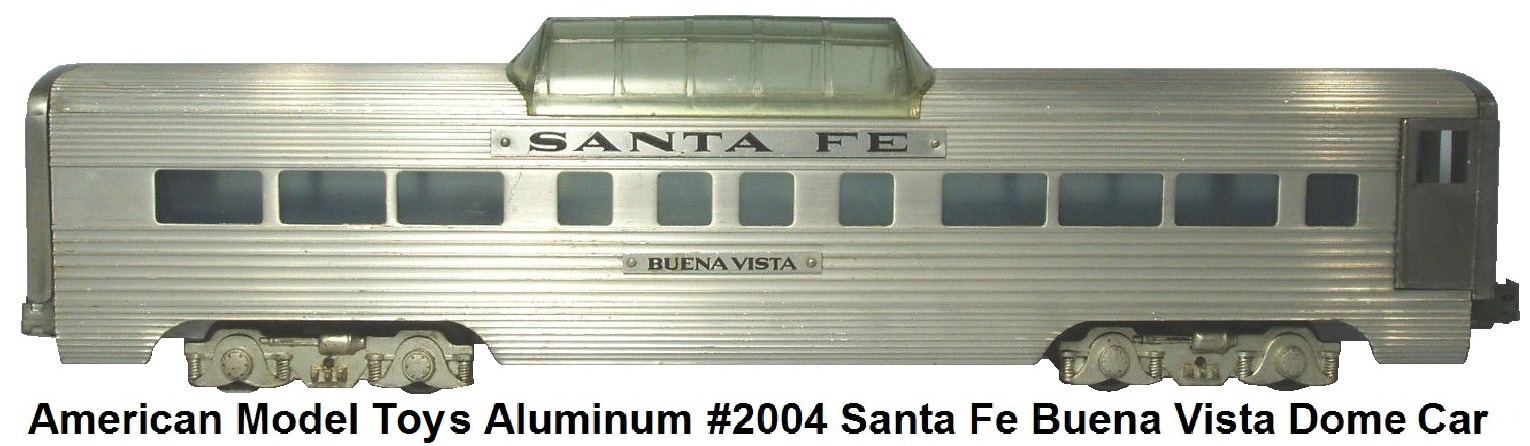
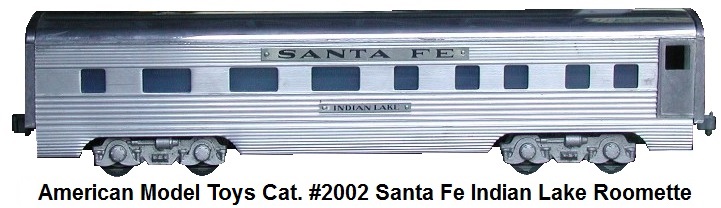

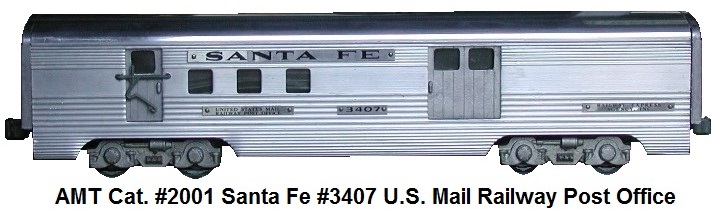
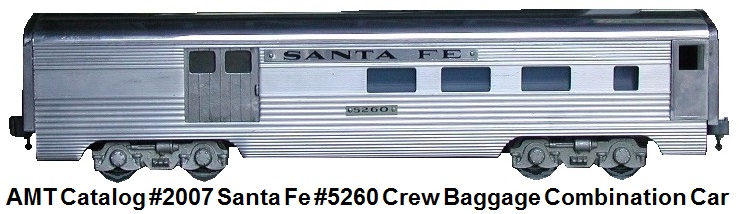
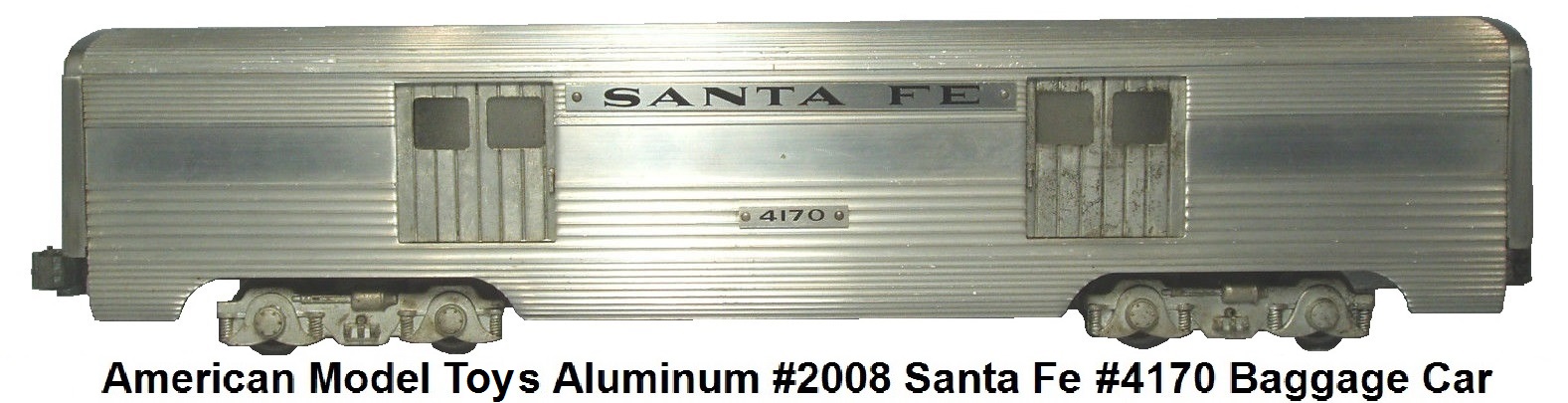
The first offerings were sand-cast passenger cars in New York Central and Pennsylvania liveries.
Initially selling its products to other companies, Ferris decided to create his own company in 1948. The
next year a set of these passenger cars was produced using extruded aluminum. The design change came as a
suggestion by Carter Collier, who was in charge of design work for AMT. The switch to aluminum facilitated
a mechanism to build greater quantities of a more realistic model, for less cost. These shiny cars could
negotiate Lionel track and switches. The design consisted of a single solid piece of extruded
aluminum that formed the
fluted sides and smooth roof of each car. The ends were cast in aluminum as well. They came complete with
interior lighting, realistic trucks with knuckle couplers and detailed window patterns that matched the prototypes.
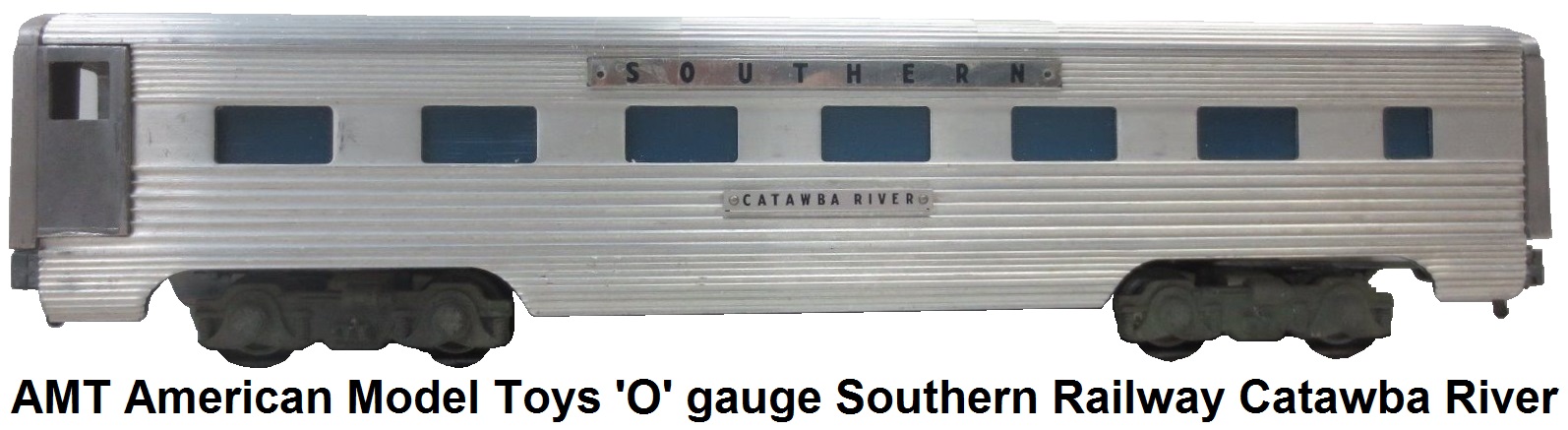
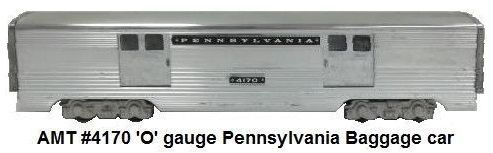
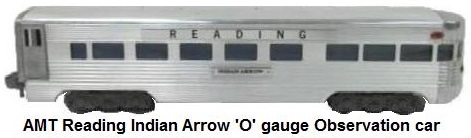
AMT eventually began producing their famous steamlined extruded aluminum passenger cars, with fluted
and smooth roof variations. The AMT passenger cars were available in a variety of body styles,
and company liveries, the initial four, in 1949-50, being Baggage, Combine, Coach and Observation,
each available in New York Central and Santa Fe paint schemes. Later, a Mail Express car,
Vista Dome car, Dining car and Bedroom Roomette were added to the line. Car names were taken from
actual prototype streamliners. Prices on these cars started at $10.50. Road names for the Baltimore & Ohio,
Chicago & North Western, Pennsylvania, Reading, Southern and
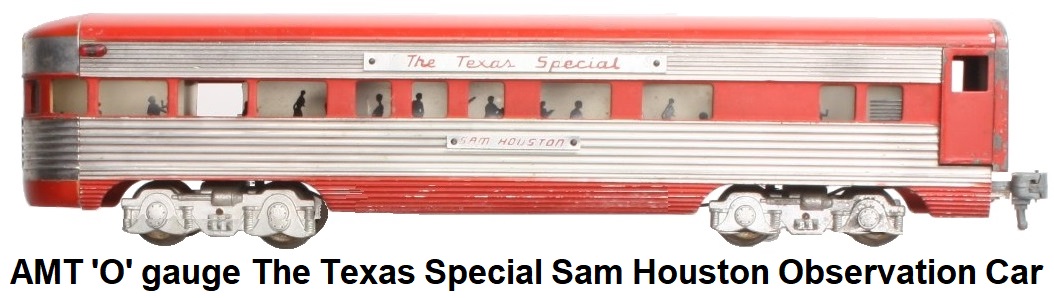
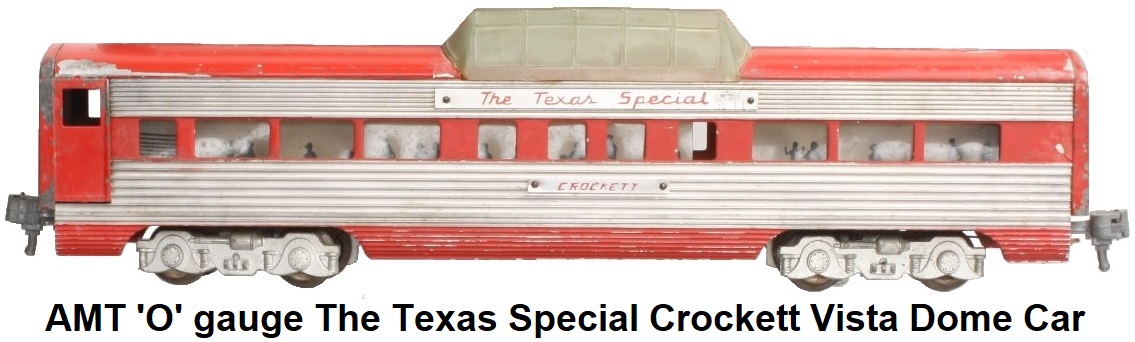
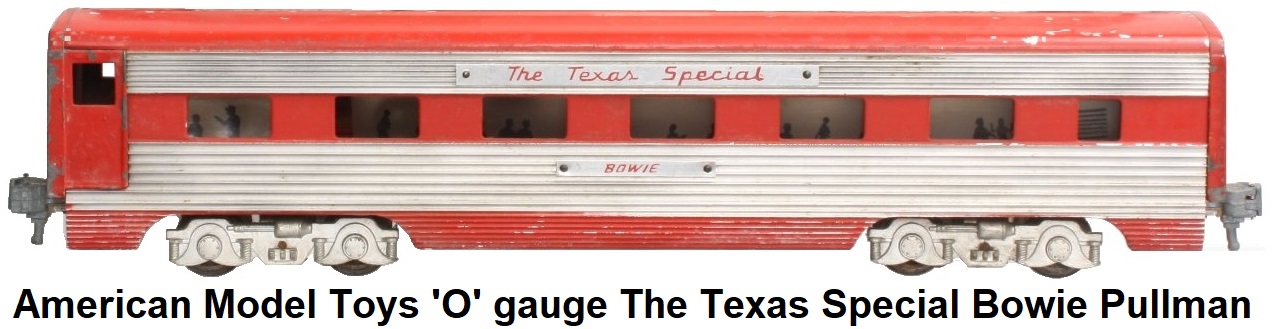
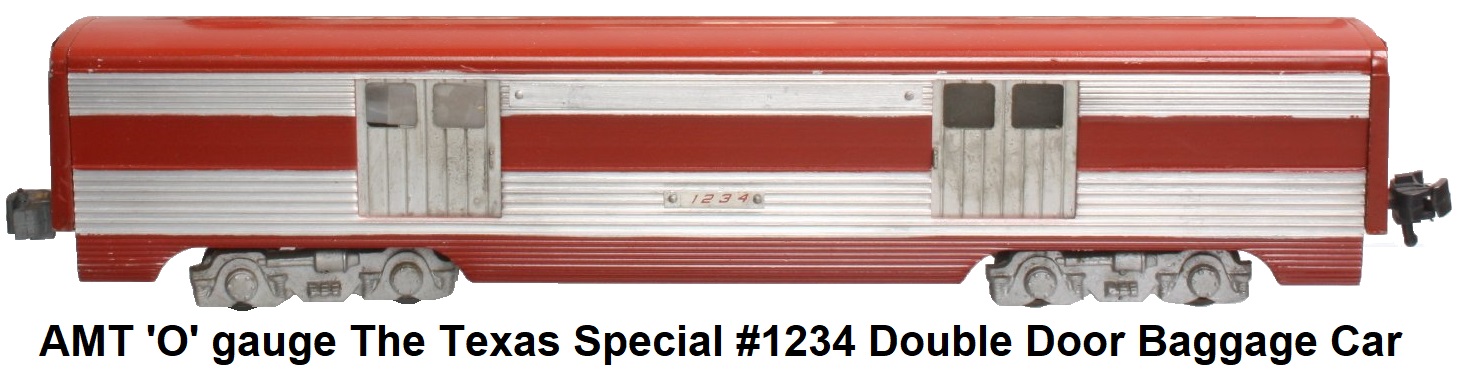
The MKT Texas Special were added. These passenger cars measure about 14" from end to end.
AMT tended to take more risks than Lionel,
and its cars were slightly larger, slightly closer to scale, and well-made. Their realism and style was
unmatched by anything Lionel produced for several years.
AMT New York Central Extruded Aluminum 'O' gauge Streamlined Passenger Cars
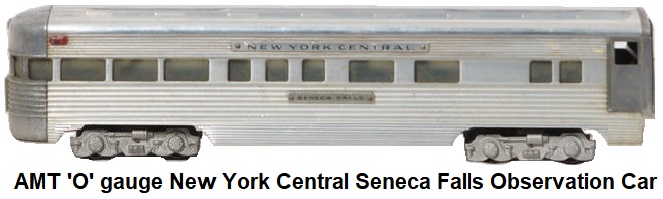
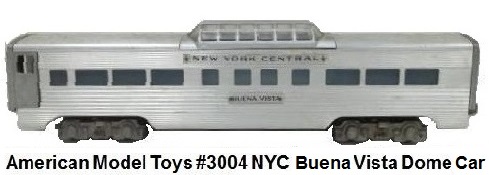
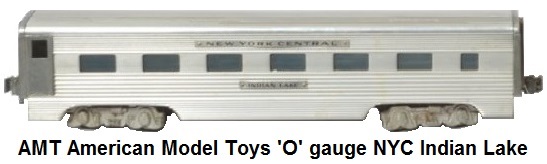
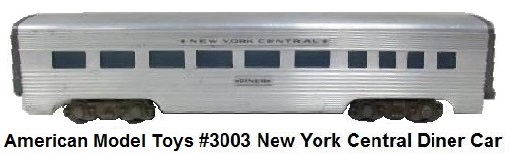
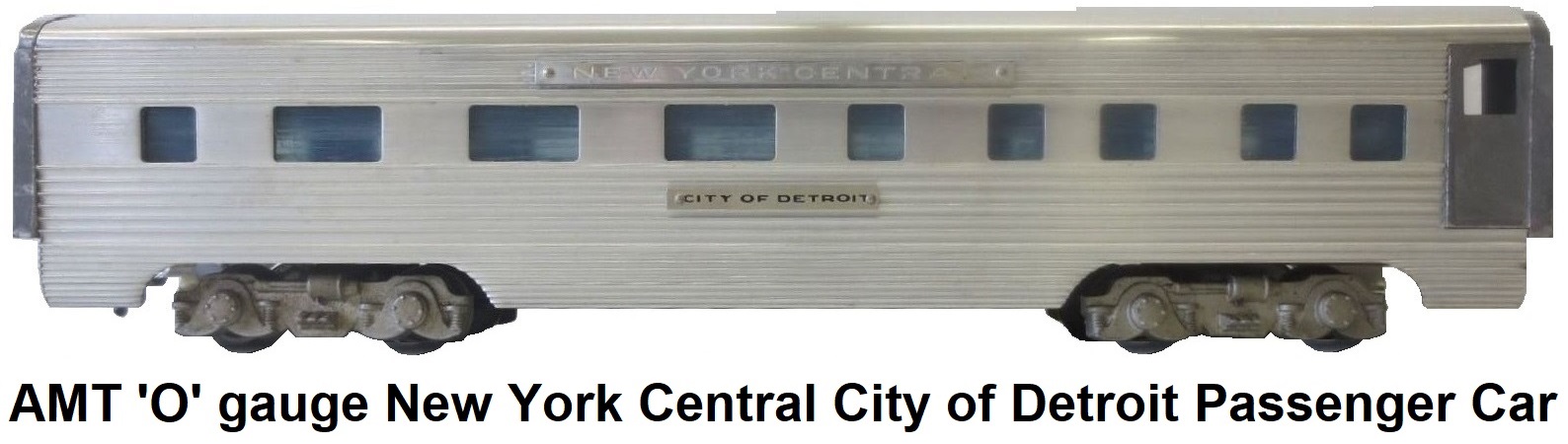
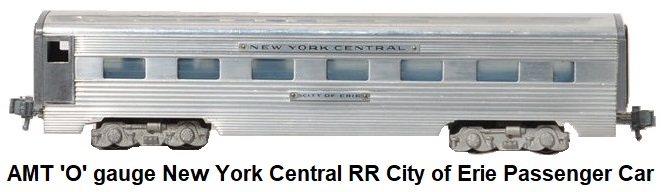
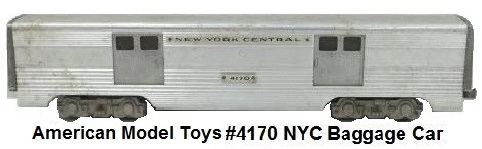
AMT MKT 'The Texas Special' Extruded Aluminum 'O' gauge Passenger Cars
AMT experienced a minor setback in 1950 when the US government placed restrictions on the
use of aluminum as a result of the Korean War effort. The company altered its manufacturing materials
slightly and weathered the storm successfully.
However, eventually Lionel caught up, releasing their first 'O' gauge #2500 series extruded aluminum
streamlined passenger equipment in 1952 and displacing AMT extruded aluminum cars as the market leader
in sales shortly there after. AMT had almost a total monopoly of the 'O' gauge Streamline passenger car market from
1950 until the public embraced the new Lionel models in 1953. AMT survived by finding other weaknesses
in Lionel's product line and
producing models that filled those weaknesses, contenting itself as an aftermarket producer who
would sell its items to Lionel's customers, and take away market share where ever possible. At this
point manufactuing was moved to new facilities in Auburn, Indiana.
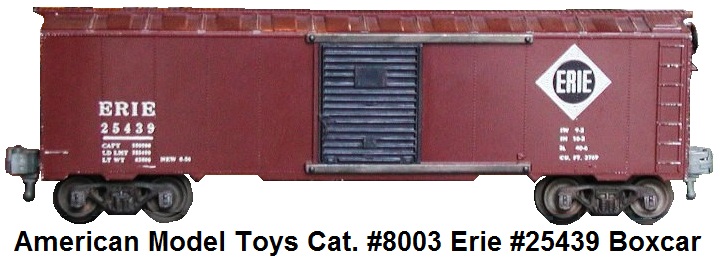
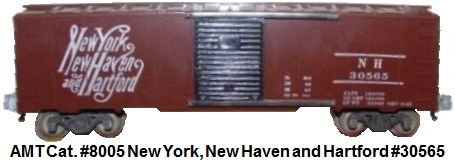
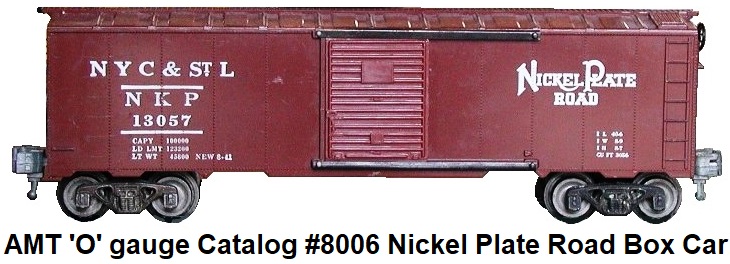
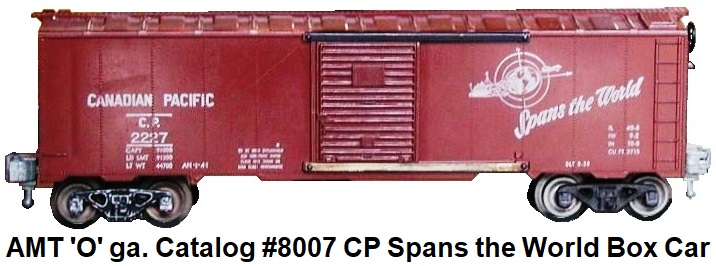
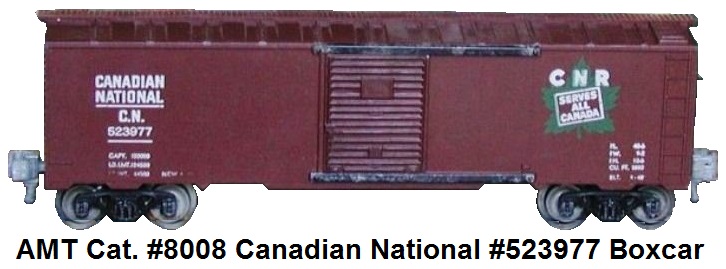
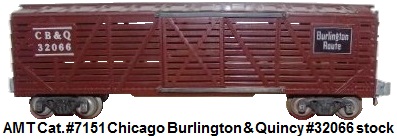
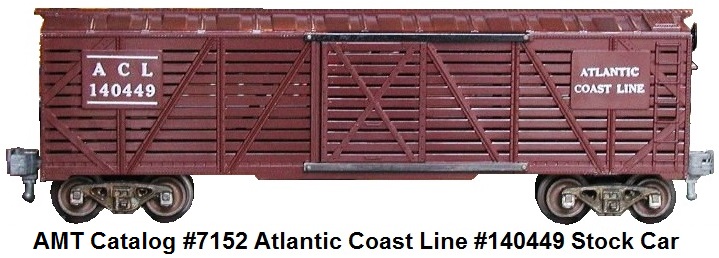
 In 1952, AMT started producing 40' box cars, stock cars and reefers in the latest,
most colorful paint schemes they could find in use by real railroads, and made them to more realistic
proportions than Lionel ever had. The new line of AMT box cars featured 12 superb models. The majority of
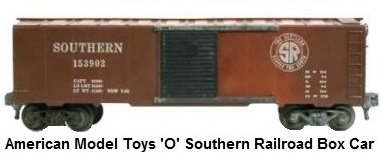
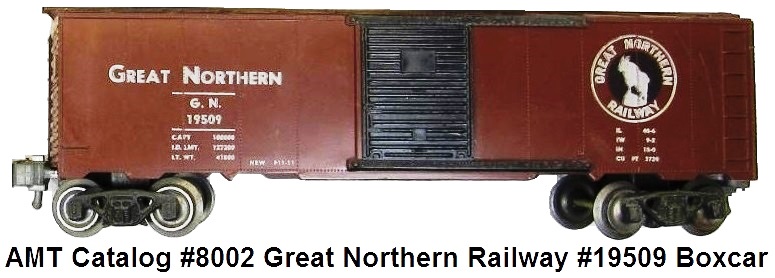
these cars were the #8000 series and were dark brown or box car red with white lettering and railroad heralds.
Each was based on an actual piece of rolling stock in use on a famous North American railroad. They represented
a notable cross-section of lines whose trains could be seen throughout the United States and Canada. They were made
of high impact styrene, a newly developed low cost plastic material that was easy to machine and fabricate, but was
tough and durable enough to withstand a child's use. The cars also came equipped with operating sliding doors,
simulated brake wheels, and patented operating 'Liftamatic' knuckle couplers. AMT marketing literature
boasted that these new freights had a low center of gravity so they would "hug the tracks just like their bigger
counterparts".
In 1952, AMT started producing 40' box cars, stock cars and reefers in the latest,
most colorful paint schemes they could find in use by real railroads, and made them to more realistic
proportions than Lionel ever had. The new line of AMT box cars featured 12 superb models. The majority of
these cars were the #8000 series and were dark brown or box car red with white lettering and railroad heralds.
Each was based on an actual piece of rolling stock in use on a famous North American railroad. They represented
a notable cross-section of lines whose trains could be seen throughout the United States and Canada. They were made
of high impact styrene, a newly developed low cost plastic material that was easy to machine and fabricate, but was
tough and durable enough to withstand a child's use. The cars also came equipped with operating sliding doors,
simulated brake wheels, and patented operating 'Liftamatic' knuckle couplers. AMT marketing literature
boasted that these new freights had a low center of gravity so they would "hug the tracks just like their bigger
counterparts".
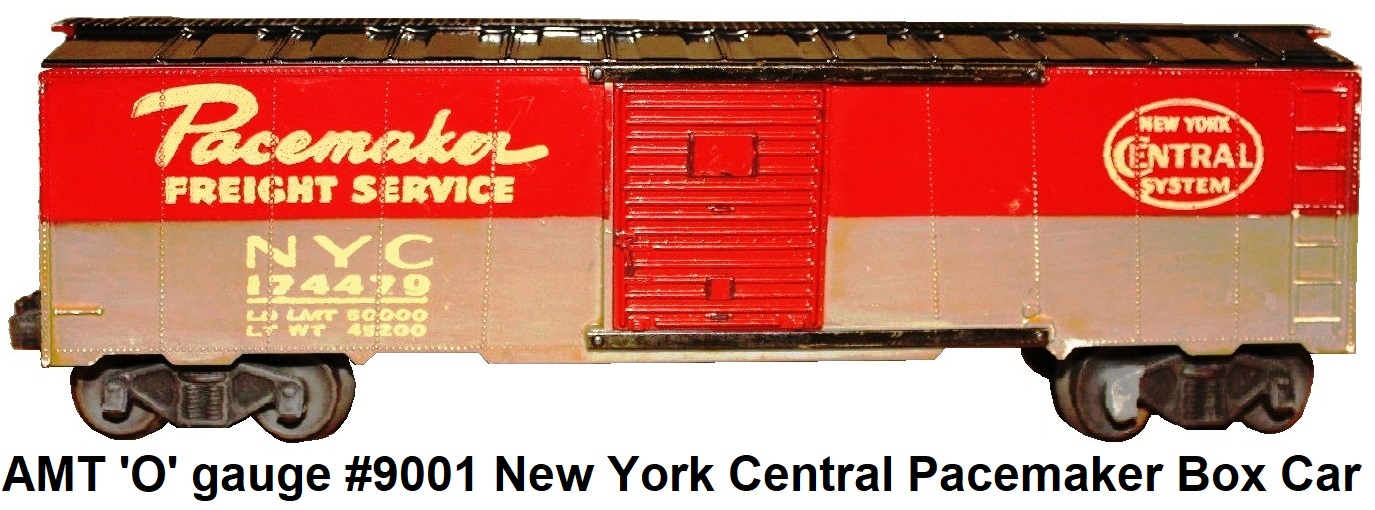
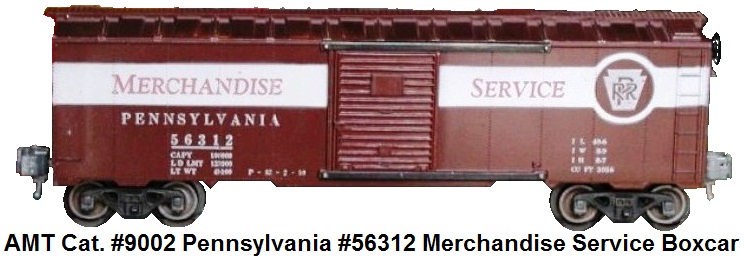
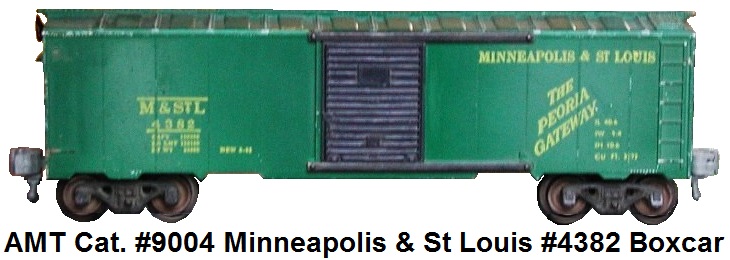
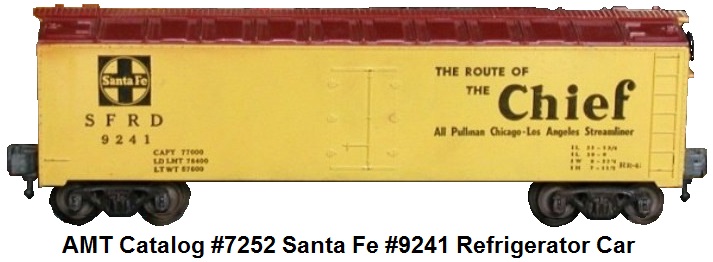 Some box cars did vary from the brown paint job. These were the #9000 Series.
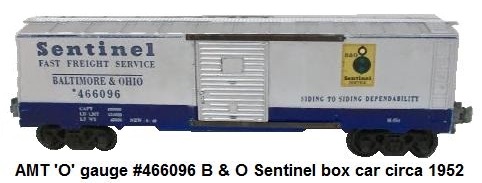
The most beautiful of these 'O' gauge models was the #9003, which came painted blue and silver for the
Baltimore & Ohio's Sentinel Service for rush shipping. An 'O' gauge refrigerator car from AMT captured the look
of the 770 cars used by the Santa Fe RR in the 1940's. The #7252 had the yellow and brown paint scheme
and accurate herald
and slogan of the prototype. Even the decaled #9241 matched one used on a particular Santa Fe reefer.
The only details left off were outlined doors with hinges that opened and roof hatches that could be opened.
Some box cars did vary from the brown paint job. These were the #9000 Series.
The most beautiful of these 'O' gauge models was the #9003, which came painted blue and silver for the
Baltimore & Ohio's Sentinel Service for rush shipping. An 'O' gauge refrigerator car from AMT captured the look
of the 770 cars used by the Santa Fe RR in the 1940's. The #7252 had the yellow and brown paint scheme
and accurate herald
and slogan of the prototype. Even the decaled #9241 matched one used on a particular Santa Fe reefer.
The only details left off were outlined doors with hinges that opened and roof hatches that could be opened.
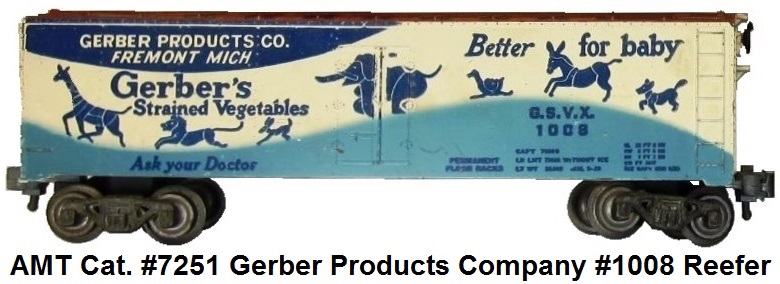 Another finely detailed and painted reefer was the #7251 Gerber Products Company model introduced in 1953.
Inspiration for this car came from AMT's design engineer Carter Collier. The reefer's prototype was a privately owned
car that ran the rails in the 1920's and 30's when billboard refrigerator cars were commonplace. Gerber Products
had owned a few of these cars that were decorated with joyful graphics displaying whimsical animals marching over
a blue hill.
Another finely detailed and painted reefer was the #7251 Gerber Products Company model introduced in 1953.
Inspiration for this car came from AMT's design engineer Carter Collier. The reefer's prototype was a privately owned
car that ran the rails in the 1920's and 30's when billboard refrigerator cars were commonplace. Gerber Products
had owned a few of these cars that were decorated with joyful graphics displaying whimsical animals marching over
a blue hill.
AMT 'O' gauge #8000 Series 40' Box Cars

AMT 'O' gauge #9000 Series 40' Box Cars
These box cars, stock cars and reefers were an immediate success with tinplate collectors
all over the US. The next year, Lionel responded with the first of its famous 6464 series box cars, which were
better than anything it had produced before, but still did not match AMT's realism. While AMT had beaten
Lionel to the box car market with this line of highly detailed cars, they were once again displaced by
Lionel's popularity and marketing prowess with consumers.
AMT 'O' gauge 40' Stock Cars

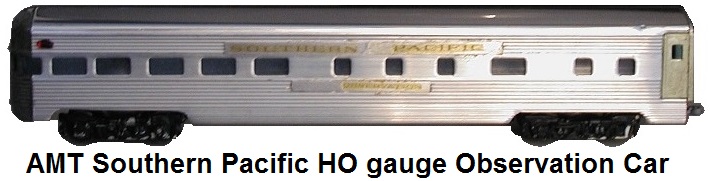
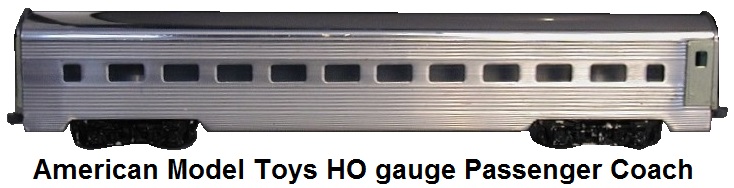
Starting in 1952 AMT also made HO gauge streamlined passenger cars. These models were a #H-008 4-door
Baggage, #H-007 Combination or Crew Car, #H-006 Day Coach, #H-003 Dining Car, #H-002 Bedroom-Roomette Pullman, and
#H-005 Observation Car. These cars were priced at $6 to $7 each and came in kit form, or for a dollar more, fully assembled.
Like the 'O' gauge products, they had one piece extruded aluminum bodies, however these cars used die-cast ends, floors and
trucks. The combination and baggage cars featured operating sliding doors. Each car had two metal light sockets cast into the
floor. The lights were wired in series. The observation cars were
furnished with marker lights that fit into pre-drilled holes. The trucks were insulated from the metal floors by plastic
grommets. The wheels were brass with an oxidized finish which caused the interior lights to flicker until the film
sufficiently wore off and better track contact could be made. The 4-wheel sprung streamliner passenger car trucks were
from the American Beauty Line manufactured by American Railroad Models Inc. of Detroit Michigan. An 18 inch radius curve was
recommended for operation, but the trains could be used on even smaller radii curves. AMT was the first manufacturer to
produce rib-sided aluminum streamliner passenger cars in HO scale. All HO streamliner cars came with Santa Fe name plates.
An Athearn plastic molded HO gauge F-7 powered A unit diesel and a dummy B unit in Santa Fe silver
and red paint provided the motive power in the passenger sets that AMT offered. The 2 sets were the #H22-235 Super Chief and
the #H22-765 El Capitan. In 1953 the AMT HO streamliner passenger cars made an appearance in the first
Fleischmann train set produced for the American market. The Express set was headed by
Fleischmann's #1360 steam locomotive and tender, modified by removing the smoke deflectors and painting the chassis and wheels
in black, and included the AMT baggage, Day Coach and observation cars. The following year, Fleischmann began making its own
HO gauge American-style streamliner passenger cars.
American Model Toys Extruded Aluminum HO gauge Passenger Cars
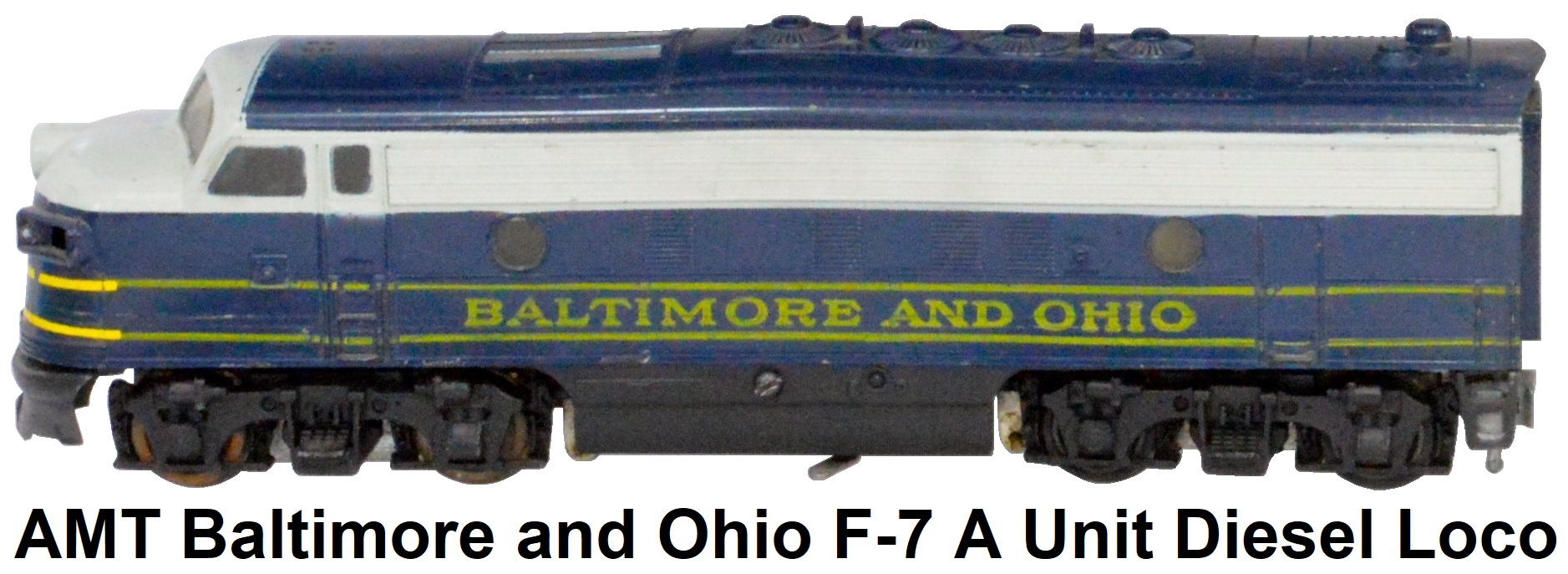
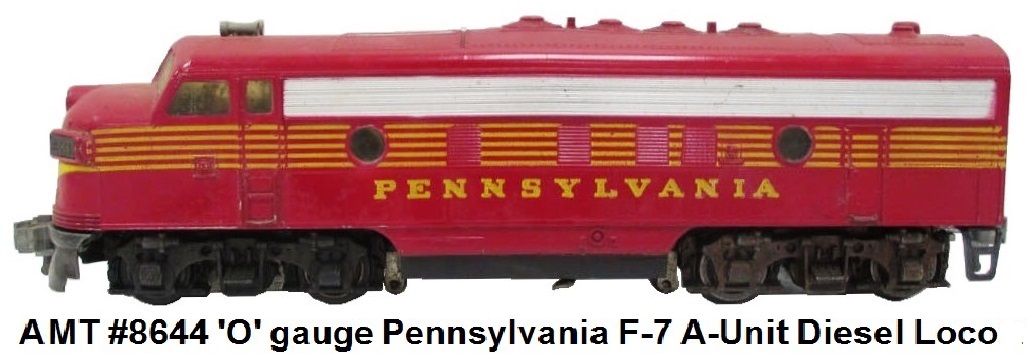
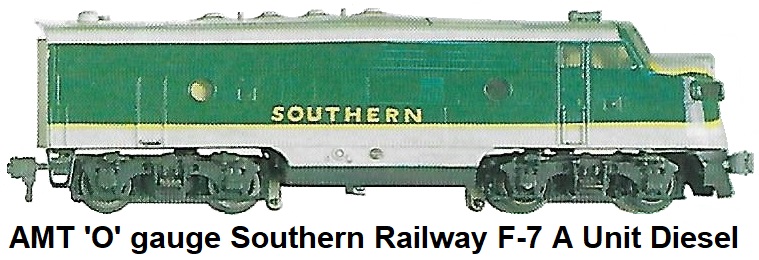
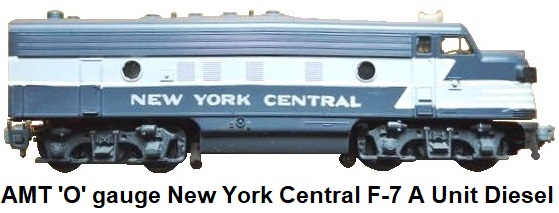
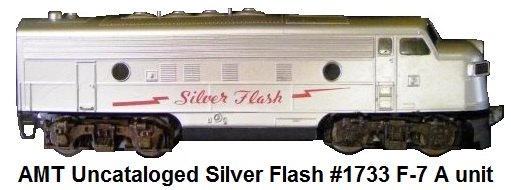
The following year, AMT decided to produce an 'O' gauge model of an F-7 type diesel locomotive, in both
powered and dummy unit versions, which also permitted them to sell complete 'O' gauge train sets for the first time.
The 1953 catalogue pictured both A and B units, but the B units were never manufactured. The AMT version of the
F-7 A unit was made using a clear plastic shell. The windshield and portholes were filled in and were masked
during the paint process so that they remained opaque. The loco featured a heavy duty 7-pole
Pittman motor rated to run on up to 24 volts. It was equipped with heavy duty
traction tires and could pull a fairly long train. The plastic molded AMT shell had an easily identifiable
hump on the top, evidently caused by removing the shells from the mold before they were fully cooled down.
Road names included Southern RR, NYC, Santa Fe (blue freight scheme), Pennsylvania, Silver
Streak, and B&O. The Santa Fe War Bonnet paint scheme was depicted on an illustration of an F-7 in the 1953
AMT catalogue, but it was never produced in those colors.

As American Model Toys, the firm brought
out starter sets in 1953. Sets sold for as low as $50 and the high end sets were in the $90 range.
AMT's working coupler, branded 'Liftamatic', closely followed
AAR design, and had a simulated air hose which when pushed up permitted uncoupling of the trains. This
required an uncoupling track, the first track of any kind made by AMT. Its design was such that it could be
mated with Lionel 'O' gauge track. The mechanism was essentially a ramp, that when an activation button was pushed,
lifted the ramp, and would push up on the simulated air hose, which was the actual coupler spring pin, opening
the knuckle coupler. Other accessories were also designed.
AMT catalogues advertised the aluminum passenger cars, the 40' freight cars, and
replacement parts. The HO scale H-008 four door baggage car, the HO scale H-007 combination or crew car, and the
HO scale H-005 observation car could be ordered for $6.95 in kit form or $7.95 finished. A.A.R. type #8000 series
'O' gauge box cars such as the #8001 Southern could be purchased for $5.95. Additionally, three #9000 series box cars,
the #9001 New York Central, the #9002 Pennsylvania, and the #9003 Baltimore & Ohio could be ordered for $6.95.
Various parts, including HO-19 marker lights, H003-B dining car extrusions, 101 freight trucks, 103 box car
floors and a pair of 109 Liftamatic couplers could be purchased for $.20, $1.75, $1.60, $.80 and $.90
respectively. AMT’s automatic couplers could be retrofitted on the #1000, #2000, #3000, #4000, and #5000
series cars built from 1948 - 1951. AMT suggested that modelers who were interested in purchasing
“tail signs” for observation cars should contact Virden Mfg. Co., 4124 W. 69th St., Mission, Kansas.
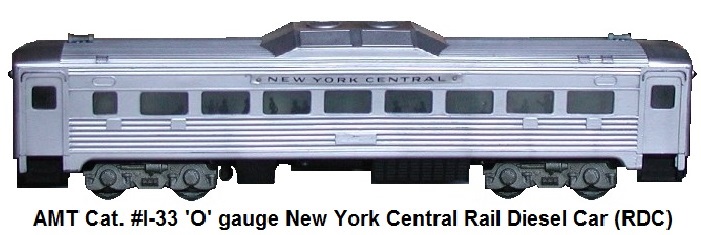
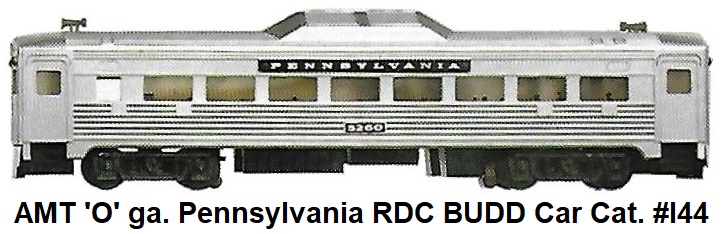
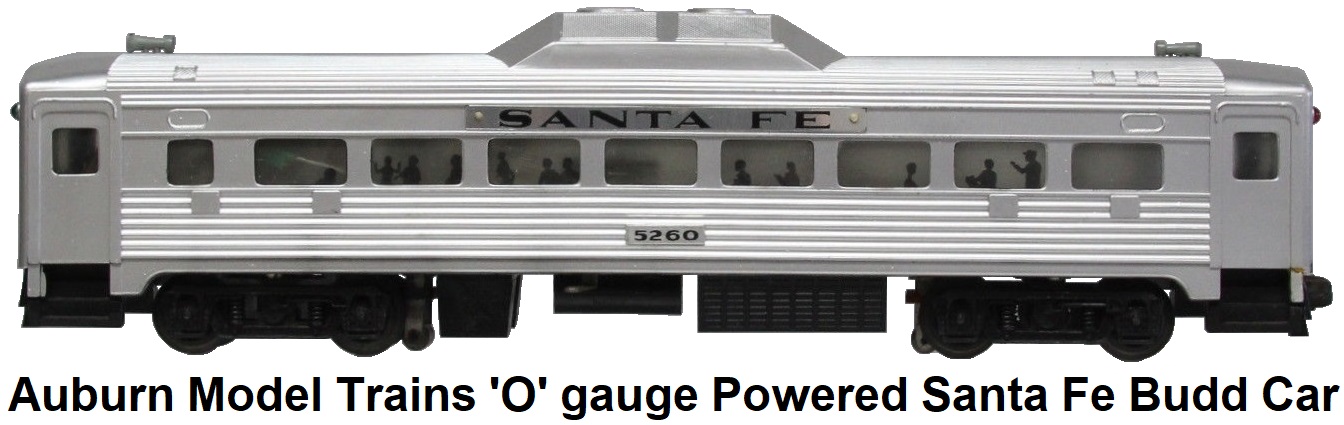
The firm continued with production of F-7 Diesels and introduced Budd RDC cars as well, but the
model train market began to decline considerably in the mid-1950's and the company ran into financial straits.
Demand wasn't as high as expected, and in 1954, AMT reorganized and changed its name to
Auburn Model Trains. Although Auburn's offerings are highly regarded today, they were not very
popular then, and by the autumn of 1954, the reorganization was deemed to be unsuccessful and Auburn sold
out to Kusan, a plastics and toy company based in Nashville, Tennessee, who continued
production.
Kusan produced train sets from the AMT tooling, as well as from new designs of their own, largely with
atomic and military themes. Kusan is also credited with making the first 'O' gauge trains that could
run on both 2-rail and 3-rail track (an idea MTH would rehash some 40 years later). But the market
had peaked in 1954, and Kusan, dissatisfied with its share in a declining market, ceased production in 1960.
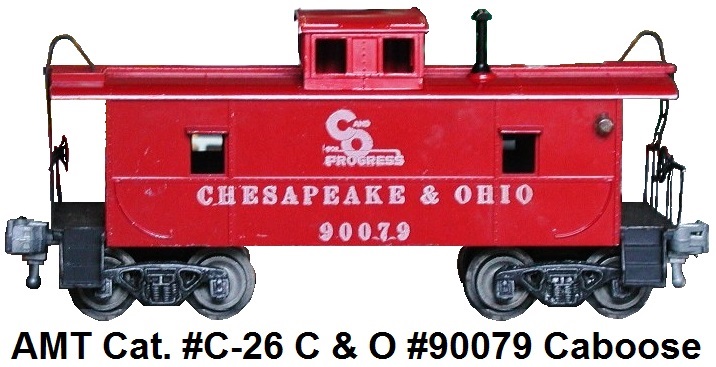
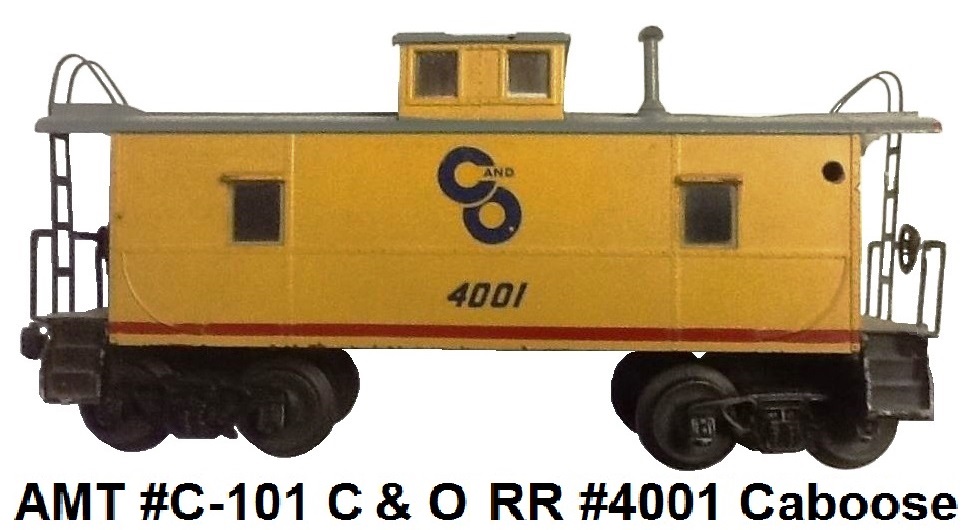
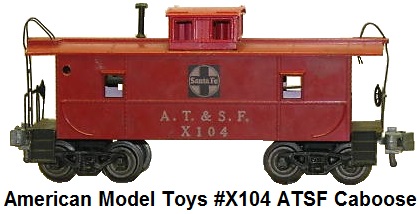
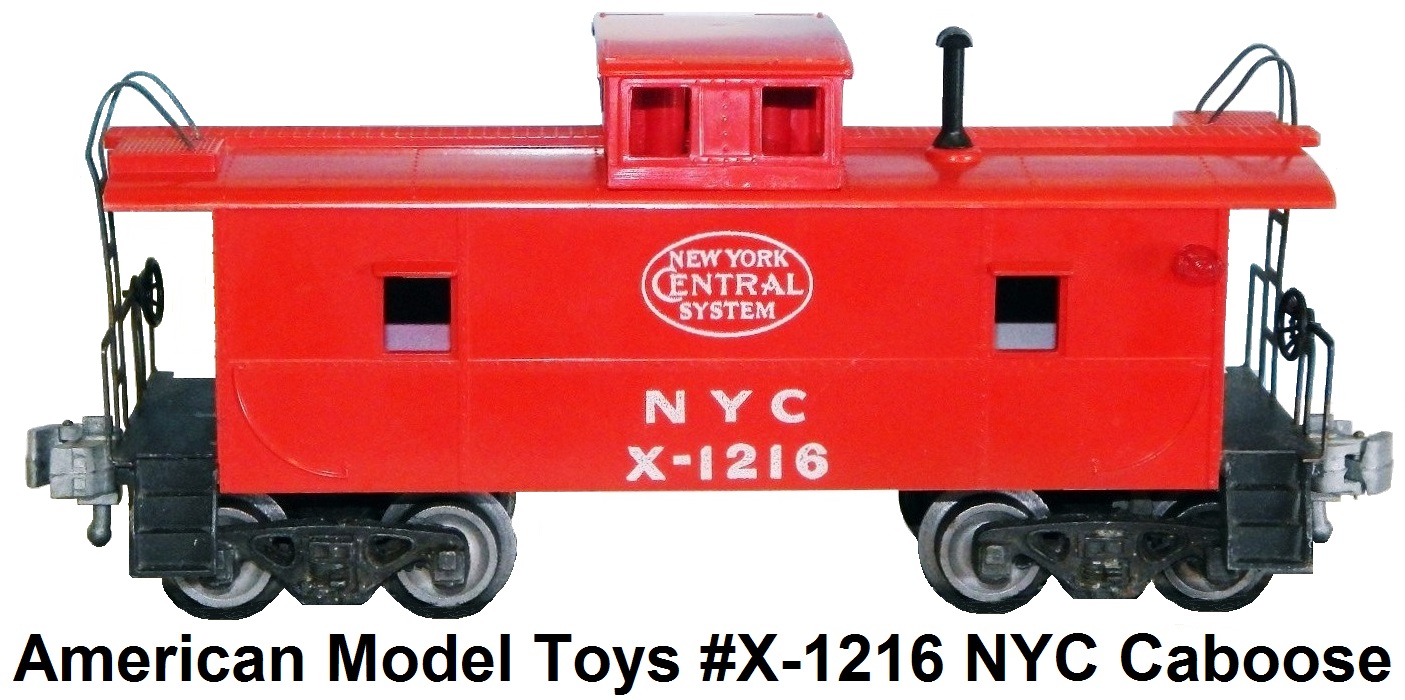
Kusan then sold its tooling to a hobbyist named Andy Kriswalus in Endicott, New York,
who operated as Kris Model Trains, or KMT. Kriswalus only produced rolling
stock, not locomotives. In the late 1980's, KMT dissolved and much of the original tooling was
sold to 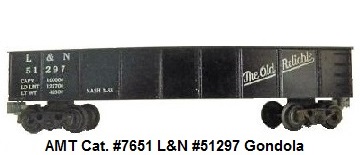 Williams Electric Trains, a small Maryland-based toymaker who had
previously created its own tooling and manufactured reproductions of Lionel's prewar
tinplate equipment. Williams soon decided to change focus. They sold the Lionel reproduction tinplate
tooling to a former employee of theirs named Mike Wolf. Wolf would go on to found
MTH Electric Trains. Williams concentrated its efforts on making
1950's-style model electric trains.
Williams Electric Trains, a small Maryland-based toymaker who had
previously created its own tooling and manufactured reproductions of Lionel's prewar
tinplate equipment. Williams soon decided to change focus. They sold the Lionel reproduction tinplate
tooling to a former employee of theirs named Mike Wolf. Wolf would go on to found
MTH Electric Trains. Williams concentrated its efforts on making
1950's-style model electric trains.
After the AMT/Kusan/KMT tooling was purchased by Jerry Williams he used much of it for a brief
period and then sold some of it to K-Line, a North
Carolina-based toymaker who had previously bought much of Marx's tooling when Marx dissolved in 1978 and was
using it to produce inexpensive trains that competed with Lionel's entry-level offerings. Like Williams,
K-Line used the old AMT/Kusan/KMT tooling to produce rolling stock that directly competed with
Lionel in the marketplace. Williams made the AMT designed, almost scale sized 40'
box car with opening doors, the reefers and as well, evolved versions of the F-7 locomotives, with better motors
and even added B units. The Williams box cars made from original AMT tooling were referred to as the Crown
Series models. These cars are recognizable as they have a stamped metal frame with a fishbelly, and a brake cylinder on the
under carriage. The sliding doors have the single large square and single small square, just like the AMT designed car.
Bachmann continued to make and sell these box cars after the acquisition
of Williams.
American Model Toys BUDD Aluminum Rail Diesel Cars
John 'Jack' Ferris' efforts to create quality model trains was not in vane
despite the fact that his AMT brand train making days only covered a brief period between 1948 and 1954.
The original designs and tooling lived on in train manufacturing circles for many years,
and were used by many companies. Today there is a small but loyal group of hobbyists and
collectors that actively seek out any and all items manufactured by AMT in the post war
era. It is interesting to note that when the extruded aluminum passenger cars were new, the fluted roof versions
were priced below the smooth versions, but today collectors seem to seek out the fluted roof versions,
and as a such, the fluted roof versions tend to command higher prices. Streamline passenger cars in good
condition usually sell for around $50. Cars in excellent condition go for $100 and up. Box cars, stock
cars and reefers in good condition can be found for around $25. These same freight cars in excellent
condition can be acquired for around $60.