 Kusan-Auburn was a subsidiary of Kusan Inc., an established plastics manufacturer based in Nashville,
Tennessee. In the 1950's and 60's, Kusan was well known for being the first to manufacture a
yo-yo/spinning top combination called the Kusan Twin Twirler. Kusan
also made several other plastic toy items including toy guns, furniture, games and pull toys. Under
the guidance of 41 year old President Bill McLain and co-founder Earl Horton, Kusan purchased
American Model Toys/Auburn Model Trains (AMT's) tooling in 1954 and used
it as a base to produce their own line of model trains. Kusan trains were unique in being able to run
on either two or three rail track.
Kusan-Auburn was a subsidiary of Kusan Inc., an established plastics manufacturer based in Nashville,
Tennessee. In the 1950's and 60's, Kusan was well known for being the first to manufacture a
yo-yo/spinning top combination called the Kusan Twin Twirler. Kusan
also made several other plastic toy items including toy guns, furniture, games and pull toys. Under
the guidance of 41 year old President Bill McLain and co-founder Earl Horton, Kusan purchased
American Model Toys/Auburn Model Trains (AMT's) tooling in 1954 and used
it as a base to produce their own line of model trains. Kusan trains were unique in being able to run
on either two or three rail track.
After Kusan acquired the inventories and production tools of Auburn Model Trains,
the equipment was moved from Indiana to a new plant in Franklin, Tennessee, which had been especially prepared
for train production. 1955 was spent on re-tooling efforts, and the development of new manufacturing processes.
Design engineer George Dunbar was tasked with coming up with ideas for new items that could be mass produced
at low cost that would allow Kusan to compete with the likes of Lionel and
Gilbert American Flyer. Kusan's business
plan to do so had three components. First they would put out a full line of 20 trains, including a deluxe
'O' gauge ¼ inch to the foot scale, also a slightly smaller medium priced "K" line that could run on
'O' gauge track, and a ⅛ inch to the foot HO gauge hobbyist train. Second, they would provide products
of high quality at a competitive price. And third, they would offer brand new products, never manufactured by
other brands.
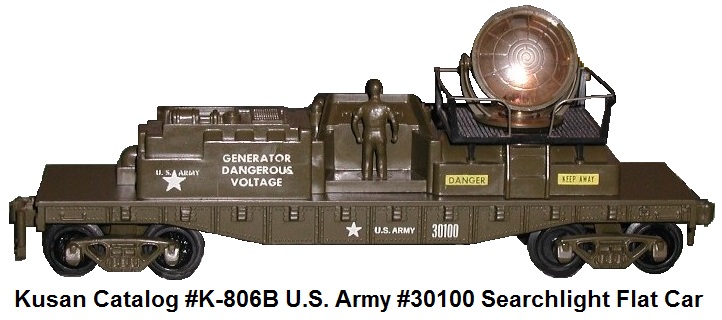 One of the new products was the Kusan KF-110 Atomic Train in 'O' gauge. It was the first toy train to have an
"atomic theme." This was Kusan's first toy train and its introduction was the
subject of an article in the June 29, 1957 issue of Business Week. It was produced between 1957 and 1960. The
Atomic Train was Kusan's idea of what such a product might look like if there were such a thing in the real world.
The train set was intended to tap into a child's imaginiation and make them think that they could fight
and win the ultimate conflict of World War III.
The company described it as "An exciting new train with extra play value in each
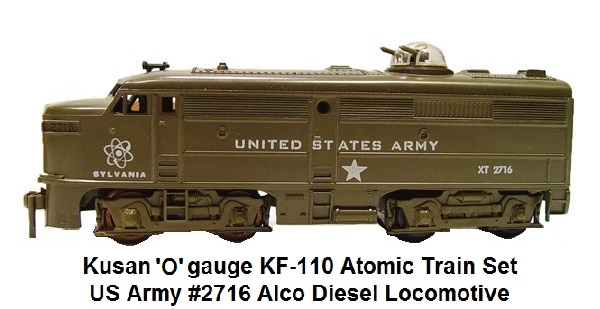
unit." It was decorated in "realistic" military colors. The atomic train diesel locomotive was
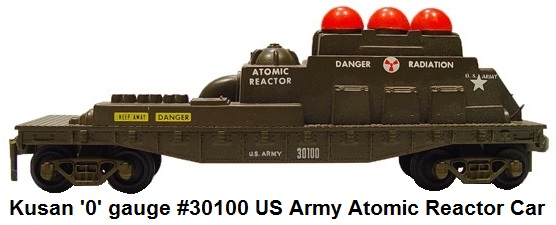
equipped with a moveable machine gun turret with adjustable guns. The train also included a power plant
car simulating an "atomic reactor pile" that included 3 red lights that would blink and flash as
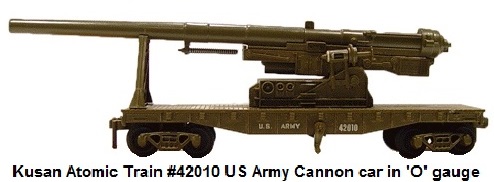
if fissionable materials were actually burning inside. The train also had a giant "atomic cannon"
which could be elevated and lowered approximately 60 degrees, and swiveled in any direction. The
cannon fired small wooden missiles while the train was in motion and could also recoil during firing.
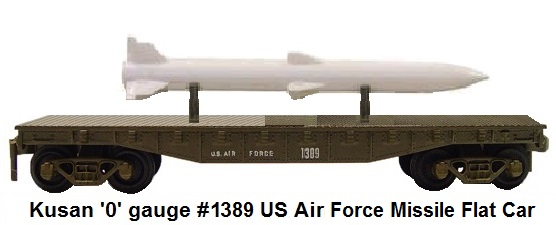
Another car was a flat carrying a "Honest John" type rocket that could be removed from its cradle. Finally
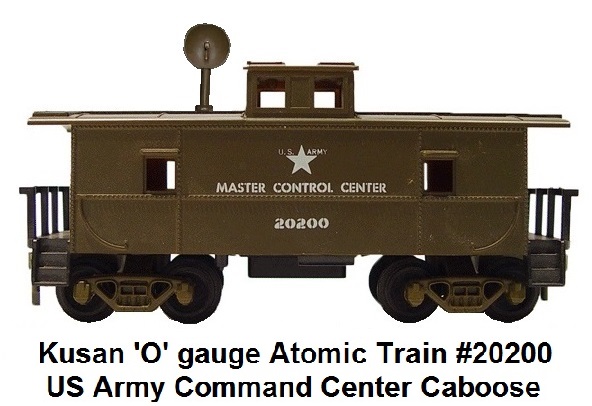
there was a "Fire Detection Center" caboose with a rotatable dish antenna. Plastic army men were included
with the set. The set came ready to run with power supply and track included. It sold for $44.95 retail. Some of
these sets were made for the Sylvania Corp., who gave them away with the purchase of a televsion set.
One of the new products was the Kusan KF-110 Atomic Train in 'O' gauge. It was the first toy train to have an
"atomic theme." This was Kusan's first toy train and its introduction was the
subject of an article in the June 29, 1957 issue of Business Week. It was produced between 1957 and 1960. The
Atomic Train was Kusan's idea of what such a product might look like if there were such a thing in the real world.
The train set was intended to tap into a child's imaginiation and make them think that they could fight
and win the ultimate conflict of World War III.
The company described it as "An exciting new train with extra play value in each
unit." It was decorated in "realistic" military colors. The atomic train diesel locomotive was
equipped with a moveable machine gun turret with adjustable guns. The train also included a power plant
car simulating an "atomic reactor pile" that included 3 red lights that would blink and flash as
if fissionable materials were actually burning inside. The train also had a giant "atomic cannon"
which could be elevated and lowered approximately 60 degrees, and swiveled in any direction. The
cannon fired small wooden missiles while the train was in motion and could also recoil during firing.
Another car was a flat carrying a "Honest John" type rocket that could be removed from its cradle. Finally
there was a "Fire Detection Center" caboose with a rotatable dish antenna. Plastic army men were included
with the set. The set came ready to run with power supply and track included. It sold for $44.95 retail. Some of
these sets were made for the Sylvania Corp., who gave them away with the purchase of a televsion set.
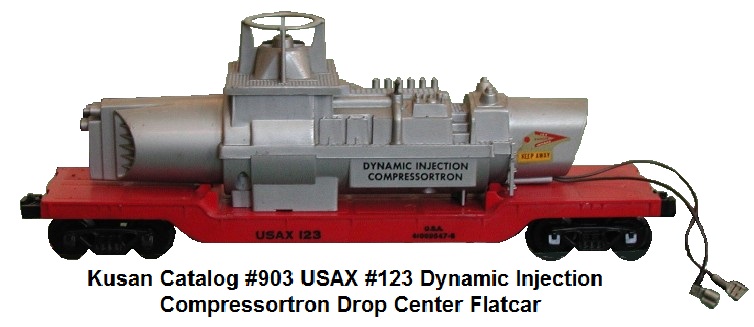 Kusan created many "space train" items in the late 1950's. The most notable was the KF-119 Satellite train.
These trains were an attempt to reach out to
a younger, changing hobbyist market that was more in tune to the events of space exploration taking
place during this period. Whimsical items such as "Satellite Engines", "Dynamic Injection Compressortron
Cars", "Radar Scanning Cars" and "Space Research Cars" were made. The K-901 USAX Dynamic Injection Compressortron
was a depressed center flat car with a large gray contraption that used a fan motor to blow air and suspend
a lightweight 'satellite' an inch above the car as it circled the track. The special effects of the satellite train
were quite impressive, certainly far beyond what Lionel was offering at the time. This activity prompted
Lionel to do the same with their manufacturing and marketing tactics, just as they
had done with creation of their aluminum extruded passenger cars to
compete with the original AMT products. In another attempt to challenge Lionel, Kusan made a smaller size
two-rail, "K" series DC-powered train line, which was intended to compete with Lionel's 0-27 trains. Kusan also
made its own detailed track, that had 17 ties per piece, as opposed to Lionel and other manufacturer's 3 ties
per piece. And the ties were more realistic looking, as they were molded in plastic.
Kusan created many "space train" items in the late 1950's. The most notable was the KF-119 Satellite train.
These trains were an attempt to reach out to
a younger, changing hobbyist market that was more in tune to the events of space exploration taking
place during this period. Whimsical items such as "Satellite Engines", "Dynamic Injection Compressortron
Cars", "Radar Scanning Cars" and "Space Research Cars" were made. The K-901 USAX Dynamic Injection Compressortron
was a depressed center flat car with a large gray contraption that used a fan motor to blow air and suspend
a lightweight 'satellite' an inch above the car as it circled the track. The special effects of the satellite train
were quite impressive, certainly far beyond what Lionel was offering at the time. This activity prompted
Lionel to do the same with their manufacturing and marketing tactics, just as they
had done with creation of their aluminum extruded passenger cars to
compete with the original AMT products. In another attempt to challenge Lionel, Kusan made a smaller size
two-rail, "K" series DC-powered train line, which was intended to compete with Lionel's 0-27 trains. Kusan also
made its own detailed track, that had 17 ties per piece, as opposed to Lionel and other manufacturer's 3 ties
per piece. And the ties were more realistic looking, as they were molded in plastic.
Kusan-Auburn Aluminum Extruded Streamlined Passenger Cars Made From AMT Tooling
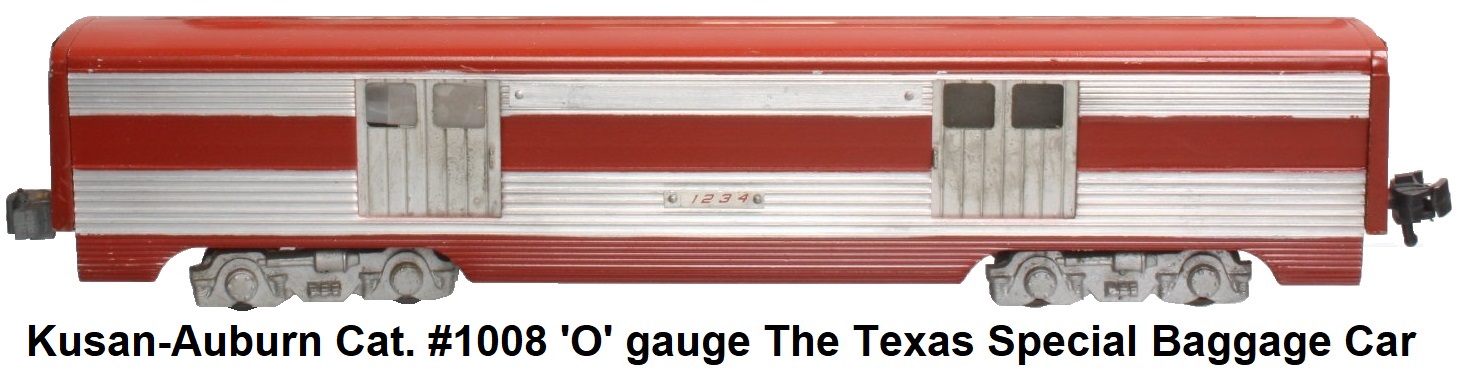
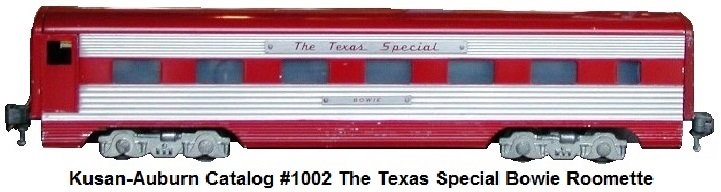
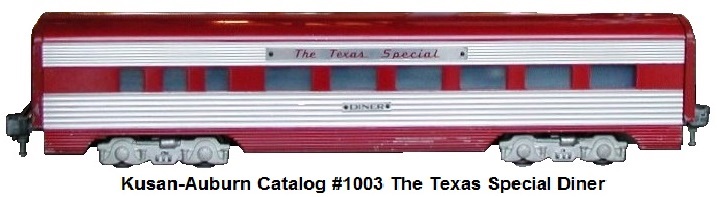
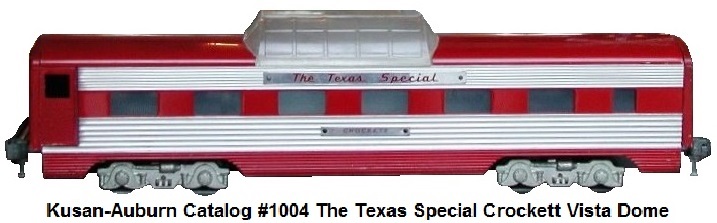
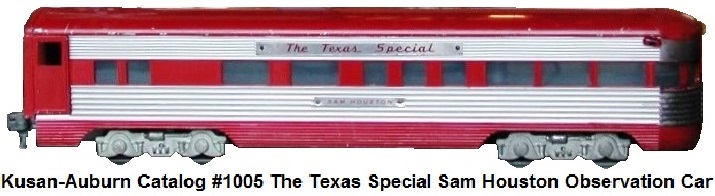
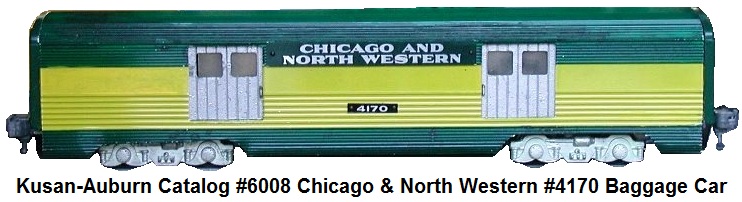
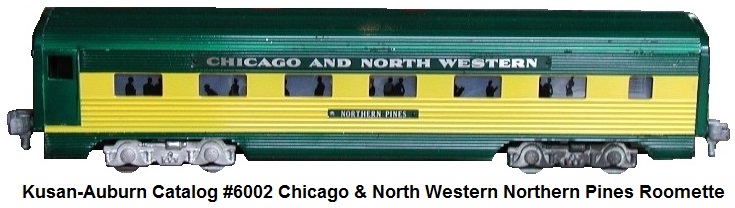
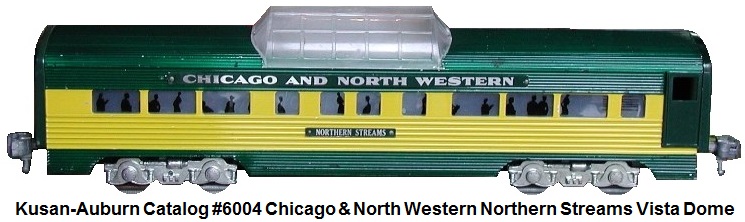
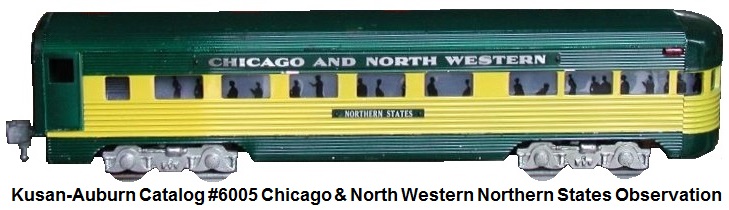
Kusan also continued to manufacture and kept the highly detailed line of AMT created aluminum
extruded passenger cars alive, using the dies it had purchased with some decorating changes. These 'O' gauge
cars, originally issued in 4 styles - a Baggage, Combine, Coach and Observation, became a full range of eight car sets,
with Baggage-mail, Roomette, Diner, and Dome car. Each offered in a choice of seven different Famous
American Railroad names, including NYC, PRR, Southern, C&NW, Texas Special and Santa Fe Railroads.
Kusan KMT Trains Freight Cars Made Using AMT Acquired Molds and Tooling
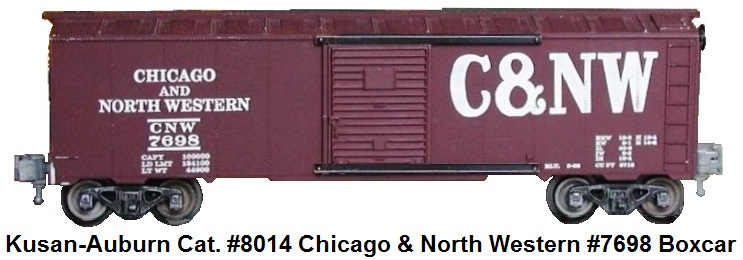
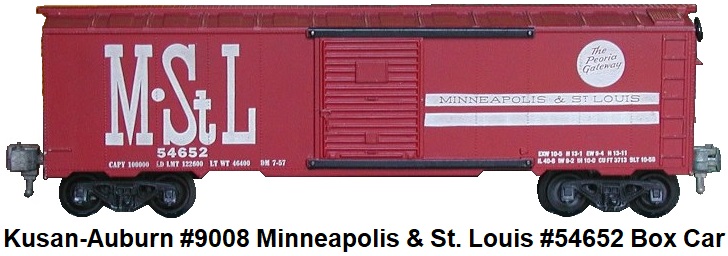
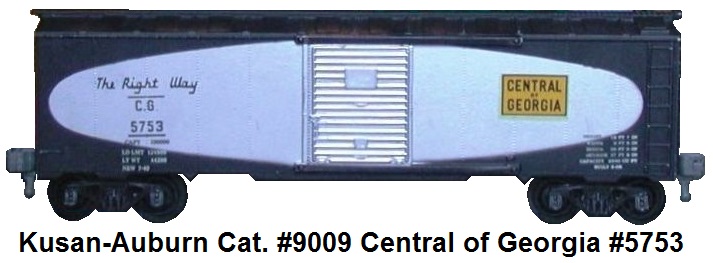
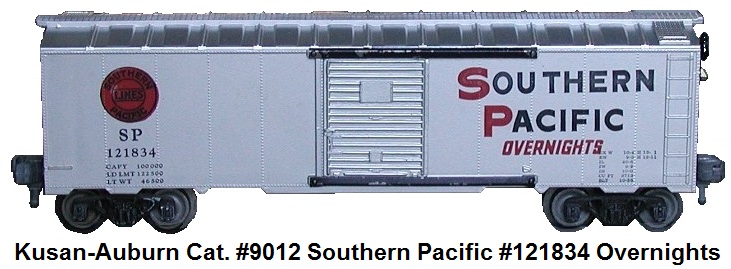
#8000 Series 40' Box Cars
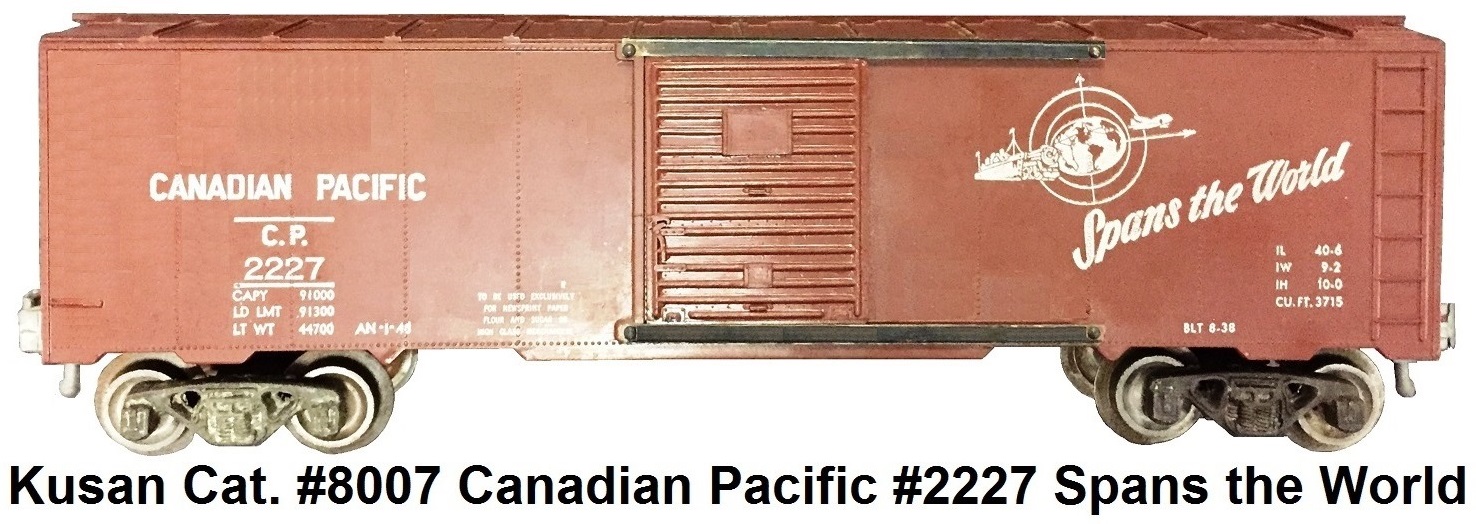
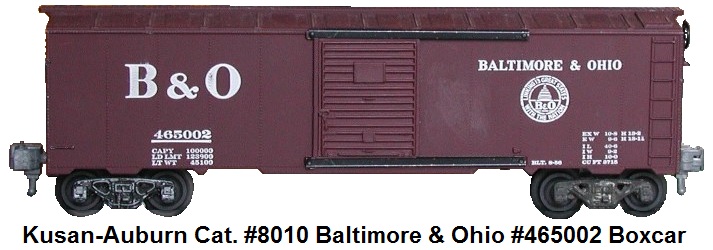
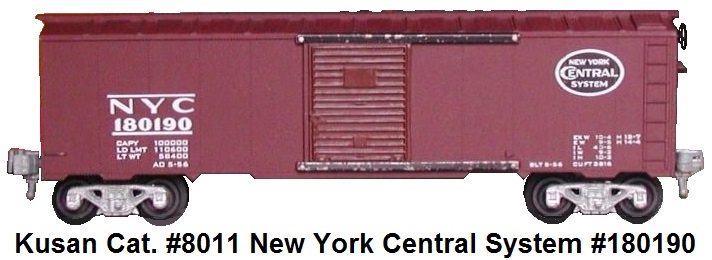
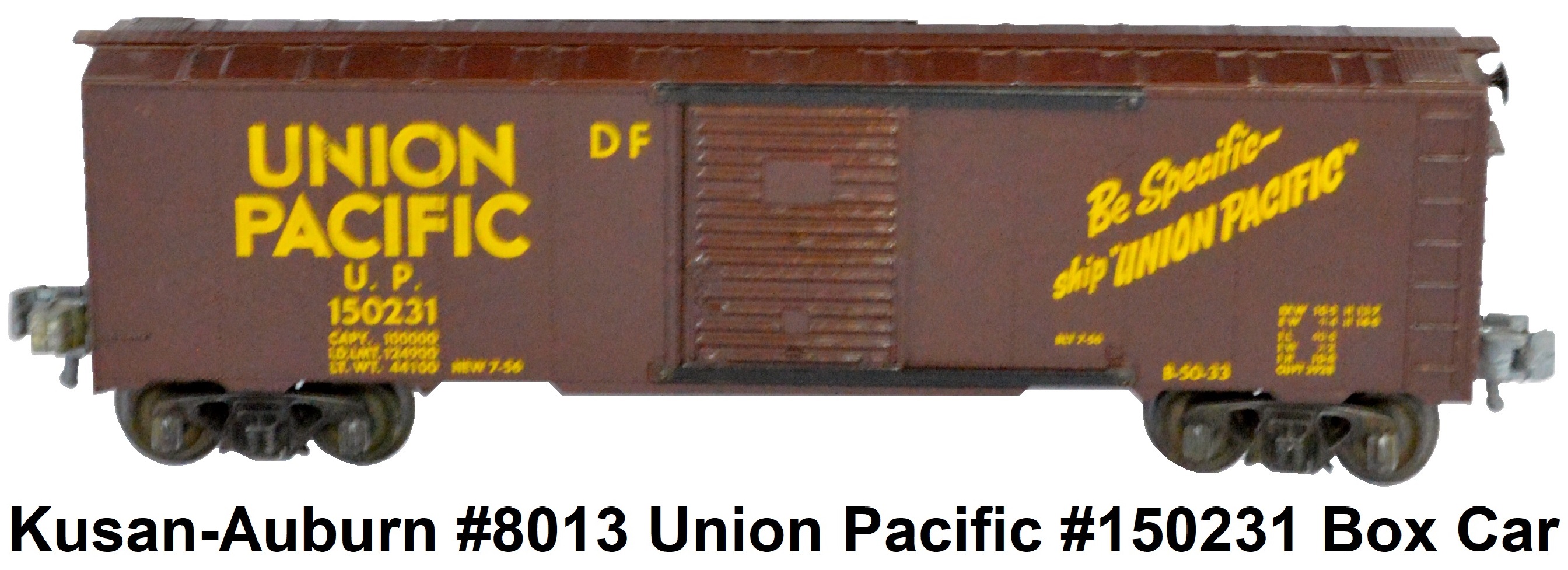

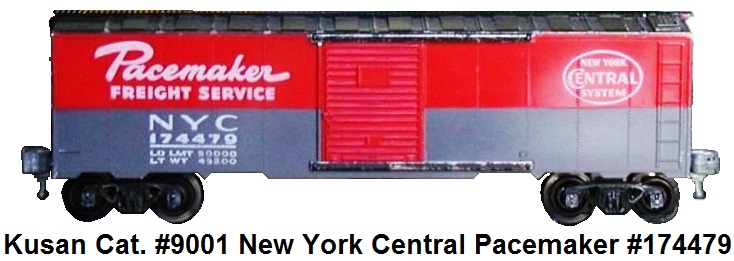
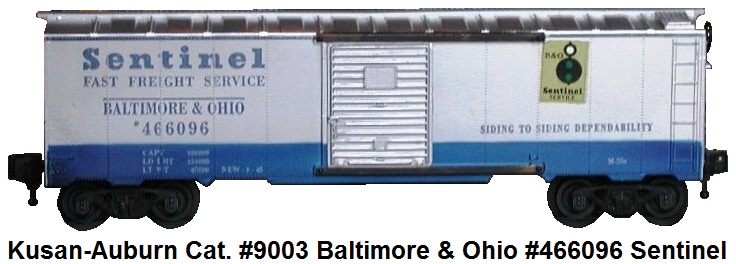
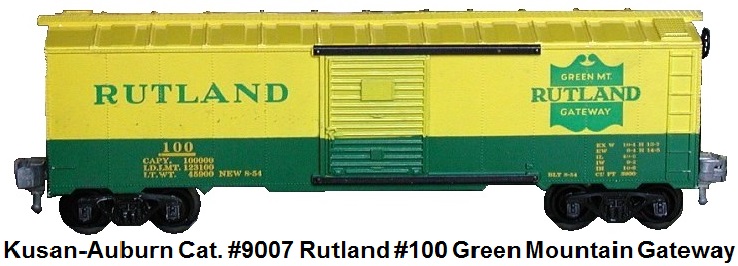
#9000 Series 40' Box Cars
#7000 Series Freights
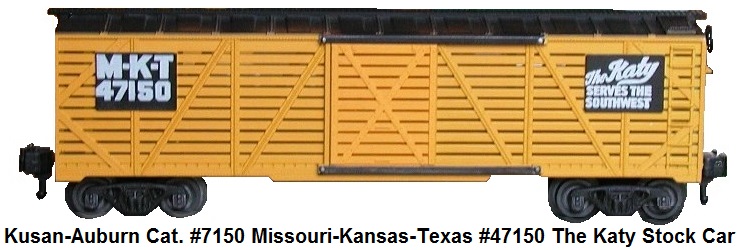
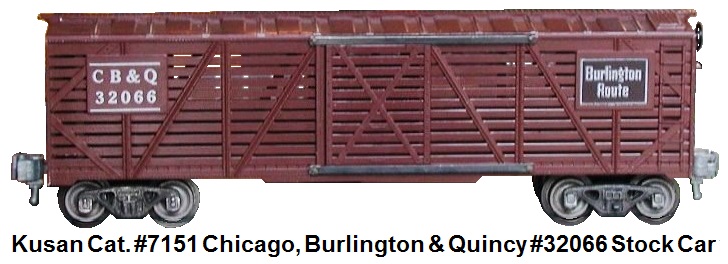
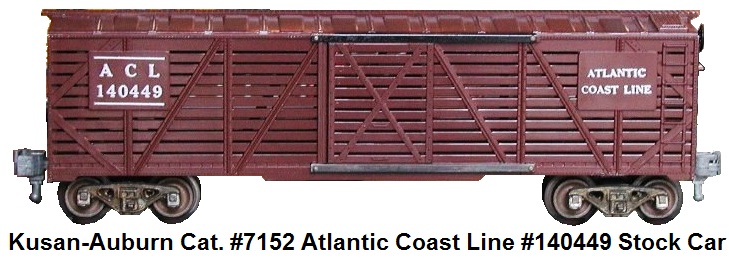
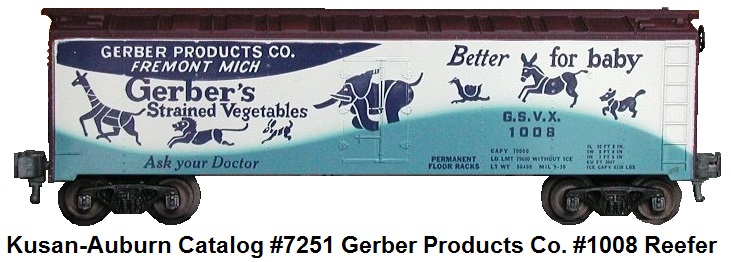
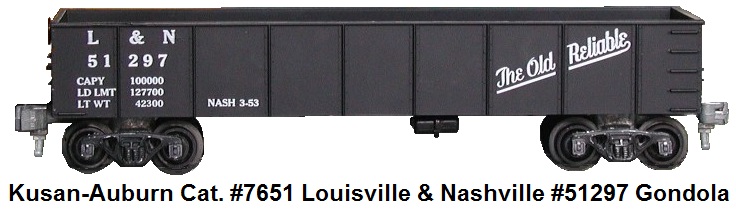
In addition to producing the passenger cars and scale box cars from the AMT tooling, Kusan continued making
the scale drop center flatcar, scale stock cars, refrigerator cars and scale gondola that AMT
had earlier introduced.
Kusan also
made their own molds for producing GM type F-7 diesel locomotives similar to the ones first produced by AMT.
The difference between an AMT F-7 and a Kusan F-7 is discerned by looking at the roof line. AMT F-7's have a
humped roof, whereas Kusan F-7's are straight. Kusan engines also have a "KMT" oval logo on the sides. Like the AMT
F-7's, the Kusan models were designed for 2-rail operation and were equipped with deep flanged wheels.
Kusan-Auburn F-7 Diesel Locomotives
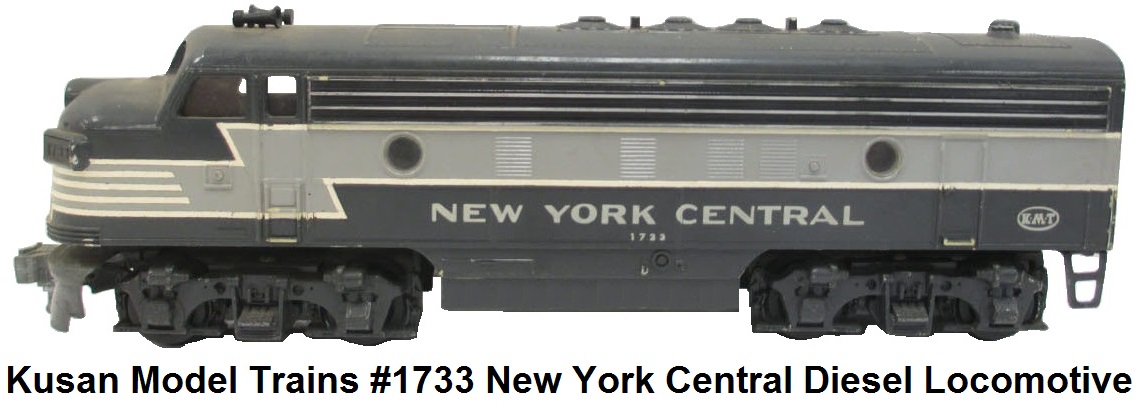



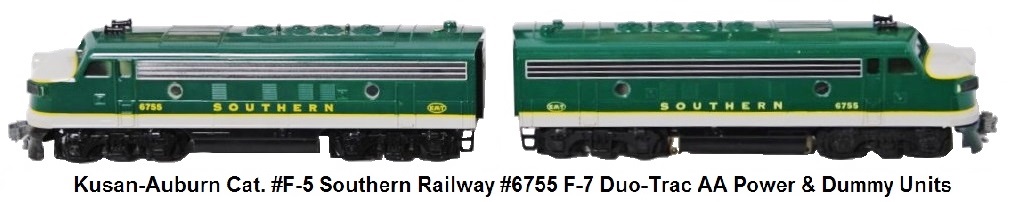

Kusan produced their 'O' gauge F-7 Diesel A units in six road-names and color schemes. They were the F-3 New York Central,
F-1 Missouri-Kansas-Texas, F-2 Atchison Topeka & Santa Fe, F-5 Southern, F-4 Pennsylvania RR, and F-6 Chicago & North Western.
These engines came with a hefty 7-pole AC/DC Pittman motor, which was
rated for operation up to 25 volts. They also had neoprene 'Traction Tread' rubber tires installed on
all four drive wheels, thus making these engines very strong pullers. The underframes, trucks, gearboxes and side
frames were die-cast metal. Powered A units sold for $27.50 while dummy A units were priced at $12.00. F units equipped
with Kusan's Duo-Trac feature were $29.50.
Kusan-Auburn K-Series Alco Diesel Locomotives
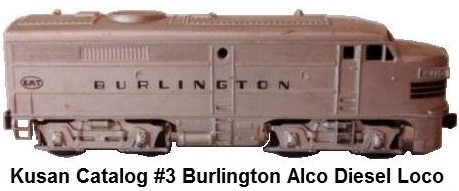
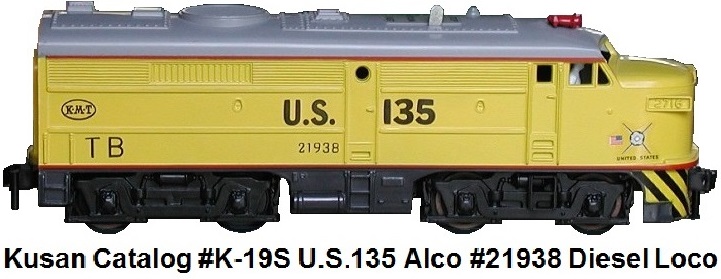
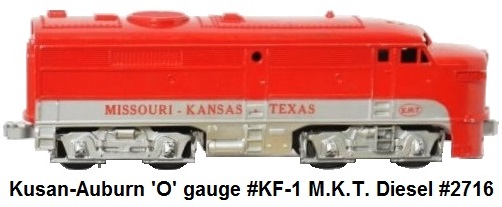
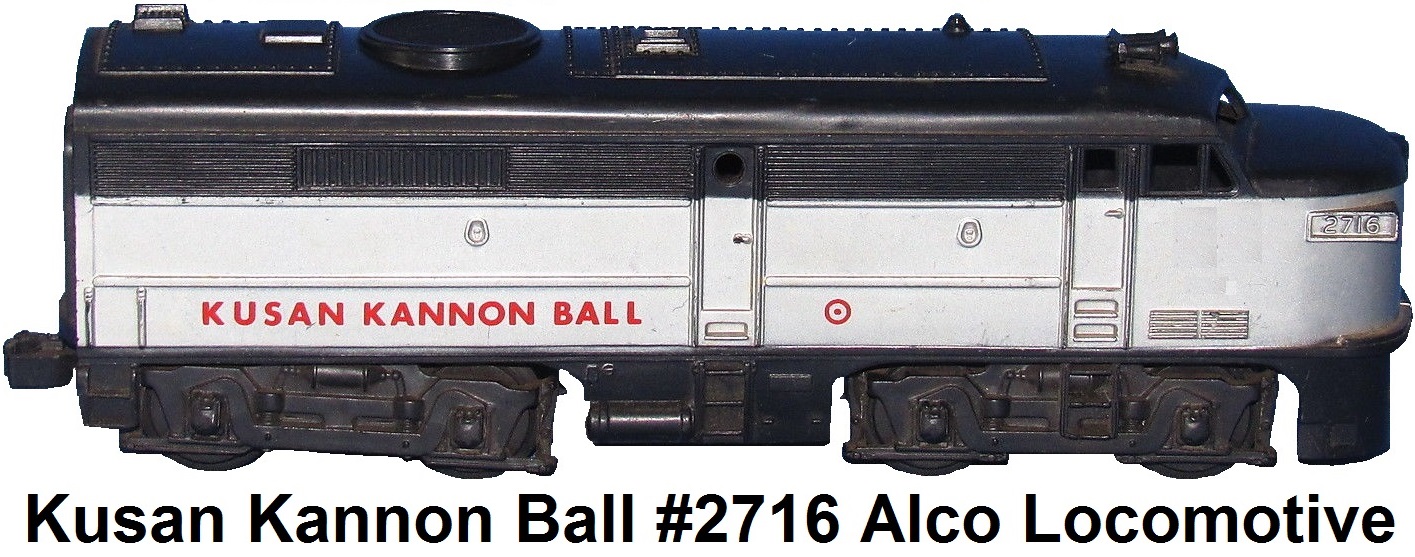
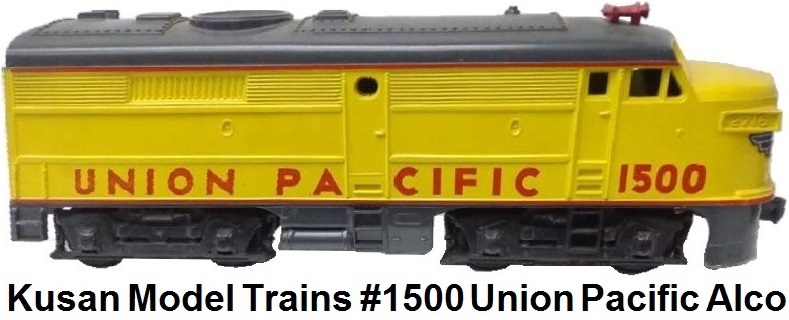
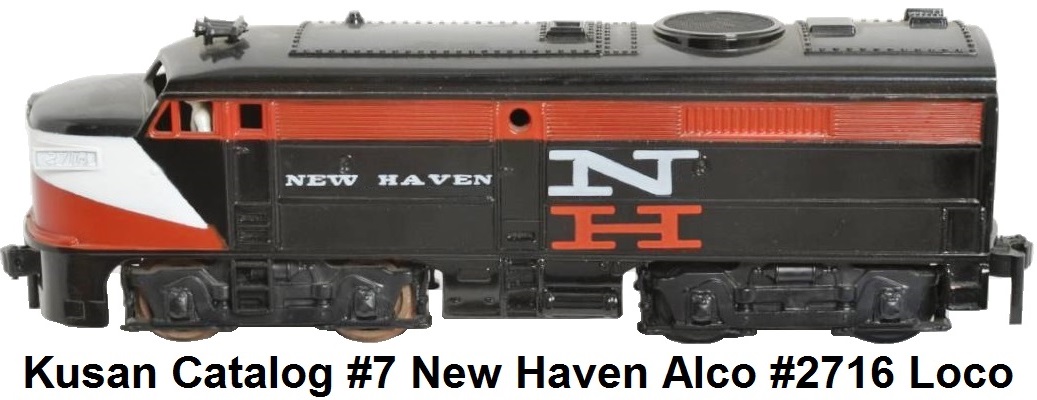
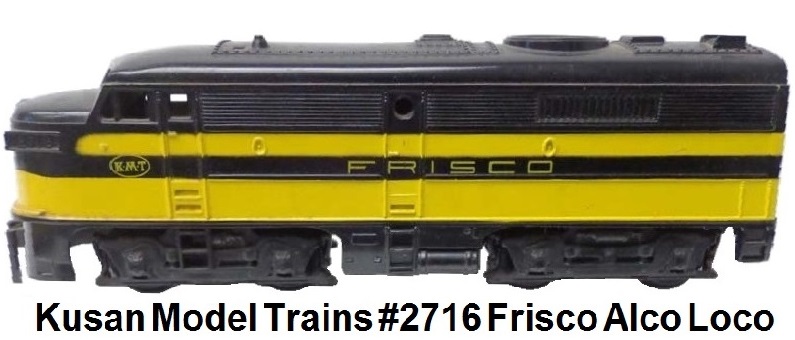
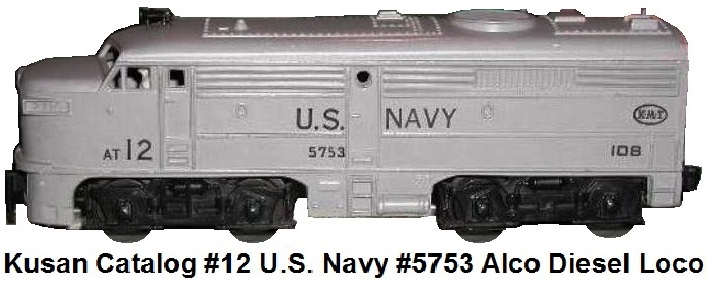
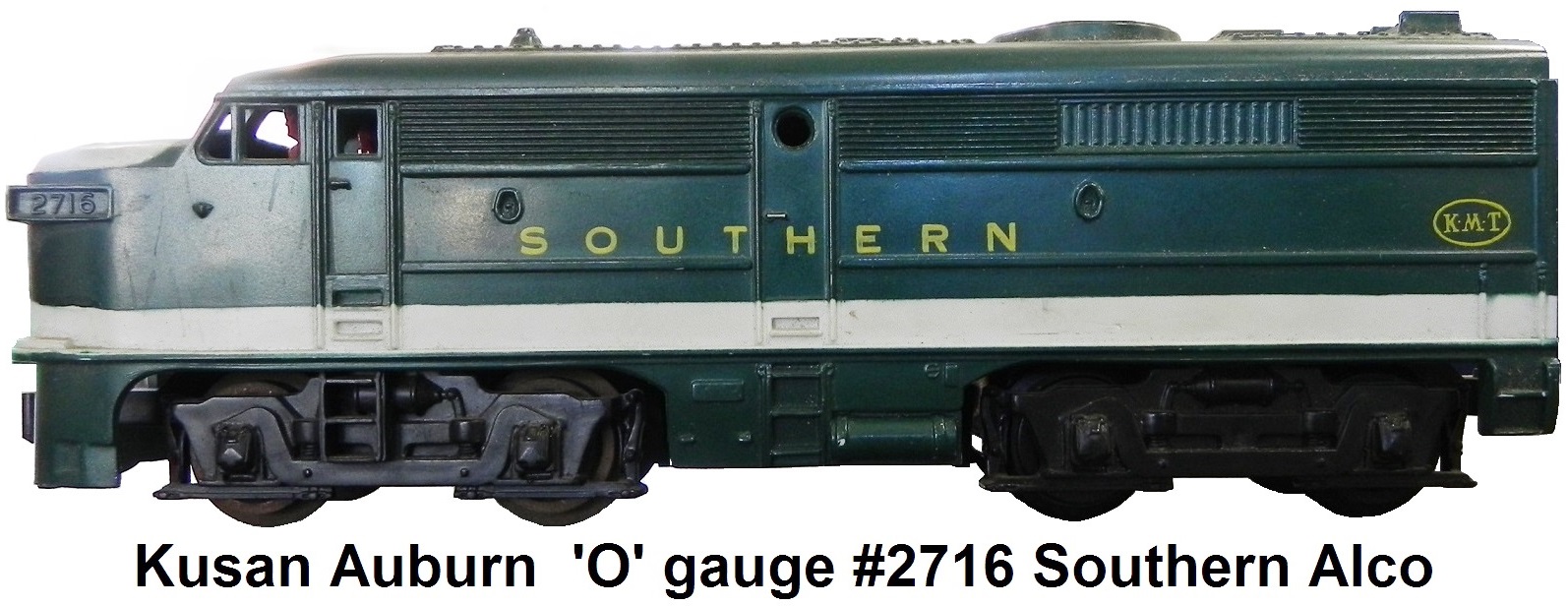
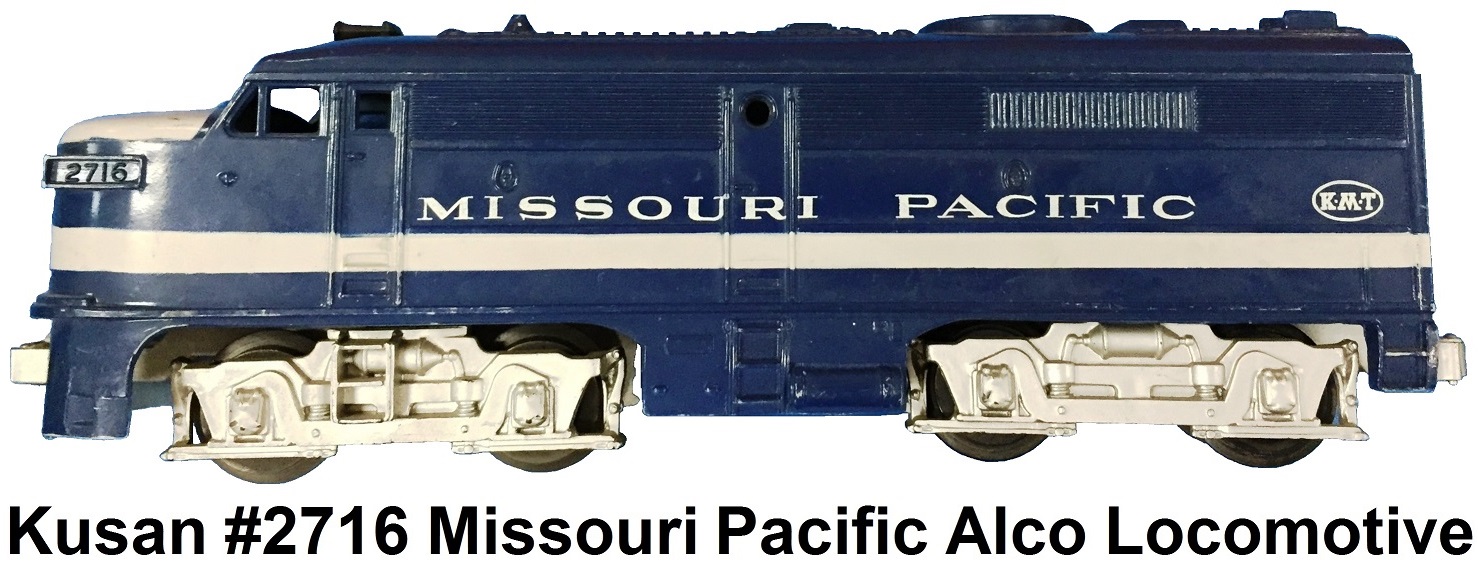
Kusan also made new Alco diesel locomotives, box cars, gondolas, refrigerator cars,
depressed-center flatcars, flatcars, hoppers, tank cars, cabooses, the military-themed cars, and
stock cars from original molds, called K-molds. They also made their own DC power supplies, and sectional three rail
and two rail track with plastic ties. Kusan also put out a
series of cardboard structures, billboards and signs. Kusan, like AMT, never made any steam outline
or electric outline locomotives, only the diesels that were prototypical of the 1940's and 50's. In addition
to already assembled freight cars, Kusan sold freight car kits.
Kusan KMT Trains Freight Cars Made from K-Molds Developed In-House
Kusan K-Series Box Cars

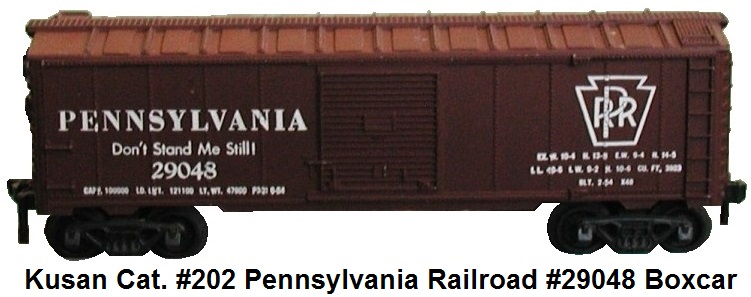
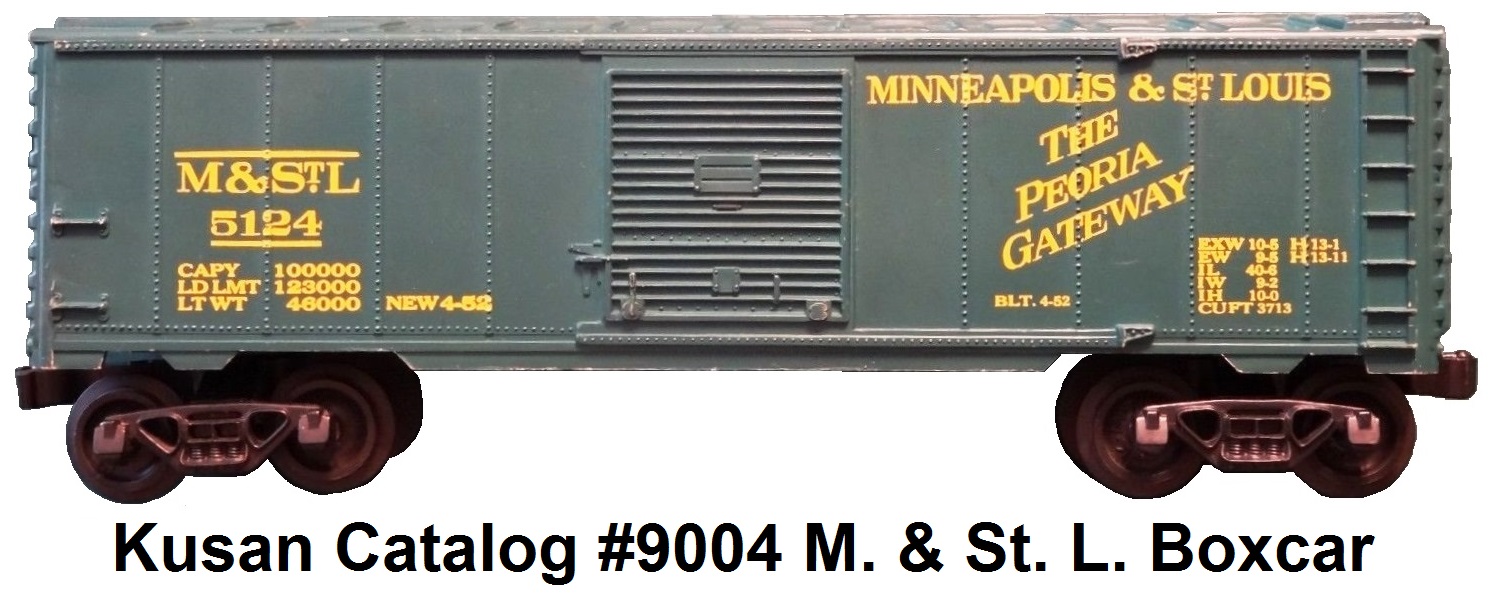
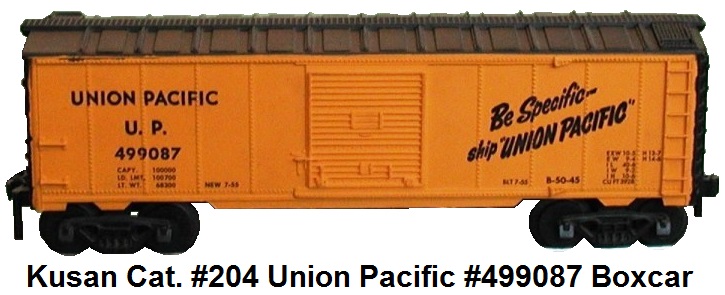
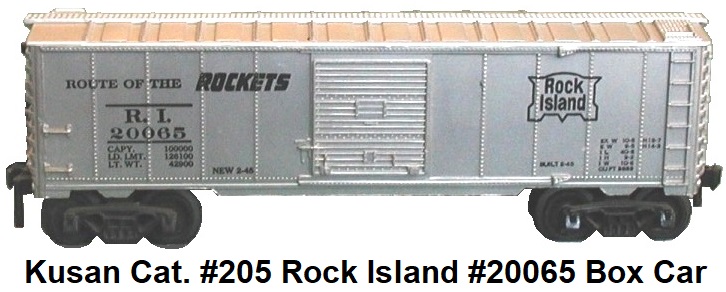
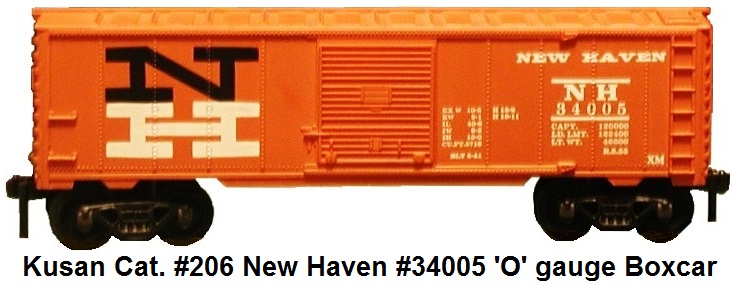
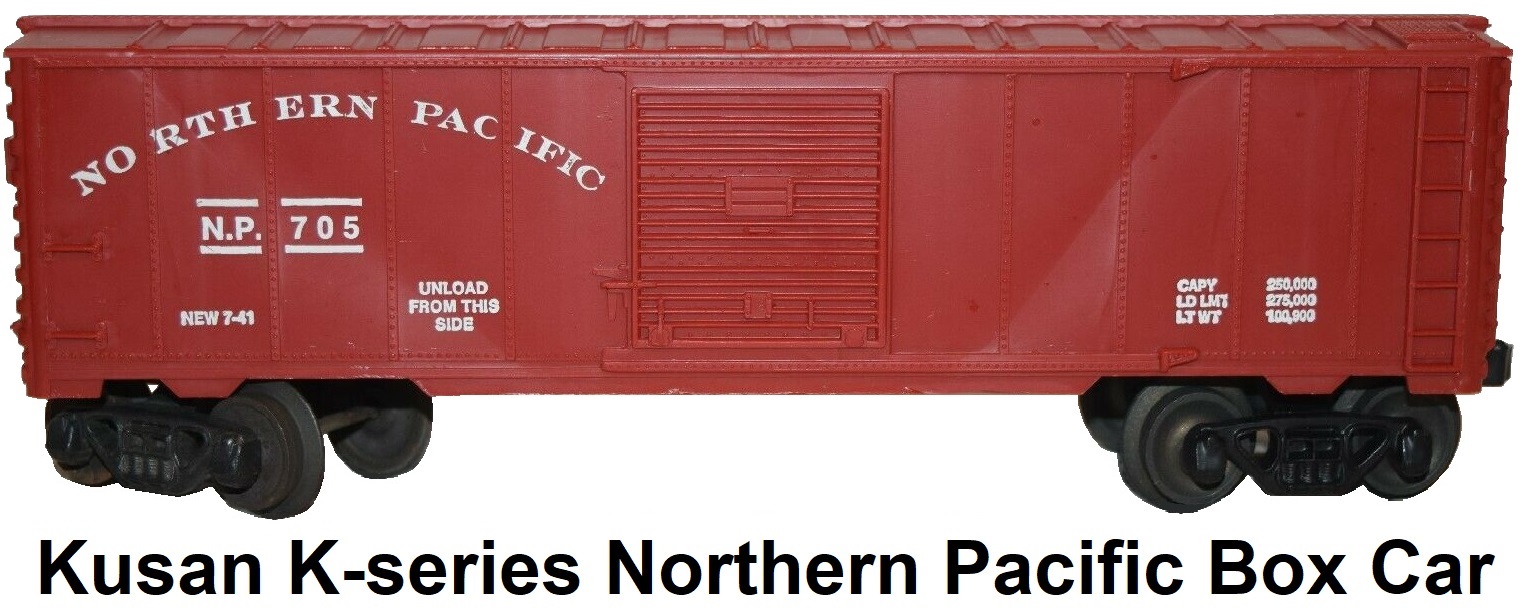
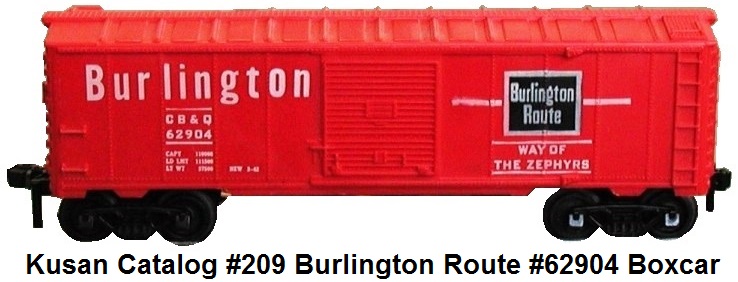
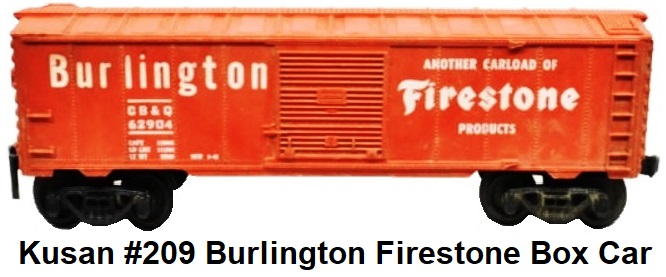
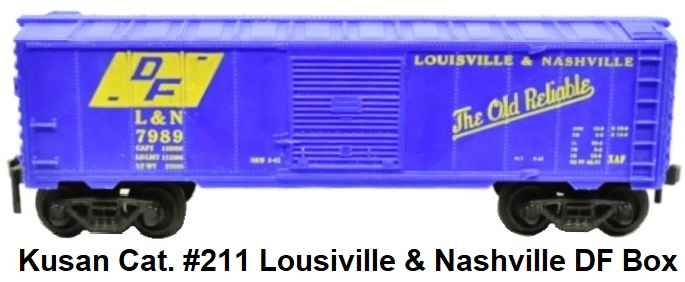

Kusan K-Series box cars with plastic trucks were slightly smaller than Lionel's #6464 series box cars.
Because they came with plastic trucks, plastic wheels, plastic couplers and plastic frames with the doors molded into the
shell casting, they were substantially lighter than the Kusan 8000 and 9000 series box cars. The K-series box cars had only
10 parts in total, as metal door guides were eliminated and the doors were non movable. The door on one side of the box car
was open and the one on the other side was closed. These cars normally were sold as kits requiring the hobbyist to assemble
the shell, floor, two trucks with non-operating couplers via two self-tapping screws to fasten the trucks, and sometimes a
plastic molded brakeman was included and could be glued inside the open door side of the box car. The box cars were issued in several
road names including the #201 Katy, #202 Pennsylvania, #203 Minneapolis & St. Louis, #204 Union Pacific, #205 Rock Island,
#206 New Haven in orange, #207 black New Haven, #208 Kusan Railroad, #209 Chicago, Burlington & Quincy, #211 Louisville & Nashville, and
#212 Western Pacific. Kusan/KMT also offered their K-Series tank cars, gondolas, hoppers, flat cars, stock cars and
cabooses as undecorated kits. The simulated knuckle couplers were plastic and were molded closed (not operable) but
they did match up to the operating knuckle couplers used on the higher end scale sized freight cars made by Kusan as
well as with Lionel's model trains. The K-Series freight cars were also offered as ready-to-run for a slightly higher price point,
but becuase of the smaller number of parts needed, manufacturing costs were reduced.
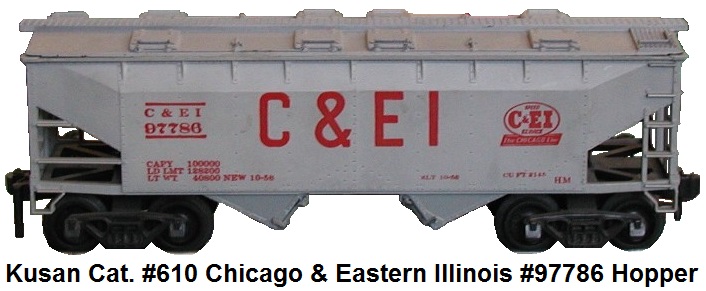
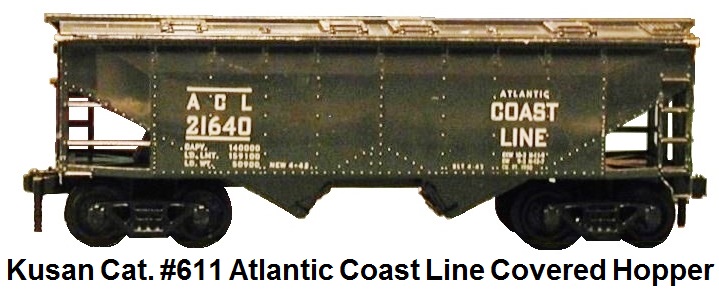
Kusan K-Series Hoppers
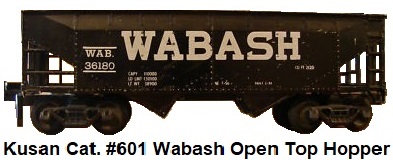
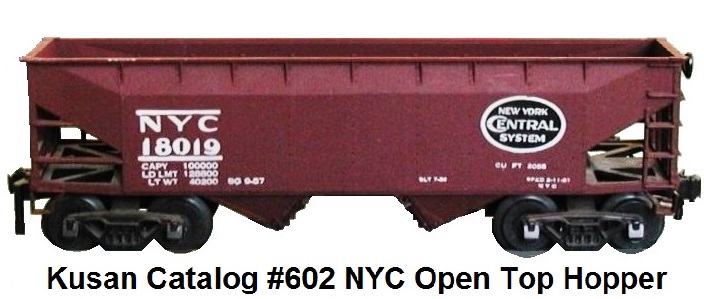
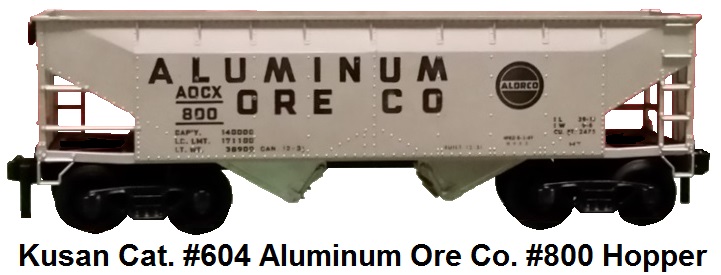
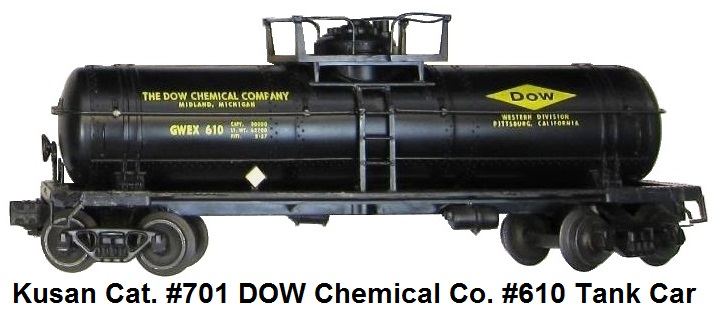
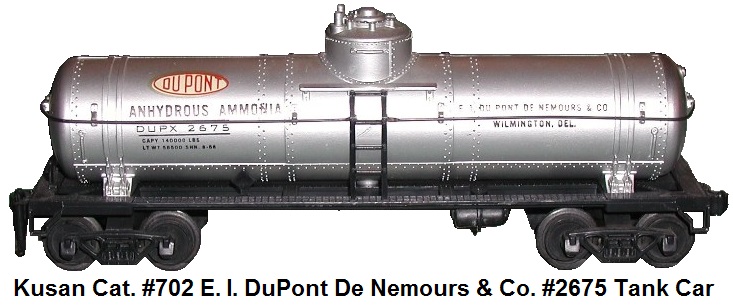
Kusan K-Series Tank Cars
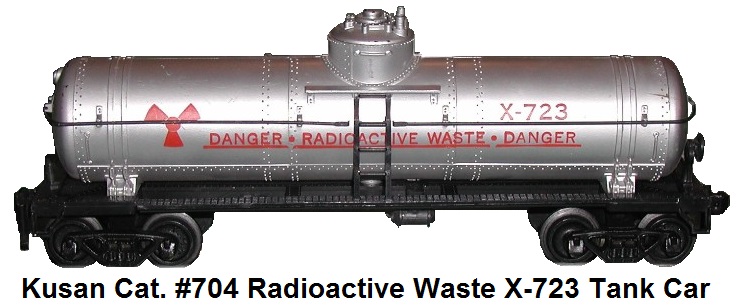
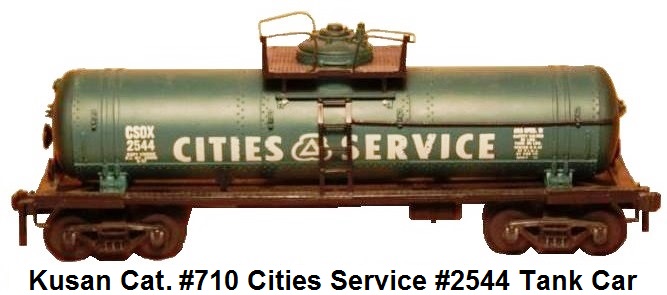
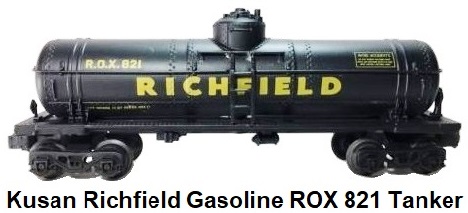
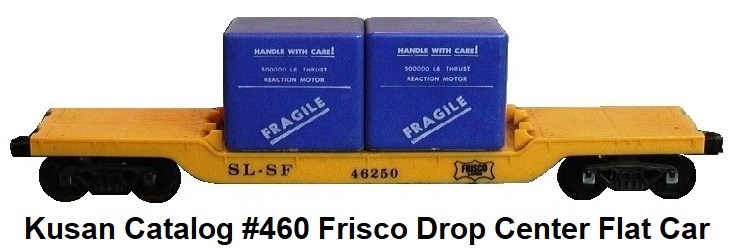
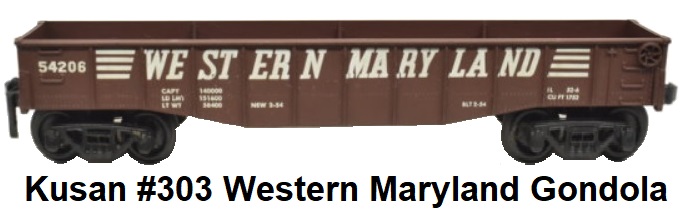
Kusan K-Series Flats and Gondolas
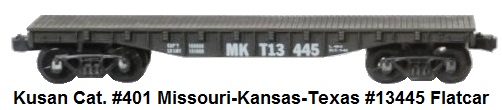
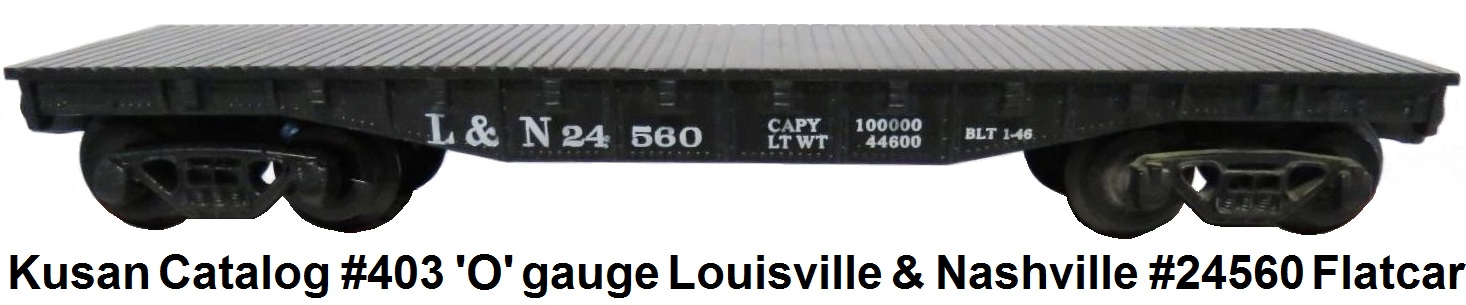
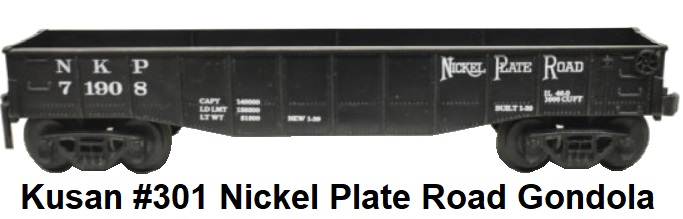
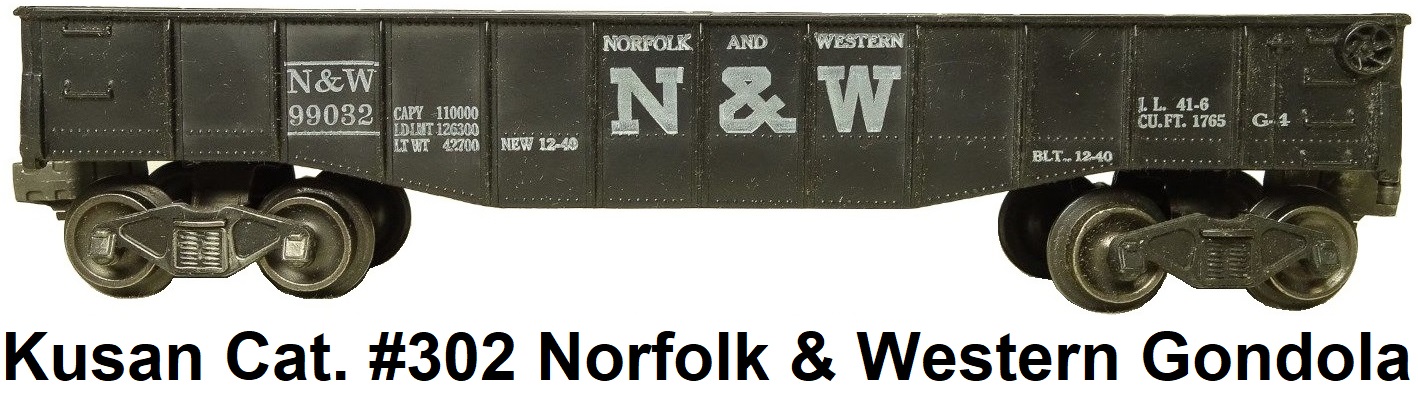
During the 1956-1958 period Kusan developed new items for the line, and added innovations. This
included a system called 'Duo-Trac' which featured a slide switch under the Diesels, passenger cars and
cabooses which allowed the equipment to be operated on either two-rail DC track, or three-rail AC track.
The Texas Special, Santa Fe and Pennsylvania F-7 A units did not come with the Duo-Trac upgrade, but
the Southern and Chicago & North Western AA units did. Other innovations and technical improvements included
a new transformer that put out an audible buzz if a short circuit occurred, and use of snap wiring developed
by the elctronics industry to eliminate the need to solder joints and wires. This snap-on wiring method had been
used widely in Kusan's other manufacturing business for appliance electrical harnesses.

Kusan also made many special-order models and sets. A few were produced by the thousands, such as the
battery operated 'Gravy Train' Dog Food set, and some were one of a kind. Among these limited run orders were three 'O' gauge
passenger sets for the B&O, and one each for the UP, and ACL Railroads. Set #KF-1015 was a promotional freight set made
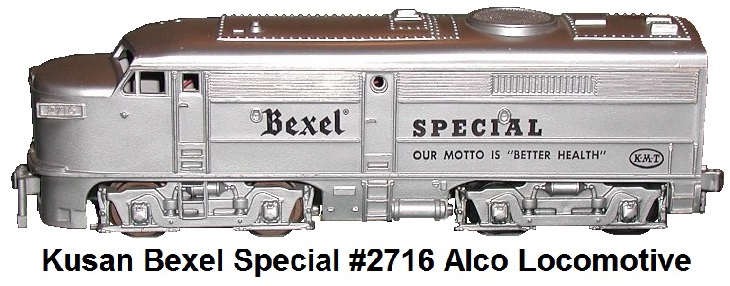
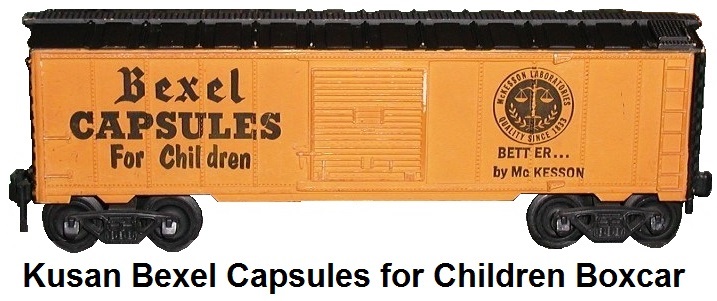
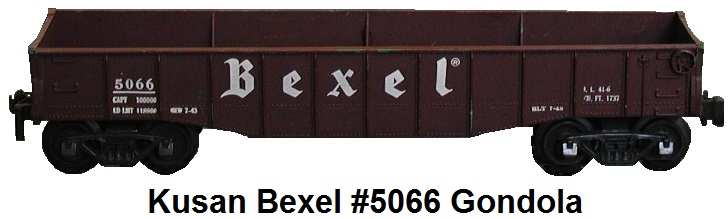
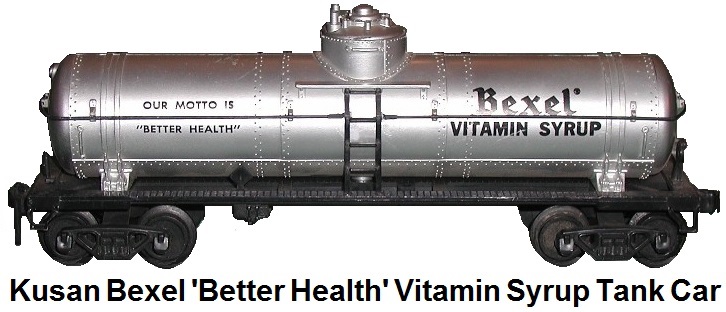
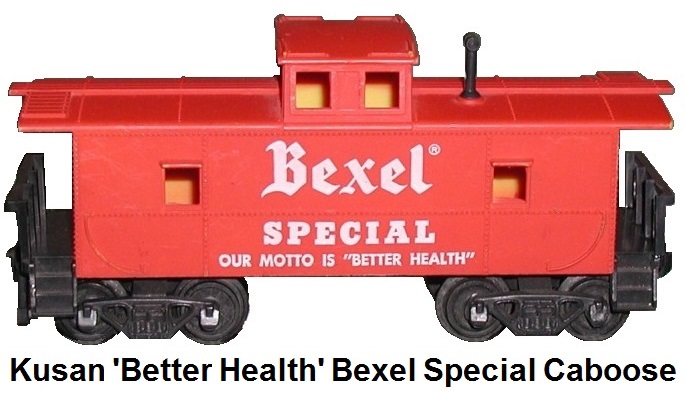
by Kusan called the Bexel Special used to promote children's vitamins made by McKesson Labs. It came with a specially logoed
#03 'Bexel Special' Alco diesel locomotive, #0201 box car, #0701 tank car, #0301 gondola, #0504 caboose, 16 pieces of curved
two-rail track and a DC power pack. Another unusual set produced by Kusan was the Kannon Ball Express which featured a
motor-less plastic shell Alco locomotive, K-series box car, flat car and caboose. It was promoted, and the box was labeled as
an 'authentic, scale model, push-train'.
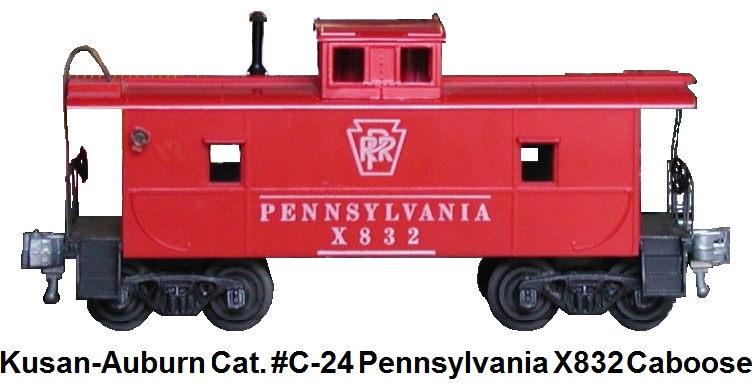
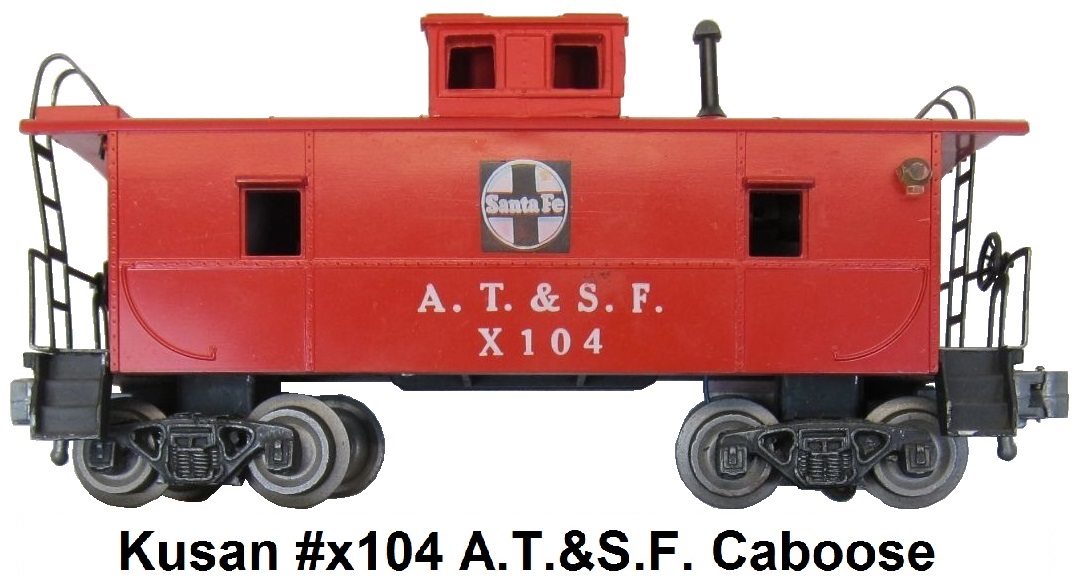
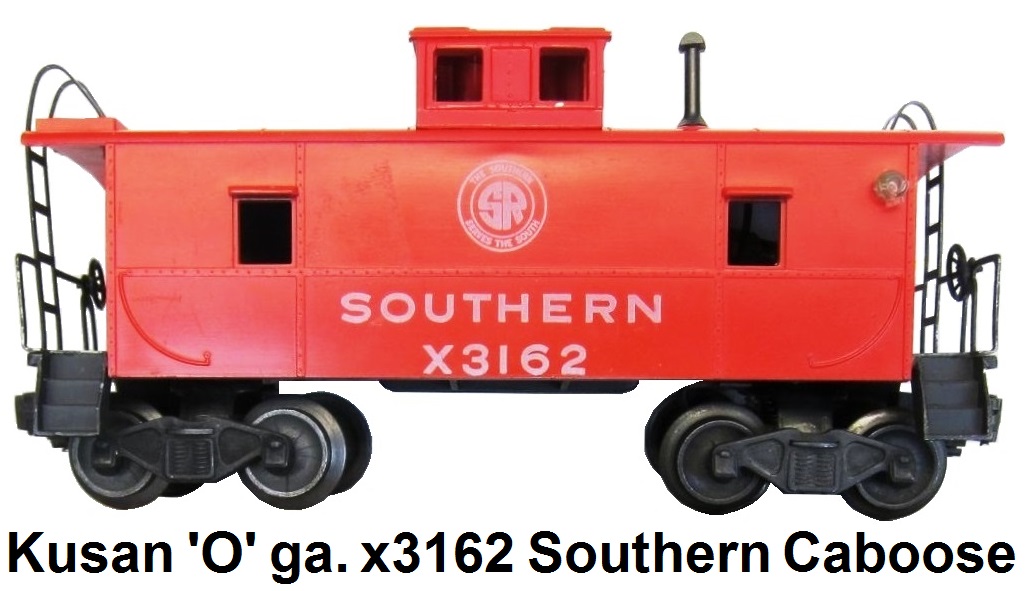
Kusan-Auburn Cabooses
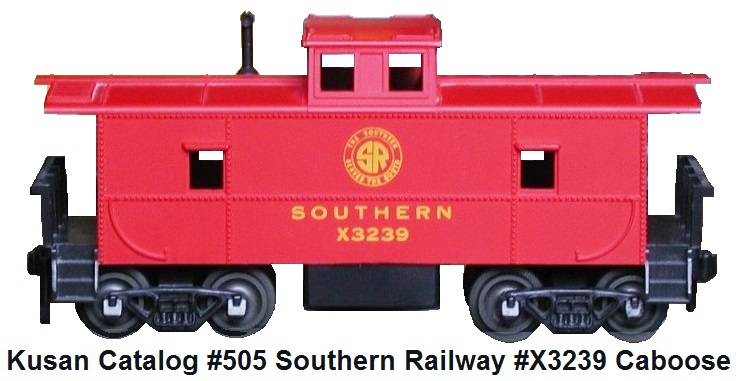
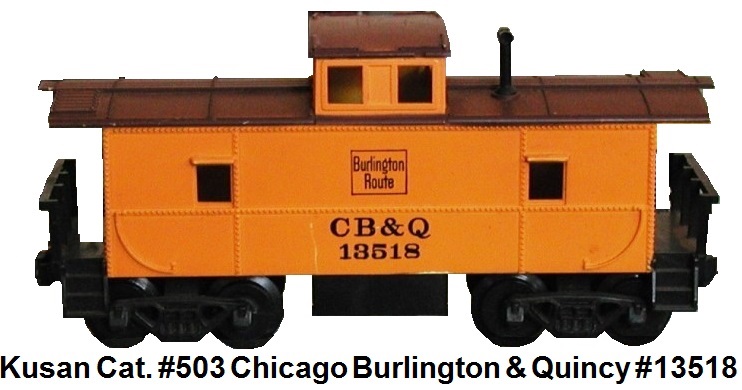
It was not easy for Kusan to crack the market. In the year ended Nov. 30. 1956,
Kusan reported total sales of all products just
over $2.6-million, about two-thirds of which came from plastic toys. The rest came from sales of
plastic molded and electrical components for the appliance, automotive, and other industries,
and such miscellaneous plastic items as football helmets. Kusan was a little business in what was at this time
a tightly held market. Estimates of the total train market, both toy and hobby, ran anywhere
from $70-million to $1OO-million at retail, with the toy end accounting for by far the biggest segment.
Kusan's most formidable competitor was Lionel Corp., with reported sales that year of $23-million. Next
was A.C. Gilbert Co., makers of American Flyer Trains with sales of $15-million.
Due to the increased competition from Lionel, and the general decline in the train market overall, Kusan was
financially forced to start phasing out the line of trains beginning in 1958. By 1961 the line ended production
completely in the United States.
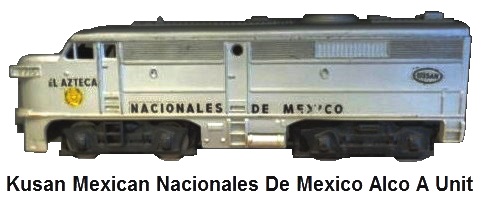
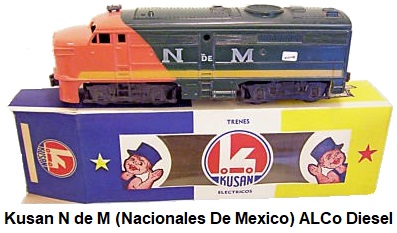 For a 4 year period in the 1960's the trains were made in Monterey, Mexico by Plasticos Leon S.A. Unique
Mexican produced products were created from the lower cost plastic trains and sets that used the Kusan developed K-molds.
The new line-up consisted of Alco diesel locomotives including the #2716 Nacionales De Mexico that came painted in silver with
black lettering 'El Azteca' or yellow and gray paint with red lettering 'El Internacional', a N de M (Nacionales De
Mexico) red and black painted version with white lettering and a gold stripe, a blue, white and yellow painted #2716
Chihuahua al Pacifico and a red Alco lettered 'El Yaqui'.
There were also a few general purpose type 4-wheeled diesel switchers, including the #3206 Nacionales De Mexico switcher
in silver paint and black lettering with hand rails, a Fundidora switcher in green paint and the unmarked and unnumbered
version in green molded plastic with no hand rails. These locos were made using the mold that eventually became known as
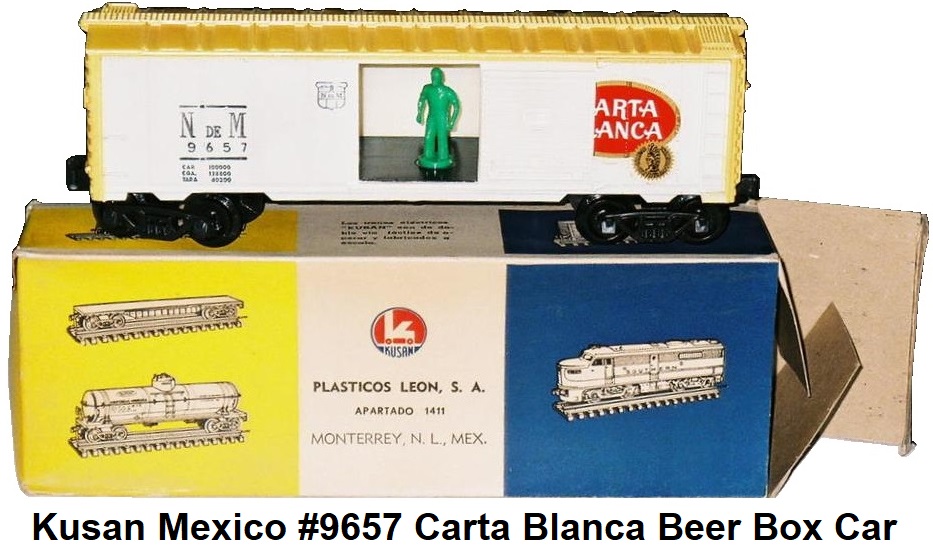
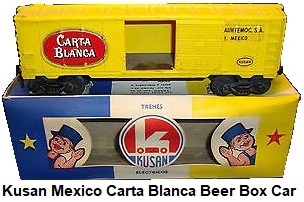
the Beep. Box cars included the #9657 N de M Carta Blanca beer car in either
yellow paint with black lettering 'Cerveceria Cuauhtemoc, S.A.', a white plastic with yellow paint and black lettering
version, or a yellow paint version without a number but with the words 'Cerveceria Honora Mexico'. There was a red painted
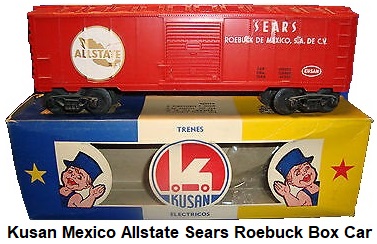
Sears Roebuck de Mexico, S.A. DE C.V. box car that featured hand-applied white decals with 'Allstate'. A #21137 Del Fuerte
Chihuahua Pacifico (CH.P) box car with a Garci Crespo product decal that came in either silver paint with black and red
lettering 'Garci-Crespo' 'Agua Mineral Que Nace No Se Hace' or in gold paint, black top, black lettering 'Fuerte Agua Mineral
Que Nace No Se Hace'. Other box cars were a #37211 CH.P in blue and white paint with black and white lettering, and a #87153
Ejercito Mexicano in olive drab paint with white and red lettering 'Explosives - Peligro'.
For a 4 year period in the 1960's the trains were made in Monterey, Mexico by Plasticos Leon S.A. Unique
Mexican produced products were created from the lower cost plastic trains and sets that used the Kusan developed K-molds.
The new line-up consisted of Alco diesel locomotives including the #2716 Nacionales De Mexico that came painted in silver with
black lettering 'El Azteca' or yellow and gray paint with red lettering 'El Internacional', a N de M (Nacionales De
Mexico) red and black painted version with white lettering and a gold stripe, a blue, white and yellow painted #2716
Chihuahua al Pacifico and a red Alco lettered 'El Yaqui'.
There were also a few general purpose type 4-wheeled diesel switchers, including the #3206 Nacionales De Mexico switcher
in silver paint and black lettering with hand rails, a Fundidora switcher in green paint and the unmarked and unnumbered
version in green molded plastic with no hand rails. These locos were made using the mold that eventually became known as
the Beep. Box cars included the #9657 N de M Carta Blanca beer car in either
yellow paint with black lettering 'Cerveceria Cuauhtemoc, S.A.', a white plastic with yellow paint and black lettering
version, or a yellow paint version without a number but with the words 'Cerveceria Honora Mexico'. There was a red painted
Sears Roebuck de Mexico, S.A. DE C.V. box car that featured hand-applied white decals with 'Allstate'. A #21137 Del Fuerte
Chihuahua Pacifico (CH.P) box car with a Garci Crespo product decal that came in either silver paint with black and red
lettering 'Garci-Crespo' 'Agua Mineral Que Nace No Se Hace' or in gold paint, black top, black lettering 'Fuerte Agua Mineral
Que Nace No Se Hace'. Other box cars were a #37211 CH.P in blue and white paint with black and white lettering, and a #87153
Ejercito Mexicano in olive drab paint with white and red lettering 'Explosives - Peligro'.
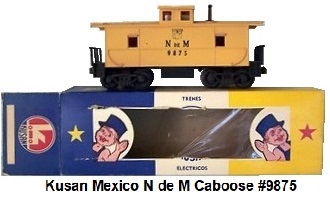
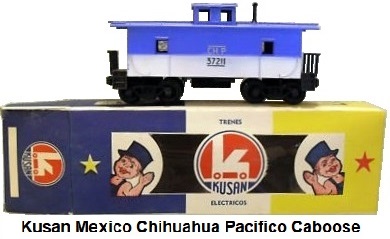
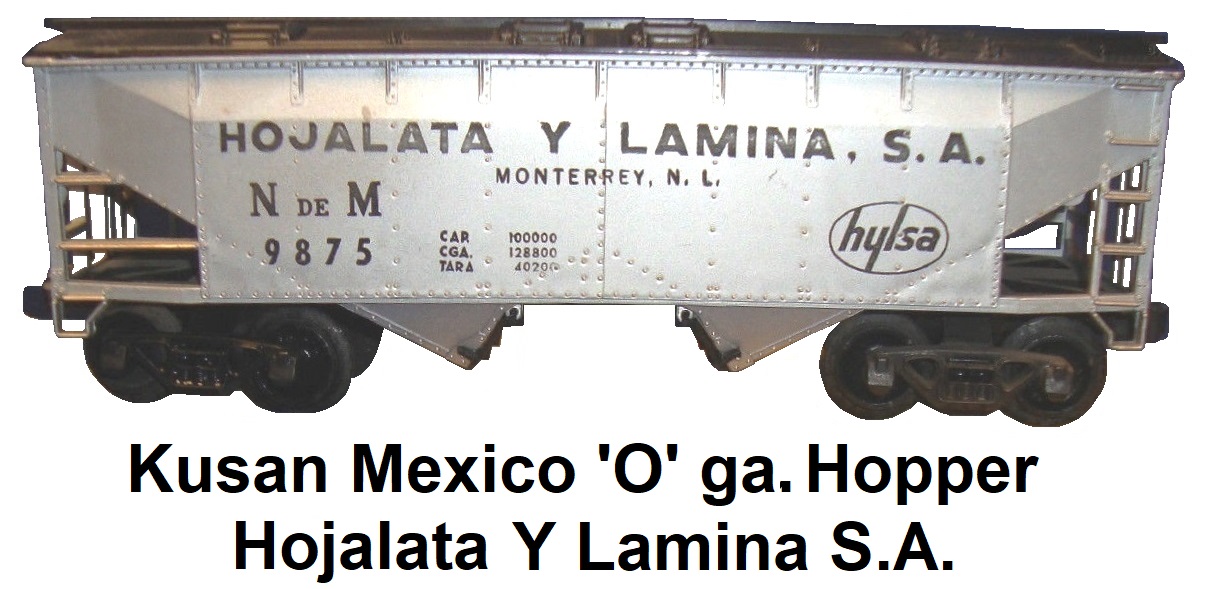 Other Mexican produced freight cars included a DuPont Tank Car in yellow paint with the word 'chemicals',
a Nacionales De Mexico Tank Car in black paint, a PEMEX gasolina Tank Car in silver paint, a Hylsa gondola in red paint with
the word 'steel', a Tubacero gondola in tuscan bearing a logo with a bird head and the words 'Hecho en Mexico' printed
inside an oval on the car side, a U.S. Space Research #4190 plastic gondola painted gray with lettering applied using decals,
a #9875 N de M Hopper in silver and black paint with black lettering 'Hojalata & Lamina S.A.' and 'Hylsa' in an oval, a
#9875 N de M Caboose in gold paint with black lettering and a CH.P #37211 (Chihuahua Pacifico) Caboose in blue and white. The
most unusual item produced was a black plastic molded flat car with a metal orange painted crane that could be swivelled 360
degrees, and featured a black metal hook that could be raised or lowered via a hand crank. The flat car also featured a
figure of a man in white glued to the deck. Another unique item was a double deck auto loader similar to the Lionel
post-war era Evans auto loader. Because of the Mexican specific markings it would seem that these trains were
produced primarily for that market, but many did become available in America, as evidenced by several turing up with
'Mexico' import stickers. The line did include a few American production carryover products such as the military themed
US Air Force #938 V-9 Rocket on flat car and the G-E Lamps ILDX #316 black molded 2-bay hopper.
Other Mexican produced freight cars included a DuPont Tank Car in yellow paint with the word 'chemicals',
a Nacionales De Mexico Tank Car in black paint, a PEMEX gasolina Tank Car in silver paint, a Hylsa gondola in red paint with
the word 'steel', a Tubacero gondola in tuscan bearing a logo with a bird head and the words 'Hecho en Mexico' printed
inside an oval on the car side, a U.S. Space Research #4190 plastic gondola painted gray with lettering applied using decals,
a #9875 N de M Hopper in silver and black paint with black lettering 'Hojalata & Lamina S.A.' and 'Hylsa' in an oval, a
#9875 N de M Caboose in gold paint with black lettering and a CH.P #37211 (Chihuahua Pacifico) Caboose in blue and white. The
most unusual item produced was a black plastic molded flat car with a metal orange painted crane that could be swivelled 360
degrees, and featured a black metal hook that could be raised or lowered via a hand crank. The flat car also featured a
figure of a man in white glued to the deck. Another unique item was a double deck auto loader similar to the Lionel
post-war era Evans auto loader. Because of the Mexican specific markings it would seem that these trains were
produced primarily for that market, but many did become available in America, as evidenced by several turing up with
'Mexico' import stickers. The line did include a few American production carryover products such as the military themed
US Air Force #938 V-9 Rocket on flat car and the G-E Lamps ILDX #316 black molded 2-bay hopper.
 In 1967, Andy Kriswalus purchased much of the tooling and shortly thereafter began producing
a line of rolling stock under the Kris Model Trains name. Kris Model Trains,
also called KMT, only produced the box, stock, gondolas and refrigerator cars from the Kusan dies, in a very wide
assortment of road names and liveries, and on many of these cars they mounted die-cast trucks made from the
Kusan tooling. In 1990, after Kriswalus' death, the original tooling was sold to K-Line and
Williams Electric Trains, who continued to use it to produce parts of
their budget lines. K-Line acquired the 'K' series box car dies and made many improvements, adding movable doors,
sheet metal frames, die-cast trucks and much better paint. K-line also acquired the Alco tooling and utilized it to
produce their FA Alco diesels.
In 1967, Andy Kriswalus purchased much of the tooling and shortly thereafter began producing
a line of rolling stock under the Kris Model Trains name. Kris Model Trains,
also called KMT, only produced the box, stock, gondolas and refrigerator cars from the Kusan dies, in a very wide
assortment of road names and liveries, and on many of these cars they mounted die-cast trucks made from the
Kusan tooling. In 1990, after Kriswalus' death, the original tooling was sold to K-Line and
Williams Electric Trains, who continued to use it to produce parts of
their budget lines. K-Line acquired the 'K' series box car dies and made many improvements, adding movable doors,
sheet metal frames, die-cast trucks and much better paint. K-line also acquired the Alco tooling and utilized it to
produce their FA Alco diesels.
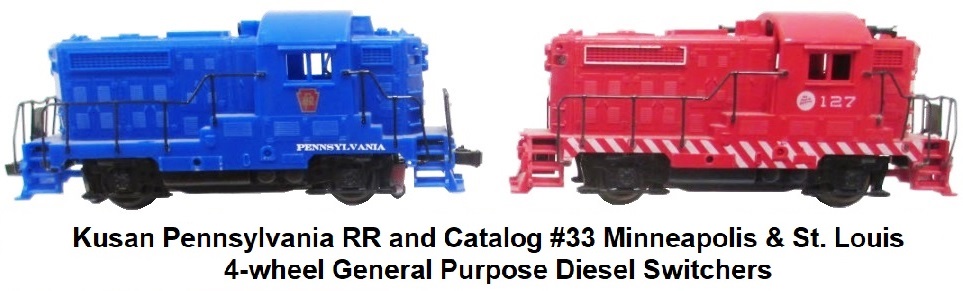
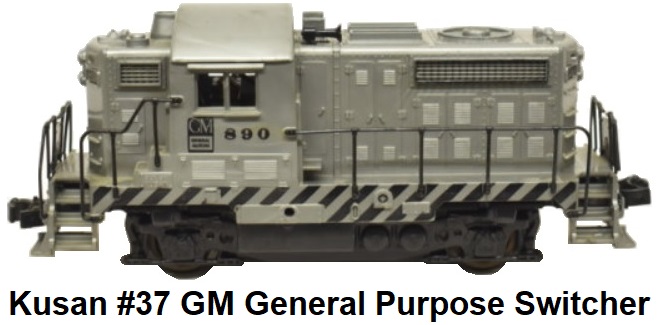
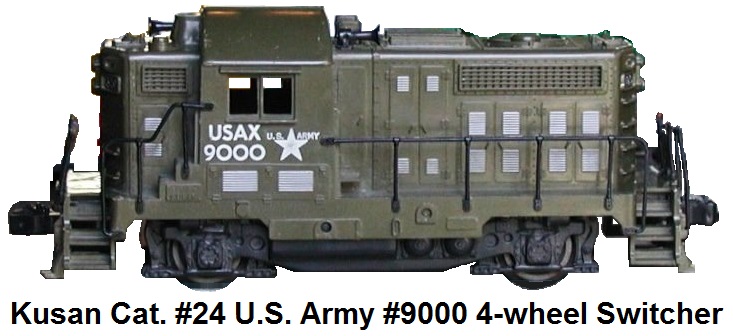 A relic of the Kusan era that wound up causing some controversy later on, was a small,
non-prototypical (but realistic-looking enough to be convincing)
general purpose (GP) type switcher. Kusan had made a version that ran from track power, and
a version that used two C-cell batteries. Williams manufactured it briefly, calling their version of
the small diesel the 'Mighty-Mite'. K-Line later purchased this original Kusan tooling from
A relic of the Kusan era that wound up causing some controversy later on, was a small,
non-prototypical (but realistic-looking enough to be convincing)
general purpose (GP) type switcher. Kusan had made a version that ran from track power, and
a version that used two C-cell batteries. Williams manufactured it briefly, calling their version of
the small diesel the 'Mighty-Mite'. K-Line later purchased this original Kusan tooling from
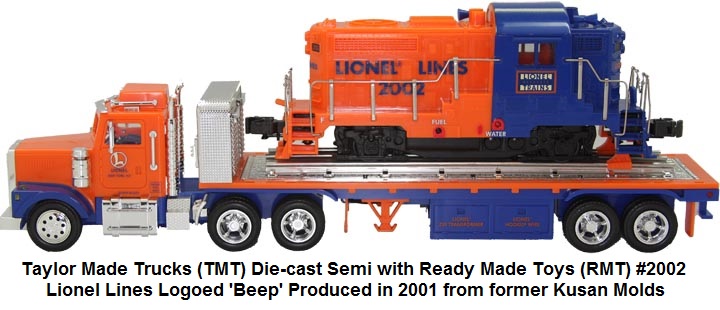 Jerry Williams, but K-Line never actually used it. They later had an agreement
to mold the body cab for Ready Made Toys (RMT). RMT called this item the "Beep"
(for Baby Geep). RMT, a company that subcontracted for Taylor Made
Trucks (TMT), had gained a license to put the Lionel logo on die-cast vehicles. In 2001, RMT used
the Beep tooling to produce a Lionel-logoed mini-locomotive, which TMT placed on a freight truck.
But when collectors realized the body could be removed from the semi-permanently attached chassis
on the truck bed and placed on a powered Beep chassis, making a powered non-Lionel Lionel locomotive,
Lionel revoked TMT's license. This RMT/TMT Beep remains the only Lionel-logoed locomotive ever
produced by and marketed by someone other than Lionel.
Jerry Williams, but K-Line never actually used it. They later had an agreement
to mold the body cab for Ready Made Toys (RMT). RMT called this item the "Beep"
(for Baby Geep). RMT, a company that subcontracted for Taylor Made
Trucks (TMT), had gained a license to put the Lionel logo on die-cast vehicles. In 2001, RMT used
the Beep tooling to produce a Lionel-logoed mini-locomotive, which TMT placed on a freight truck.
But when collectors realized the body could be removed from the semi-permanently attached chassis
on the truck bed and placed on a powered Beep chassis, making a powered non-Lionel Lionel locomotive,
Lionel revoked TMT's license. This RMT/TMT Beep remains the only Lionel-logoed locomotive ever
produced by and marketed by someone other than Lionel.
Ready Made Toys released the Beep in a powered version, priced at $49.95
and lettered for numerous railroads, in late 2003. This product was released at a time when
few brand-new locomotives retailed for less than $400
and fewer still for under $200. The Beep became very popular this time around.
If you ask a train enthusiast if they can recall anything about Kusan, they typically
mention the military and space themed 'O' gauge sets. What folks seem to remember more than the colorful scale
box cars and the highly detailed aluminum passenger car sets are the sets that came with artillery pieces, satellites, and
flashing red lights. Kusan/KMT trains are somewhat collectible, as the military and space era train sets sell for
as much as $200 to $400 when found in excellent to like new condition with original packaging and all components.
The KMT/Kusan Tennessee scale 40' box cars produced in Rutland, Boston & Maine, red M&StL, UP, WP, Pennsylvania 'Don't
Stand Me Still', brown NYC, SOO Line, C&EI and B&O can be acquired anywhere from $15 to $50 depending on road name.
While these trains are not as desirable as Lionel trains from the same era, they were made in far less quantities and
are scarcer/harder to locate, especially in excellent or better condition. The scale like design and quality, and the
ability to run them on either 2 or 3 rail track systems, makes these trains popular with 'O' scale hobbyists and operators.
There was a small production run of Kusan New Haven black and orange checkerboard painted 40' box cars that are considered the
hardest to find. The Mexican produced Kusan trains are also extremely rare and highly sought after by collectors.